Jinhua Ham and Dongyang
Jinhua ham is cured from the hind legs of the two-ends-black pig, salted between Lidong and Lichun and ripe by high summer; the craft has been national intangible heritage since 2008. Dongyang is one of its main producers, and its village of Shangjiang gave the trade the well-known Xuefang Jiang ham.
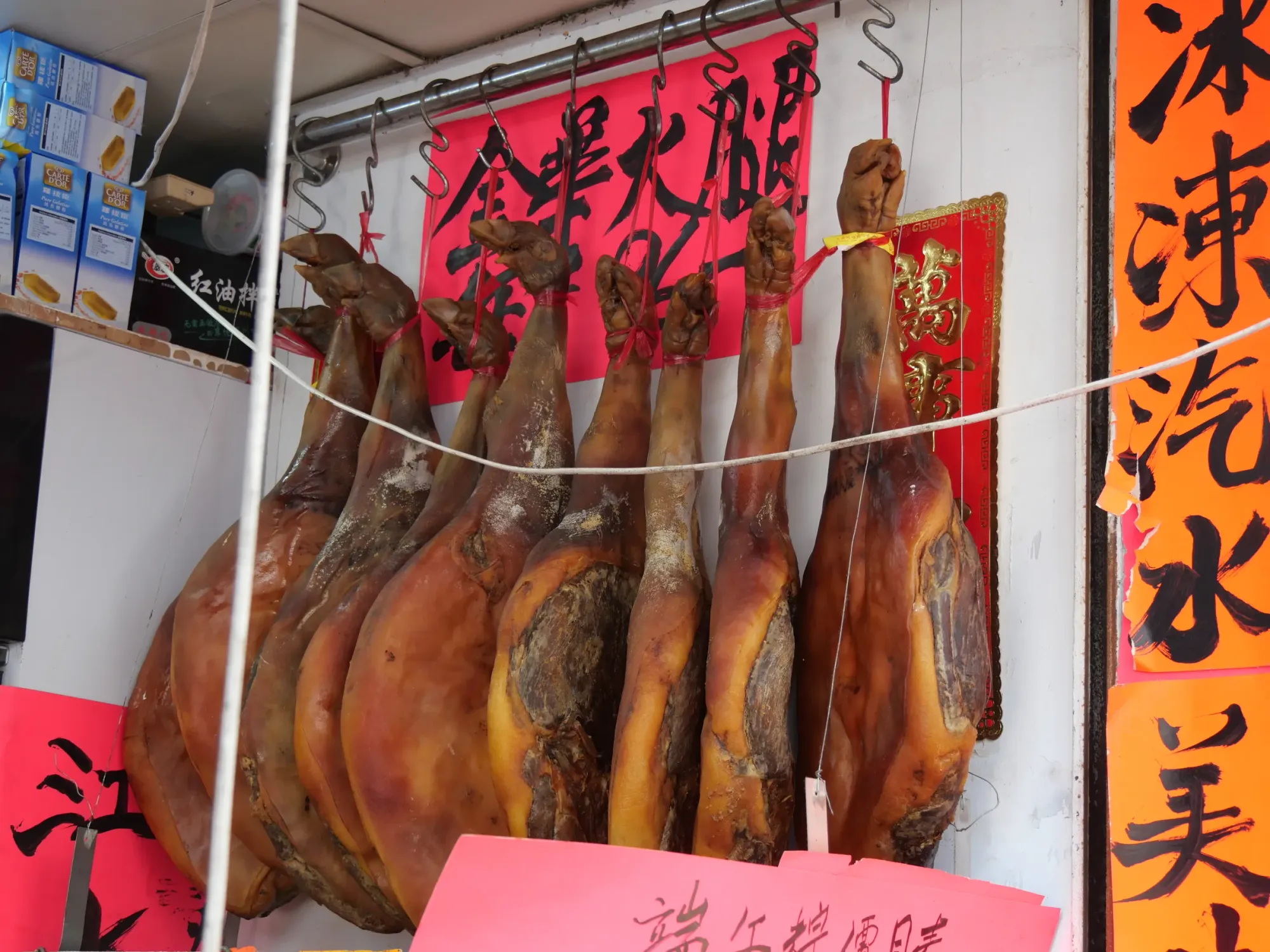
Jinhua ham is the dry-cured ham of the Jinhua area in central Zhejiang: the hind leg of the local “two-ends-black” pig, salted in winter and hung until the next summer, a craft on China’s national list of intangible cultural heritage since 2008. Dongyang is one of its main producers. “Jinhua ham comes from Dongyang, and Dongyang ham comes from Shangjiang,” people there have long said — Shangjiang being the Dongyang village that gave the trade a famous name, Xuefang Jiang ham.
What Jinhua ham is
Only the hind leg is used. China’s intangible heritage website describes the pig as Jinhua’s own “two-ends-black” breed, black at the head, neck and rump and white in between, nicknamed the “Chinese panda pig”; each leg weighs 6 to 7.5 kilograms and is trimmed to the shape of a bamboo leaf or a pipa lute, its lean rose-red and its fat translucent. Ham was cured in Jinhua by the Tang dynasty, the website says, and under the Ming it went to court as tribute and was made in Dongyang, Yongkang and elsewhere.
It is a national geographical indication with its own national standard since 2003, now GB/T 19088-2024. In 2025, China News Service reported, Jinhua as a whole, Dongyang included, produced 4.65 million hams, and in 2026 it had 78 ham makers.
Two awards are usually claimed for it. The heritage website names a gold medal at an exhibition in Leipzig, Germany, in 1905; a 2003 article in the journal Meat Research and English Wikipedia, a first prize at the 1915 Panama exposition, held in San Francisco; and the chairman of Jinzi Ham, a Jinhua maker, claimed both in 2009, China News Service reported. A Zhejiang Daily commentary in 2010 noted that in the reform years “the 1915 Panama exposition” was a stock line in advertising for nearly every famous Chinese brand, Jinhua ham included; we found no award list that confirms either.
Why it is called Jinhua ham
Dongyang’s ham is Jinhua ham because Dongyang belongs to Jinhua. Under the Ming and Qing it was a county of Jinhua Prefecture, with Yiwu, Pujiang, Yongkang and others, Wikipedia says — a prefecture set up in 1360 and abolished after the 1911 revolution — and today it is a county-level city under Jinhua. In the old trade, China News Service explained in 2024, ham from Zhejiang was all called “southern ham,” or Jinhua ham.
How Jinhua ham began, nobody can say. The trade has two main accounts, the Qianjiang Evening News reported in 2015, and one is a folk legend: the Song general Zong Ze, visiting his home in Yiwu, was given pig legs for his soldiers in Kaifeng and salted them for the road; they turned as red as fire, hence huotui, “fire leg,” the Chinese word for ham. In the 1930s and 1940s, Jinhua men with ham shops in Hangzhou hung his portrait as their patron. But Ma Xiaozhong, a Dongyang man long in the trade and then deputy general manager of Jinzi Ham, found no ham in Zong Ze’s biography in the History of Song.
Another account rests on a line from the Tang medical writer Chen Cangqi — “of hams, those from Jinhua are best” — but his book is lost, and Ma found the line only in a later one. Pujiang has its bamboo-leaf smoked ham, and a CCTV food program, as China News Service reported in 2026, called bamboo-leaf ham older than Jinhua ham itself. We found no record that settles which came first.
Dongyang and Shangjiang village
In 2015 Ma Xiaozhong, later president of the Jinhua Ham Industry Association, said Dongyang and Yiwu were still the main ham-producing areas. According to the Meat Research article, “Jiang ham” was first made in the Dongyang village of Shangjiang and was said to sell well in Hangzhou, Shaoxing and beyond the province by the Jiaqing reign of the Qing (1796–1820); the article quotes the saying. Legend has it that a hundred-odd households there cured hams, and that butchers in Shanghai, Hangzhou, Nanjing and Hong Kong hung out “Jiang ham” signs.
Xuefang Jiang ham
The finest Jiang ham, by the article’s account, was Jiang Mengchang’s; China News Service gives Xuefang as his courtesy name, and the article as his sobriquet. To set his hams apart he marked them “Xuefang,” and so they became Xuefang Jiang ham. He took only two-ends-black hind legs of 4.75 to 5.5 kilograms, paying leg dealers two or three silver dollars more than others did; he salted only between the winter solstice and Lichun, finished each day’s legs that day, and on winter nights rapped a knife on the chopping block to keep his workers awake.
When he founded the brand is told differently: the article sets Shangjiang’s ham story in the Jiaqing reign, China News Service in 2025 in the Xianfeng reign (1851–1861). His descendants, the article says, changed the mark to “Shangjiang Xuefang Yuanji” in December 1921 and fought look-alike names in court for years, and won. In the early Republic, China News Service reported in 2024, the Sincere Company on Shanghai’s Nanjing Road sold Jiang ham in quantity and advertised Xuefang Jiang ham in its windows all year round.
After 1949, the article says, Dongyang County gathered the scattered workshops into a state-run ham factory and invited the Jiang descendants to teach the craft; by 2003 Shangjiang had a Jiang family ham factory. In the 1990s, China News Service reported in 2025, the craft passed to Wu Rongren, whom it calls the sixth-generation head, and in 2006 Xuefang Jiang became a China Time-honored Brand. The report’s version of the saying ends “and Dongyang ham is Xuefang Jiang,” once the slogan of the company behind the brand, Zhejiang Xuefang Industry and Trade.
A ham’s year
Ham is winter work. According to the heritage website, the pigs are slaughtered and the legs salted in the cold between Lidong, the start of winter, and Lichun, the start of spring; drying at moderate temperatures and fermenting in the warmth follow, and only after the dog days of summer begin is the ham fragrant and ripe. Lidong falls around November 7, Lichun around February 4, and the dog days usually begin in mid-July.
That calendar is now law. Jinhua’s regulation on promoting the ham industry, approved in September 2026 by the standing committee of Zhejiang’s provincial legislature and in force from Lidong, November 7, is China’s first local law on a ham industry, China News Service reported: traditional hams should be salted between Lidong and Lichun, and out-of-season hams need temperature and humidity control.
The table follows the heritage website and the Meat Research article; makers differ in the details.
By Wikipedia’s count the traditional process takes eight to ten months, and 100 jin of fresh legs yield at most 55 jin of ham, Dushi Kuaibao reported in 2018. A 2007 study in Meat Science found that the finished ham holds 14 to 16 times the free amino acids of the fresh leg. Dongyang wine is brewed in winter too; see Dongyang Wine.
How it is eaten
Traditional Jinhua ham is rarely eaten raw. Ye Liyang, a nutrition expert at Zhejiang University, said in 2009, China News Service reported, that it is salty and hard, mostly a supporting ingredient in cooking, and a Hangzhou ham dealer told Dushi Kuaibao in 2018 that, saltier and drier than Spanish or Italian ham, it is best steamed or stewed.
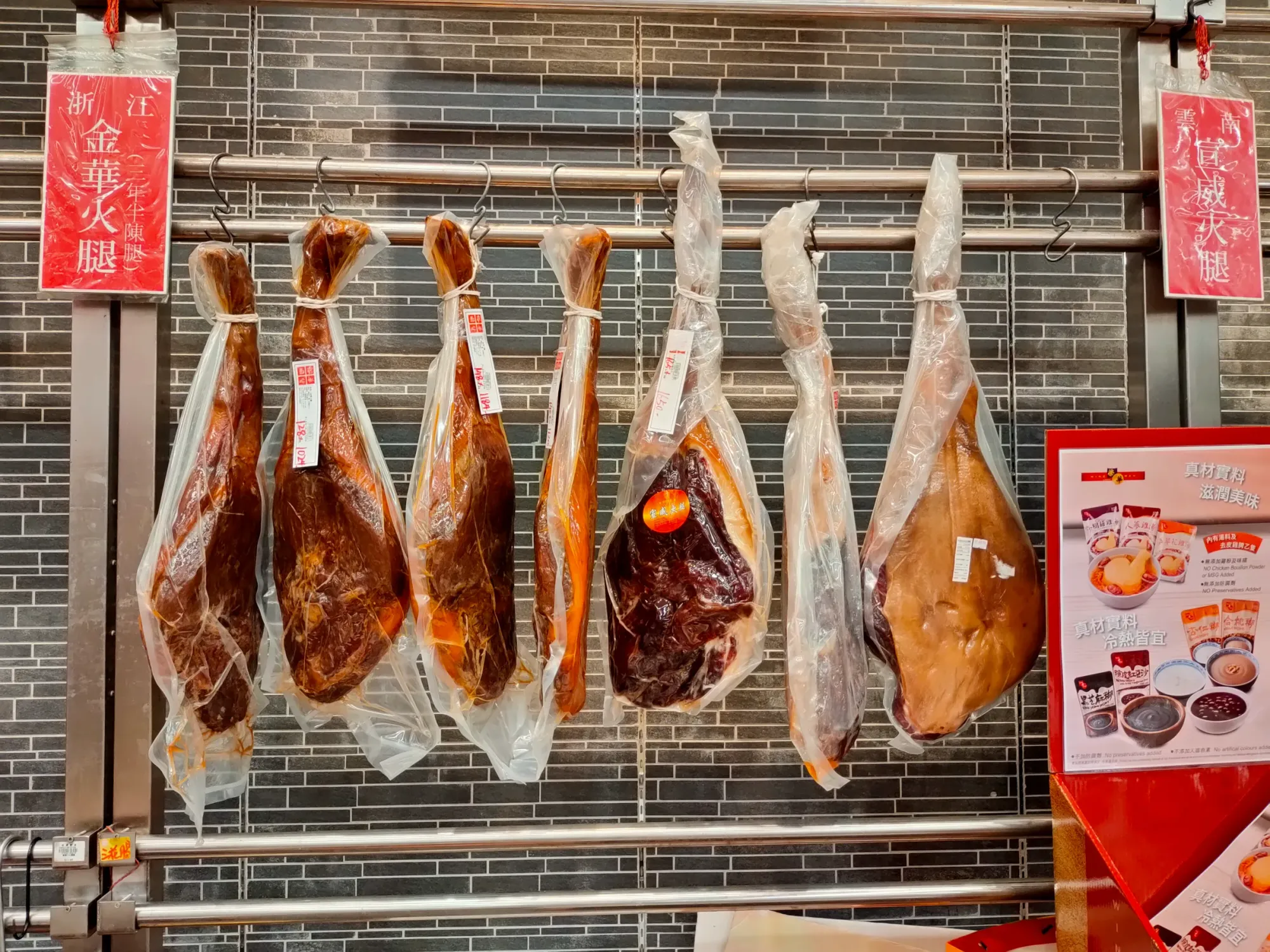
In Hangzhou a ham is used cut by cut, Dushi Kuaibao explained: the best and dearest cut sliced over fish for steaming; the sinewy hock in soup with an old duck and dried bamboo shoots, or stewed with a fresh trotter as “gold and silver trotters.” The only Hangzhou dish its reporter knew with ham as the star was honey-glazed ham. Ham is a summer food there too: “ham in the first dog days, chicken in the second, gold and silver trotters in the third.”
There are now hams made to be eaten raw: in 2009 Jinzi Ham of Jinhua launched a low-salt fermented ham that China News Service called China’s first ham that can be eaten raw, and in 2021, the Zhejiang government’s English website reported in 2025, a Pujiang company brought out an uncooked bamboo-leaf smoked ham aged three years or more.
Finding it in Dongyang
We found no ham workshop, exhibition or shop in Dongyang that welcomes visitors and publishes opening hours, and no report of Shangjiang village receiving visitors. If you want to buy a ham or watch hams being salted, ask locally before you go; the salting season runs from Lidong to the following Lichun. For what else to see in Dongyang, see Places to Visit; for what else to eat, see Virgin Boy Eggs and Dongyang Aomian.
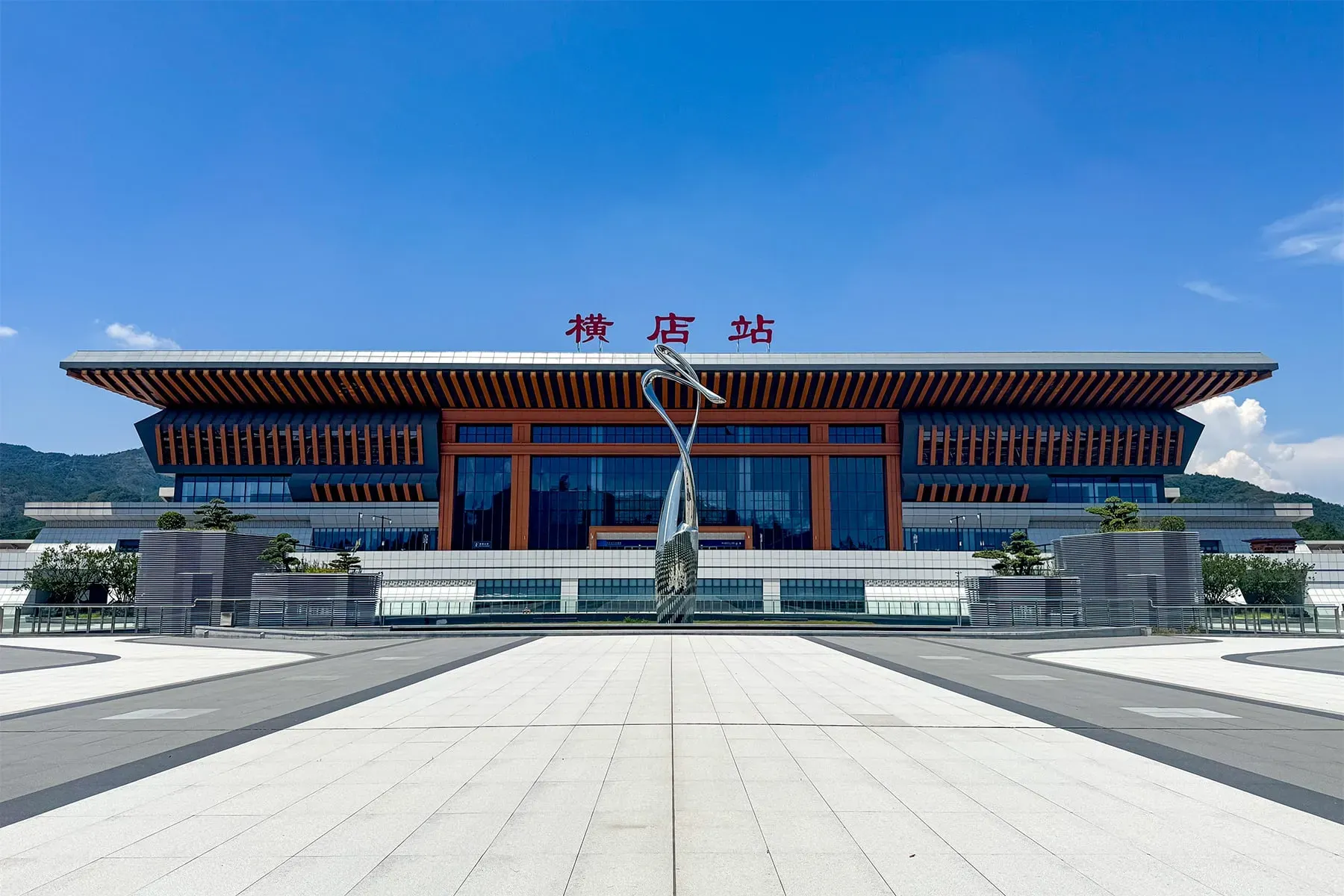
The ham museums we found are in Jinhua, at the Jinzi Ham company on Jinfan Street: a China Ham Exhibition Hall and, next door, a World Ham Exhibition Hall of about 1,400 square meters, opened in June 2013 and free at the time (Qianjiang Evening News); in July 2026, China News Service reported, a delegation of overseas Chinese-language media toured both on an organized visit. We found no current opening hours, so check before you go. Dongyang North has trains to Jinhua on the Ningbo–Jinhua railway; see Getting to Dongyang and Hengdian.
Questions & answers
What is Jinhua ham?
A traditional dry-cured ham from the Jinhua area of Zhejiang, made from the hind legs of the local two-ends-black pig. It is salted between Lidong, in early November, and Lichun, in early February, then washed, sun-dried and hung until the dog days of summer, when it is ripe. Its curing craft has been national intangible heritage since 2008, and Jinhua ham is a national geographical indication; Dongyang is one of its main producers.
Why is it called Jinhua ham if it comes from Dongyang?
Because Dongyang is part of Jinhua. Under the Ming and Qing it was one of the counties of Jinhua Prefecture, with Yiwu, Yongkang, Pujiang and others, and today it is a county-level city administered by Jinhua. In the old trade, ham from Zhejiang was called “southern ham,” or simply Jinhua ham. Dongyang has its own way of putting it: “Jinhua ham comes from Dongyang, and Dongyang ham comes from Shangjiang.”
When is Jinhua ham made?
In winter. Traditional Jinhua ham is salted between Lidong (around November 7) and the following Lichun (around February 4), a window that Jinhua’s ham-industry regulation, in force from November 7, 2026, writes into law. After salting come washing, sun-drying and months of hanging; the hams are ripe after the dog days of summer begin, eight to ten months in all.
Is Jinhua ham like prosciutto? Can you eat it raw?
Both are dry-cured hams, but they are eaten differently. Traditional Jinhua ham is saltier, drier and harder than Italian or Spanish ham, so it is steamed, stewed or cooked in soups rather than sliced and eaten raw. Since 2009, some Jinhua makers have also produced low-salt hams meant to be eaten raw.
What is Xuefang Jiang ham?
An old brand of ham from Shangjiang village in Dongyang. According to China News Service, Jiang Mengchang of Shangjiang, whose courtesy name was Xuefang, founded the Xuefang Jiang brand in the Qing dynasty, and in the early Republic the Sincere Company on Shanghai’s Nanjing Road advertised Xuefang Jiang ham in its windows all year round. The brand was named a China Time-honored Brand in 2006.
Sources
- 英文为本站翻译。节气的日期据维基百科“Solar term”和“三伏”条。
- 火腿制作技艺(金华火腿腌制技艺)· 中国非物质文化遗产网(国家级非物质文化遗产代表性项目名录,项目编号 Ⅷ-166)
- 杨合超:中国传统名优肉制品——雪舫蒋腿 ·《肉类研究》2003 年第 2 期,第 25—26、13 页
- 中国首部火腿产业地方性法规在浙“亮相” · 中国新闻网,2026 年 11 月 4 日
- “中华老字号”重生记:破产保护助企“再出发” · 中国新闻网,2025 年 3 月 11 日
- 《繁花》热播牵出浙江金华火腿“沪上礼事” · 中国新闻网,2024 年 1 月 16 日
- 金华火腿历史至少可前推150年 有1420多年历史 · 中国新闻网(钱江晚报),2015 年 4 月 10 日
- 美食文旅节目《寻味山海》走进浙江金华赴一场火腿的风味之约 · 中国新闻网,2026 年 10 月 11 日
- 中国第一条可以生吃的火腿今天面世 · 中国新闻网,2009 年 11 月 26 日
- 上海世博会,呈现一个怎样的“中国梦” · 中国新闻网(浙江日报),2010 年 3 月 30 日
- 世界火腿博览馆落户金华 仿照欧洲街头餐厅装修 · 中国新闻网(钱江晚报),2013 年 6 月 20 日
- 海外华文媒体代表在浙江金华“品”文化滋味 · 中国新闻网,2026 年 7 月 21 日
- 入伏首日 杭州大伯大妈6点多就到河坊街排队抢这个 90元一斤 却像买白菜 · 杭州网(都市快报),2018 年 7 月 17 日
- 地理标志产品质量要求 金华火腿(GB/T 19088-2024)· 全国标准信息公共服务平台
- 标准检索“金华火腿”(GB 19088-2003、GB/T 19088-2008、GB/T 19088-2024)· 全国标准信息公共服务平台
- 东阳市 · 维基百科
- 金华府 · 维基百科
- 金华火腿 · 维基百科
- Jinhua ham · Wikipedia
- Solar term · Wikipedia
- 三伏 · 维基百科
- Pujiang bamboo leave-smoked ham: Traditional craft reinvented for modern palates · Zhejiang government English site (ezhejiang.gov.cn, presented by China Daily), August 25, 2025
- Zhou G. H., Zhao G. M., Biochemical changes during processing of traditional Jinhua ham · Meat Science, vol. 77, no. 1, pp. 114–120, 2007