Xianju Boneless Lanterns
Xianju’s needle-pricked boneless lanterns have no frame at all. A dozen or more paper panels, sometimes several dozen, are folded and glued together, and the patterns are chiseled and pricked through the paper so that they glow when the lantern is lit. Said to date from the Tang dynasty, the craft began in Potan and joined China’s first national list of intangible cultural heritage in 2006. Every square centimeter takes 100 to 150 pinholes; a simple lantern takes about a week, a complex one more than a hundred days.
Most lanterns hang their paper or silk on a frame of bamboo or wood. Xianju’s needle-pricked boneless lanterns have none. The whole lantern is made of paper panels, folded, fitted together and glued; the pattern is first chiseled out, then pricked through with an embroidery needle, one tiny hole at a time, so that it only shows when the lantern is lit. The craft comes from Potan, an old town about 25 km west of Xianju’s county town, and has been on China’s first national list of intangible cultural heritage since 2006.
A lantern of paper alone
On the national list, the craft is entered as “Lanterns (Xianju lanterns),” one of several local traditions listed under item Ⅶ-50 among the traditional fine arts, put forward by Xianju County and looked after by the county’s Cultural Heritage Protection Center. China’s intangible heritage website says it brings together painting, embroidery and architecture.
How does a lantern keep its shape without a frame? Inside, Wang Rulan, one of the craft’s national masters, told People’s Daily in 2026, there are only paper panels of different sizes and shapes, folded and glued together. Having no frame is also why Xianju lanterns are usually small and dainty, and why their shapes can be so varied. A single lantern is glued together from a dozen or more pricked panels, sometimes several dozen, Zhejiang Online reported in 2024.
There are single lanterns and group lanterns. In the Guangming Daily in 2023, Wang described the kinds recovered over the years: delicate single lanterns such as the lychee, longan, gemstone and vase lanterns, and grand group lanterns such as the long-banner, drum-pavilion and archway lanterns — 27 kinds in all, with 52 variants.
A hundred pinholes to the square centimeter
How many steps a lantern takes depends on who is counting: thirteen in Li Xiangman’s entry on China’s intangible heritage website and in Wang Rulan’s account to the Guangming Daily in 2023, eighteen in Beijing Review in 2024, more than twenty in Zhejiang Online the same year, and “dozens” in People’s Daily in 2026. The main stages named by Zhejiang Online and by People’s Daily in 2026 are drawing the pattern, mixing the paste, ironing the paper, chiseling and pricking, and finally standing the panels up and assembling the lantern.
The paper, China Daily reported in 2025, is pearlescent paper and colored card, chosen for its purity and the even way it lets light through. Each panel is cut to a hand-drawn design, and the stacked layers are lined up with an awl before the pattern is pierced.
Pricking takes the longest. Makers mostly use a No. 12 embroidery needle, about 0.25 mm thick, Zhejiang Online reported in 2024, and put 100 to 150 holes into every square centimeter: from more than a hundred thousand holes in one lantern to several million. The holes can be neither too dense nor too sparse, which takes patience and care. Other reports differ a little: the Guangming Daily gives the needle as under 0.3 mm, with 120 to 150 holes to the square centimeter, and Beijing Review as about 0.3 mm, with around 100; both the Qianjiang Evening News in 2019 and Beijing Review put the most holes in one lantern at over a million.
In January 2019 the Qianjiang Evening News released a video, One Minute of Heritage, showing what elderly heritage craftspeople do in a minute. Wang Rulan’s minute was 60 holes in a square centimeter of paper.
How long does one take? Often more than ten days, sometimes a month, Wang told the Guangming Daily in 2023. Zhejiang Online reported in 2024 that a simple lantern takes seven or eight days and a complex one more than a hundred. Wang’s pupil He Wenbin, described as the fourth generation of the craft, spent three months on Five Blessings Bearing Longevity, a ball of ten pentagonal and twenty triangular panels hung with a Chinese knot and tassels.
The Tang lantern: legend and record
No record we have found says when the lanterns began. China’s intangible heritage website is careful: the craft is “said to” date from the Tang dynasty (618–907), hence its popular name, the Tang lantern. A 2026 China Daily piece goes further, calling the craft more than 1,400 years old and saying it first came from the imperial court before taking root in Xianju. All of this is best read as legend.
The earliest written trace we know of is much later, and secondhand: Wang Rulan told the Guangming Daily that a clan genealogy records lantern hanging and lantern fairs already in full swing in Potan in the Wanli reign of the Ming (1573–1620). By the Ming and Qing, the 2026 China Daily piece says, the lanterns had become a centerpiece of local festivals, above all the Lantern Festival.
Then the craft nearly died. Xianju lanterns were all but lost in the late Qing and the Republican years, People’s Daily wrote in 2026, and in the 1980s the county government set up the Xianju Lantern Association. Li Xiangman began recovering the lost Tang lantern in 1984; his story is told in Potan Old Town and the Boneless Lanterns. By the 1990s, Wang Rulan told the Guangming Daily, the lanterns were popular again.
Recognition followed. According to the heritage website, Xianju’s needle-pricked lanterns won a gold award for Chinese folk art and another at the Fourth Macao International Art Expo in 1996, and in 2000 the Ministry of Culture named Xianju a “home of Chinese folk art.” In early 2010 four lanterns from the research institute Li Xiangman directed spent a month in the Lunar New Year windows of the Empire State Building in New York, the lanterns’ first trip abroad, Zhejiang Online reported.
The masters
China’s intangible heritage website lists two national masters for the craft — “representative inheritors,” in the official term — and the sixth round, announced in 2025, added no one. Li Xiangman, born in 1944, was named in the first round, in 2007. Wang Rulan, born in 1937, was named in the fifth round, which the Ministry of Culture and Tourism announced in May 2018.
“Our family were the first in Potan to make lanterns,” Wang told the Guangming Daily in 2023. Her father’s influence made her love lanterns from childhood, and once she formally became an apprentice she kept at it for more than forty years. She opened a showroom of needle-pricked lanterns on Potan’s old street in 1985, which the heritage website lists as open ever since. The same website credits her with new shapes and patterns, including flowers, fish and insects painted in watercolor. Of working the old way, she told the Guangming Daily: “Of course it’s tiring — I’m 87, after all — but lanterns made the traditional way look finer and livelier, and they have more warmth.”
The craft has stayed in her family. Her daughter-in-law, Chen Caiping, became a provincial-level master in 2018, according to Beijing Review. On January 13 that year, the Taizhou Evening News reported, a set of Chen’s lanterns won one of the eight awards for outstanding folk arts and crafts at the 13th Shanhua (“Mountain Flower”) Awards in Guangzhou, the highest awards for Chinese folk art, given by the China Federation of Literary and Art Circles and the China Folk Literature and Art Association. Zhejiang Online wrote in 2024 that Wang’s son and granddaughter have carried on her skills too.
Seeing the lanterns
To see Xianju lanterns, go to Potan’s old street, where, as People’s Daily described it at Chinese New Year in 2026, delicate frameless lanterns dot the street corners and lanes. Wang Rulan opened her showroom on the same street in 1985; we have not found its current address or opening hours, so ask locally before you go. Beijing Review mentioned in 2024 that some of her work is in a local museum, without naming it.
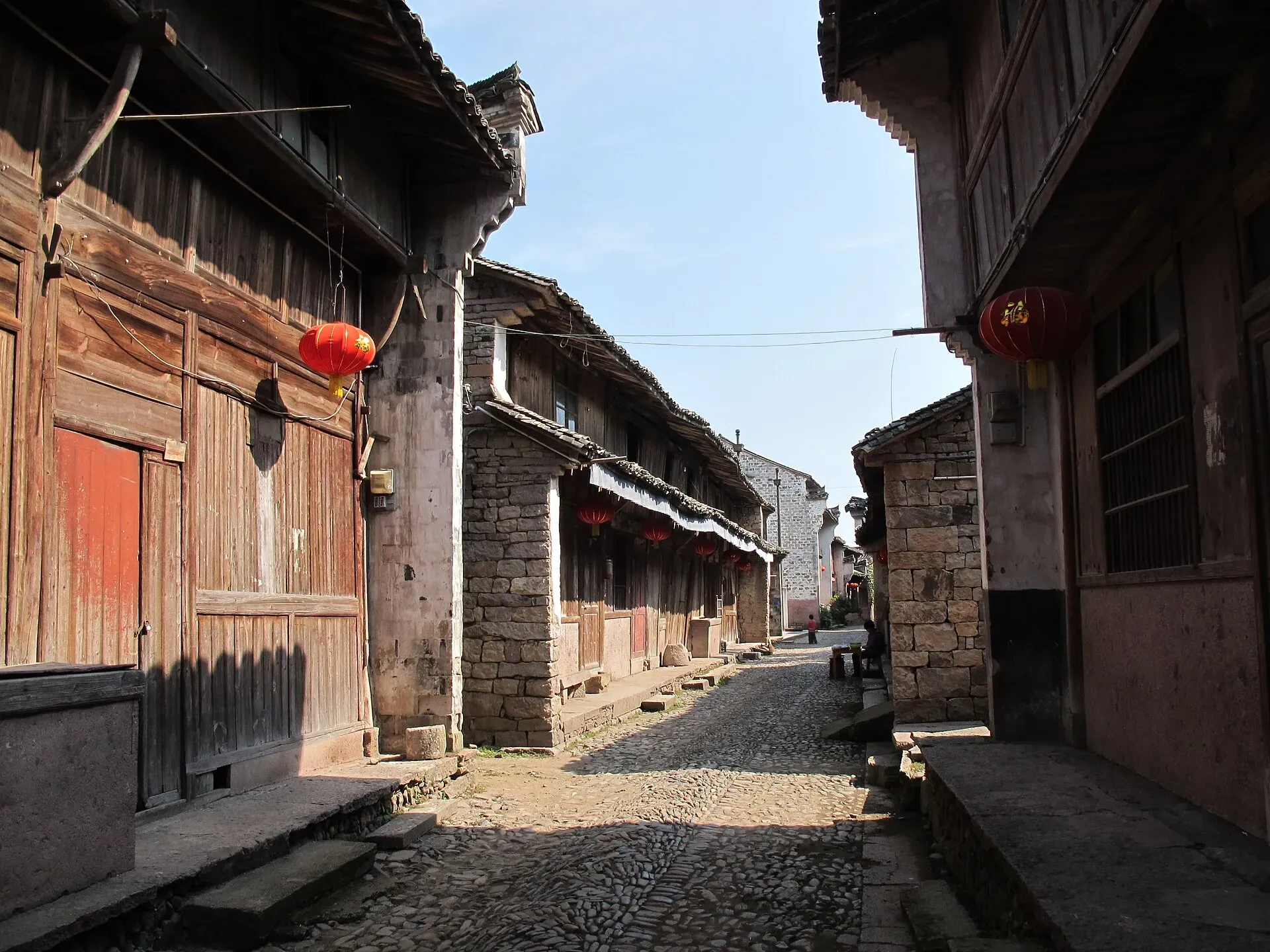
On February 17, 2019, two days before the Lantern Festival, Potan was decorated with needle-pricked lanterns, China Daily reported. The 2027 Lantern Festival falls on February 20. As of November 2026 we have found no announced program for Xianju or Potan, so check nearer the time or ask locally. For the journey, see Getting to Xianju; for more to see in the county, Places to Visit.
Buying one, or learning to make one
Hand-pricking is hard and slow, and that kept prices high: 3,000 to 7,000 yuan a lantern, Zhejiang Online reported in 2024. Zhu Fuwei, a county-level master of the craft who runs a local company, Zhejiang Huijin Tourism Development, found a cheaper way. In 2010, hearing makers at a crafts fair in Xiamen talk about laser cutting, he hit on “laser pricking”: a lantern’s pattern now takes about five minutes, and prices came down to three to five hundred yuan. He also simplified the craft into a fold-flat paper-cut lantern, borrowing from pop-up books and cards, that sold for 200 yuan.
Those were 2024 prices, so check before you buy — and if you want a lantern pricked by hand, ask whether it was.
To try it yourself, ask about the Huijin study base. According to Zhejiang Online in 2024, the lanterns come there as kits that visitors simply glue and assemble, and in peak season the base held more than eighty study sessions a month. We have not found the base’s address, hours or fees, so ask before you go.
Schools teach it too. Since 2009, Beijing Review reported, the Xianju Vocational School has run an elective course in the craft, taking 20 students a year from hundreds of applicants; People’s Daily wrote in 2026 that Xianju has brought the craft into its schools, with lantern clubs and teaching materials of their own, as well as a lantern art festival and master studios. More and more people come to her to learn, Wang Rulan told the Guangming Daily in 2023.
Questions & answers
With no frame, what holds a boneless lantern together?
The paper itself. Inside, the national master Wang Rulan told People’s Daily in 2026, there are only paper panels of different sizes and shapes, folded and glued together. Having no frame is also why Xianju lanterns are usually small.
How long does it take to make a boneless lantern?
It depends on the size and the design. Often more than ten days and sometimes a month, Wang Rulan told the Guangming Daily in 2023; Zhejiang Online reported in 2024 that a simple lantern takes seven or eight days and a complex one more than a hundred. Pricking takes the longest, at 100 to 150 holes to the square centimeter.
Where can I see Xianju’s boneless lanterns?
On Potan’s old street, about 25 km west of Xianju’s county town. The national master Wang Rulan opened a lantern showroom there in 1985, and before the 2019 Lantern Festival the old town was decorated with needle-pricked lanterns. We have not found the showroom’s address or opening hours, so ask locally before you go.
Can I buy one, or learn to make one?
Yes, but ask first. Zhejiang Online reported in 2024 that a hand-pricked lantern sold for 3,000 to 7,000 yuan, a laser-pricked one for three to five hundred, and a fold-flat paper-cut lantern for 200, and that at the Huijin study base visitors could make one from a kit. Prices change, so check before you go.
Is there a lantern fair in Xianju for the 2027 Lantern Festival?
The 2027 Lantern Festival falls on February 20. As of November 2026 we have found no announced program for Xianju or Potan. In 2019, Potan was decorated with needle-pricked lanterns two days before the festival, and People’s Daily described lanterns dotting the old street at Chinese New Year in 2026. Check nearer the time, or ask locally.
Sources
- 中文资料的英文、英文资料的中文,都是本站翻译。
- 灯彩(仙居花灯)· 中国非物质文化遗产网(国家级名录,项目序号 349,编号 Ⅶ-50)
- 李湘满 · 中国非物质文化遗产网(国家级代表性传承人)
- 王汝兰 · 中国非物质文化遗产网(国家级代表性传承人)
- 文化和旅游部关于公布第五批国家级非物质文化遗产代表性项目代表性传承人的通知(文旅非遗发〔2018〕8号)· 中国非物质文化遗产网,2018 年 5 月 16 日
- 国家级非物质文化遗产代表性项目代表性传承人 · 中国非物质文化遗产网(2026 年 11 月 5 日查阅)
- 文化和旅游部关于公布第六批国家级非物质文化遗产代表性传承人的通知(文旅非遗发〔2025〕23号)· 中国非物质文化遗产网,2025 年 3 月 17 日
- 仙居针刺无骨花灯首次走出国门 将在美国展出一个月 · 浙江在线(中国非物质文化遗产网转载),2010 年 1 月
- 五位花灯制作手艺人讲述“守艺”故事 · 光明日报(中国非物质文化遗产网转载),2023 年 2 月
- 仙居花灯问鼎中国民间文艺最高奖 · 台州晚报,2018 年 1 月 15 日
- 陈彩平作品获“世界杰出手工艺品徽章” · 台州日报,2018 年 12 月 27 日
- 《非遗一分钟》,很慢 钱江晚报致敬这样“龟速”的一分钟 · 浙江在线(钱江晚报),2019 年 1 月 5 日
- 匠心传承:浙江仙居针刺无骨花灯 · 浙江在线,2024 年 2 月 23 日
- 仙居针刺无骨花灯的“华丽变身” · 浙江在线(望潮),2024 年 12 月 30 日
- 仙居花灯 立身无骨 光影有魂 · 人民日报,2026 年 2 月 21 日(第 7 版)
- 2027 年公历与农历日期对照表 · 香港天文台
- The light never dies · Beijing Review, March 4, 2024
- Xianju traditional art lives on through artist Chen Caiping · China Daily, February 24, 2018
- Potan Ancient Town · China Daily (Taizhou), December 26, 2018
- Cultural activities light up Lantern Festival in Zhejiang · China Daily, February 19, 2019
- Xianju lantern craft preserves centuries-old artistry · China Daily, November 21, 2025
- Taizhou’s Xianju county preserves ancient craft of bone-free lanterns · China Daily (Taizhou), March 24, 2026