The Xiatang Site
The Xiatang site, in Xiatang Village, Hengxi Town, Xianju, Zhejiang, is a Neolithic village lived in from the Shangshan culture of nearly 10,000 years ago, through the Kuahuqiao and Hemudu cultures, to the Haochuan culture of about 4,000 years ago. Around 9,000 years ago it was a rice-growing village built around a central terrace, with earth platforms and a moat. In 2025 it was named one of China’s top ten archaeological discoveries of 2024; work on a site museum began in February 2025.
At Xiatang, a village in Xianju, archaeologists are uncovering a settlement where people grew rice, built houses and fired pottery for more than five thousand years. Its lowest layer belongs to the Shangshan culture of nearly ten thousand years ago; above it come the Kuahuqiao and Hemudu cultures, and at the top the Haochuan culture of about four thousand years ago. In 2025 the Xiatang site was named one of China’s top ten archaeological discoveries of 2024.
Where it is
The site lies in Xiatang Village, in Hengxi Town, Xianju County, Taizhou. It covers about 30,000 square meters. Zhong Zhaobing of the Zhejiang Provincial Institute of Cultural Relics and Archaeology, who leads the excavation, told Xinhua that it is a fairly self-contained basin, close to water yet safe from floods, with flat land good for farming: an ideal place to live. Of the 24 Shangshan culture sites known in 2025, Xiatang is the southernmost, Xinhua reported; most of the others, Zhejiang Online noted in 2017, lie in the Jinhua–Quzhou basin south of the Qiantang River, while Xiatang is in the basin of the Ling River. For the Shangshan culture itself, see Xiaohuangshan and the Shangshan culture.
From leveled fields to a national project
Villagers found it first. Zhejiang Online reported in 2017 that stone tools and pottery came up in large numbers when Xiatang leveled its fields in 1983; Xinhua and most later reports give the year as 1984, and the fortieth anniversary was marked in 2024. At the time, the site was dated to 7,000 to 5,000 years ago. In 1987 Xianju set up a group to protect it, and a villager, Zhang Jinmiao, became one of its first wardens, walking the site every day (Zhejiang Daily, 2025); in 1989 it was listed for protection by Zhejiang Province.
At the end of 2014, a team led by Wang Haiming, then deputy director of the Zhejiang institute, began surveying and test-digging, and their report reached a first conclusion: the main deposits belonged to the Kuahuqiao culture of about 7,500 years ago and the Shangshan culture of about 10,000. Formal excavation began in 2018. According to the project summary that Tide News published in 2025, in 2022 Xiatang joined a national “Archaeology China” project on how early rice-farming societies formed in the middle and lower Yangtze; China Daily, also in 2025, gave 2023. By early 2025, 2,250 square meters had been dug. China Daily reported that year that five more years of excavation were planned, and in October 2025 the Zhejiang Daily reported a new pit holding more objects than any other found at the site, “very likely a high-status grave” — though that is still a first reading.
Layer upon layer
Along one side of an excavation square ten meters by ten, the archaeologists have left a flight of twelve earthen steps. Walking down them in 2025, a Xinhua reporter passed through four Neolithic cultures:
These are the dates in Xinhua’s 2025 report; others differ a little. For the Shangshan layer, China Daily in 2025 gave about 8000 to 6500 BC and Kankanews in 2024 10,000 to 8,500 years ago, so both end it about 8,500 years ago; Kankanews put the Kuahuqiao layer at 8,000 to 7,000 years ago, and China Daily the Hemudu period at about 5000 to 3300 BC, roughly 7,000 to 5,300 years ago. We have not found a published excavation report or radiocarbon results; the dates are those the archaeologists gave the press in 2024 and 2025, and with the dig still going on, they may change.
Terrace, platforms and moats
Announcing the top ten in April 2025, Xinhua said the excavation had revealed a village in three parts — central terrace, artificial earth platforms and moat — from the middle and late Shangshan period, around 9,000 years ago. Xinhua and Tide News described them in 2024 and 2025:
- The central terrace: four houses close together, one round and three rectangular, with several grinding slabs nearby where food seems to have been prepared. In the late Shangshan period a “plaza” of fired red clay was laid here; about 100 square meters have been uncovered, with more than thirty pits of pottery.
- The earth platforms: more than ten, heaped up by hand to the north and east of the terrace, most of them rectangular, 8 to 10 meters long and about 5 wide. In the southeast corner is one about 30 meters square, ringed by ditches, with pits and high-status graves.
- The moats: two. The inner one dates from the Shangshan and Kuahuqiao periods, about 10,000 to 7,000 years ago; the outer one from the Haochuan period, about 4,500 to 4,000 years ago.
The three high-status graves on the outer platforms each held more than twenty pots, more grave goods than any other Shangshan burial yet found (Xinhua, 2025). Each platform may correspond to a basic social unit, the People’s Daily overseas edition wrote in 2025, and the graves show that society had begun to divide. From the site’s area and the population density of later sites, Zhong Zhaobing reckons the village held “no more than a hundred people” (Kankanews, 2024).
Pots and rice
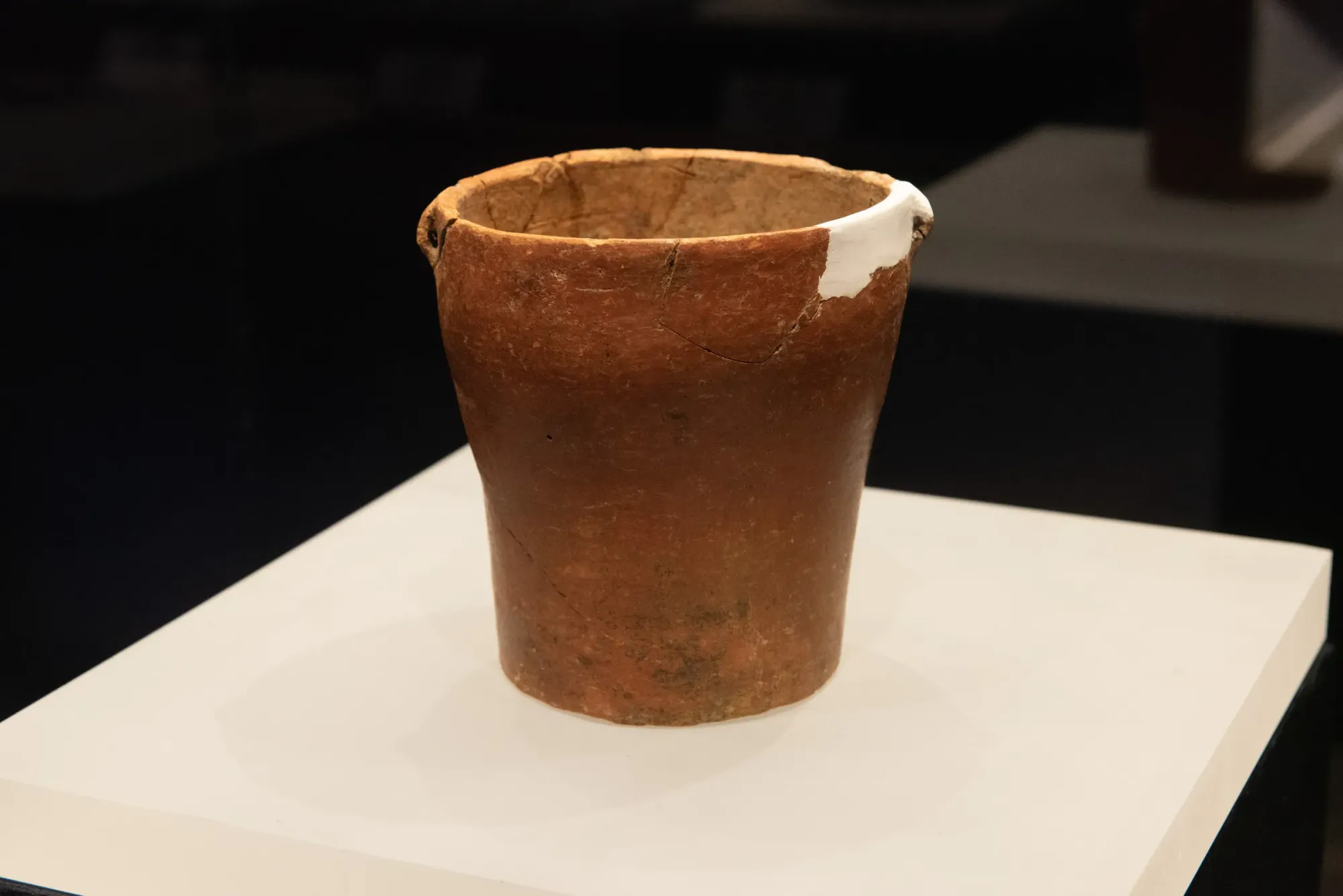
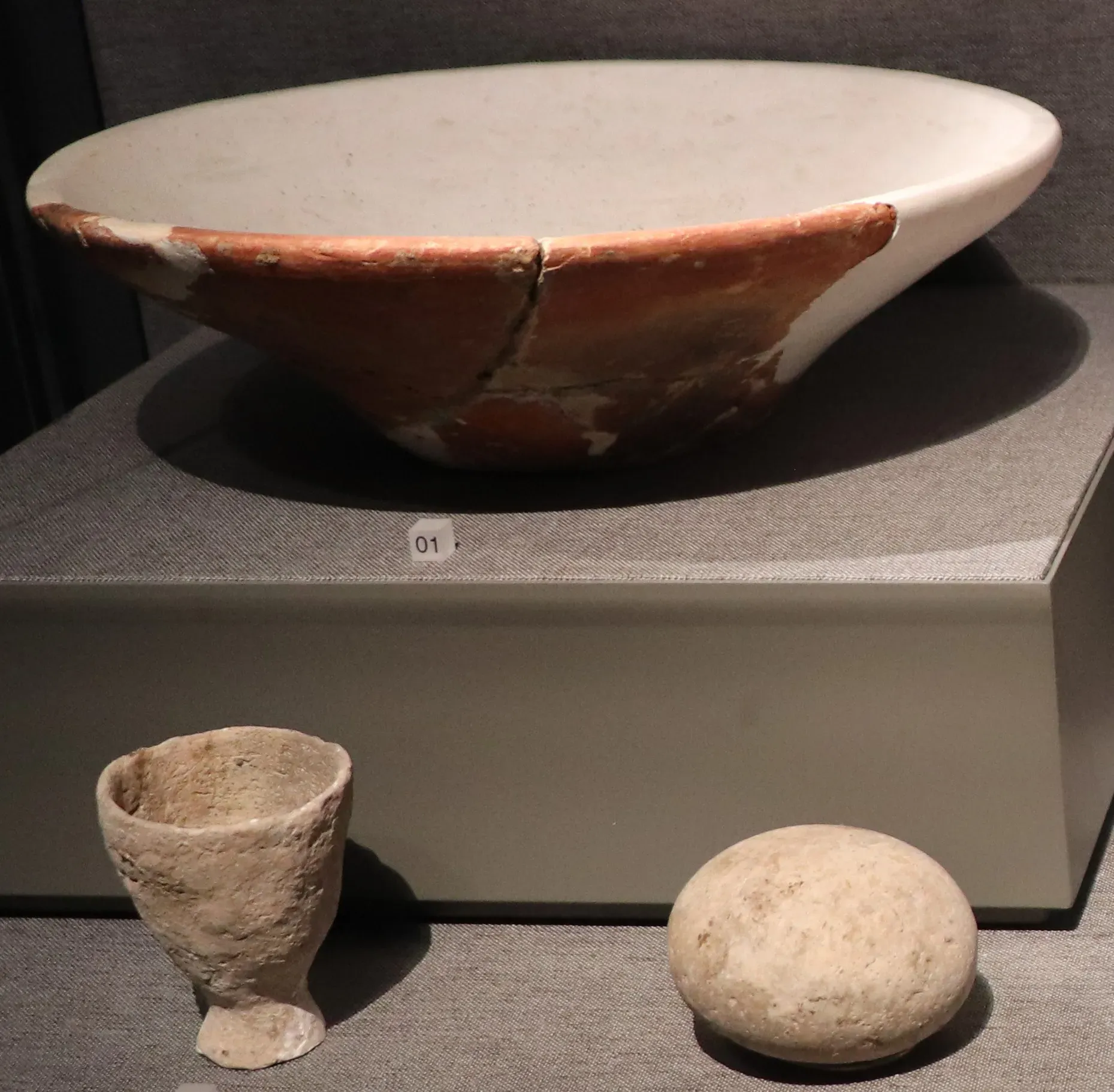
More than four hundred objects of the Shangshan period have come out of Xiatang (People’s Daily overseas edition, 2025). Nearly ten thousand years ago, Xinhua reported in 2025, potters here were already pinching, slab-building and coiling their pots, and had developed painted pottery. More than fifty pits of pottery have been found, more than at any other Shangshan site, though what they were for is uncertain: Zhong Zhaobing told Xinhua they may all be connected with ritual, and told China Daily that their function is still unknown; the largest vessel, a vat 46 centimeters across, held fifteen pots, the smallest of them a cup just 3 centimeters wide at the mouth. A flat-based cylindrical jar with a pair of small lugs at the lip and a red slip, found at no other Shangshan site, is called the Xiatang jar. And a basin dug up in 2018 bears the print of a mat on its base, so people here already had mats (Beijing News, 2021).
What they grew was rice. The charred grains from Xiatang are long and slender, much like today’s japonica rice, and Zheng Yunfei of the Zhejiang institute says they “already show the traits of domestication” (Xinhua, 2025). In the undisturbed soil beneath the site, Lyu Houyuan’s team at the Chinese Academy of Sciences has found wild rice, 40,000 to 27,000 years old according to Xinhua and the project summary that Tide News published in 2025, or 15,000 to 30,000 according to Zhong Zhaobing as quoted by China Daily the same year. The grinding slabs were used mostly for rice, but also for acorns and Job’s tears, and the bones of pigs, deer, ducks and soft-shelled turtles fill out the menu (Xinhua, 2025). By Haochuan times there were paddy fields on the edge of the village.
What the archaeologists say
“Of the Shangshan sites excavated so far, Xiatang has the most complete settlement features, the clearest structure and the richest content,” Zhong Zhaobing told Xinhua in 2024. According to Xinhua in 2025, Luan Fengshi, a professor at Shandong University, stresses its span: having gone through the whole of the Neolithic, he says, Xiatang can be called unique among China’s Neolithic sites. In the same report, Fang Xiangming, director of the Zhejiang institute, says the moat shows that people already knew the difference between inside and outside. In the People’s Daily in 2026, Sun Hanlong of the same institute wrote that the shift from small platforms to large ones clearly reflects social change in the middle and late Shangshan period.
Lists and honors
- 1989: a Zhejiang provincial heritage site.
- 2018: one of Zhejiang’s second batch of provincial archaeological site parks.
- May 2022: Xianju, with Pujiang, Shengzhou, Yiwu, Yongkang and Longyou, signs an agreement to bid jointly for World Heritage for the Shangshan sites.
- December 2024: the Shangshan sites join China’s tentative list for World Heritage; Xiatang is one of the sites in the joint bid.
- February 2025: one of six “new archaeological discoveries in China” of 2024, named by the Chinese Academy of Social Sciences.
- April 2025: one of the “top ten archaeological discoveries” of 2024, a list released jointly by China Cultural Relics News and the Society for Chinese Archaeology.
According to a 2026 reply from the Zhejiang Cultural Heritage Bureau, Xianju has been granted 500 million yuan in special bonds and 12.59 million yuan of central lottery funds to protect and manage its part of the bid. Xiatang is not on the eighth list of major national heritage sites, published by the State Council in 2019, and we have found no record of it being listed since.
Visiting Xiatang
Xiatang is still a working dig; by 2025, according to Xinhua, a protective shed had been built over the excavation. Tide News reported in 2024 that the Xiatang Site Archaeological Exhibition Hall, about 30 minutes by car from Xianju high-speed station, is on the ground floor of the Xiatang archaeological workstation, telling the story of the digs, the finds and the first villagers’ lives. We could not confirm that it is open to the public now, and found no opening hours, ticket prices or bus that goes there.
A site park is on the way. According to the Zhejiang Daily in October 2025, Xianju is building a Xiatang rice-culture site park, and its first phase, a museum for the site with the facilities around it, budgeted at about 149 million yuan, broke ground at the end of February 2025; most of the farmhouses near the core of the site had already been taken down, and Guo Hui, director of the Xianju Museum, said the villagers would be rehoused together beside the museum. We have found no opening date for the museum or the park, so check locally before you go.
For the journey, see Getting to Xianju; on the same trip you can visit Potan Old Town, and for more, see Places to Visit.
Questions & answers
Where is the Xiatang site?
In Xiatang Village, Hengxi Town, Xianju County, Taizhou, in Zhejiang. According to Tide News in 2024, the site’s archaeological exhibition hall is about 30 minutes by car from Xianju station on the Hangzhou–Wenzhou high-speed line. For the journey, see Getting to Xianju.
How old is the Xiatang site?
Its oldest layer, of the Shangshan culture, is nearly 10,000 years old and its youngest, of the Haochuan culture, about 4,000, so people lived here for more than five thousand years; the three-part Shangshan village dates to around 9,000 years ago. When it was first found, the site was dated to 7,000 to 5,000 years ago, and the work since 2014 has pushed that back to nearly 10,000. These are the dates the archaeologists have given the press; we have not found a published excavation report.
How is Xiatang related to the Shangshan culture?
Xiatang’s oldest and main layer belongs to the Shangshan culture, which China Daily in 2025 described as the earliest known Neolithic culture of the lower Yangtze and the cradle of rice cultivation; it is named after the Shangshan site in Pujiang. Of the 24 Shangshan sites known in 2025, Xiatang is the southernmost, Xinhua reported. For the culture as a whole, see Xiaohuangshan and the Shangshan culture.
Why was Xiatang named one of the top ten discoveries?
According to Xinhua in 2025, Xiatang is rich in remains of every kind and reveals a village in three parts — central terrace, earth platforms and moat — from the middle and late Shangshan period, around 9,000 years ago, giving a full picture of how an early farming society was laid out; as an early rice-farming society of southern China, it is important evidence for China’s ten thousand years of cultural history. The People’s Daily overseas edition added in 2025 that its high-status graves show that society had begun to divide.
Can you visit the Xiatang site?
In 2025 the site was still being dug, under a protective shed. In 2024 there was an archaeological exhibition hall on the ground floor of the Xiatang workstation, and a museum for the site, the first phase of a site park, broke ground at the end of February 2025. We could not confirm that the hall is open to the public now, and found no opening hours or ticket prices for it and no opening date for the museum or the park, so check locally before you go.
Sources
- 英文为本站翻译。
- 文明探源|下汤遗址:穿越新石器时代的人间烟火 · 新华社,2025 年 3 月 22 日
- “万年陶器”被批量发现!· 新华社(人民日报客户端),2024 年 10 月 28 日
- 2024年中国考古新发现揭晓,浙江仙居下汤遗址等入选 · 新华社(澎湃新闻),2025 年 2 月 19 日
- 跨越十万年,它们为何入选2024年度全国十大考古新发现?· 新华社,2025 年 4 月 24 日
- 2024年度浙江考古重要发现入围vol.1 · 潮新闻,2025 年 2 月 22 日
- 穿越一万年!跟着杭温高铁见“最早的浙江人” · 潮新闻,2024 年 9 月 8 日
- 浙江考古遗址在保护中活化利用:今天,我们怎样和历史“对话” · 浙江日报,2025 年 10 月 14 日
- 仙居下汤遗址已有万年历史 · 浙江在线,2017 年 2 月 16 日
- 浙江公布第二批省级考古遗址公园 这7处遗址你了解吗 · 浙江在线,2018 年 6 月 19 日(网页存档)
- 它们何以入选“2024年中国考古新发现” · 人民日报海外版(中国社会科学网),2025 年 2 月 24 日
- 生动勾勒万年文化长卷 · 人民日报海外版,2025 年 5 月 13 日
- 上山文化,中华万年文化史的重要源头 · 人民日报(孙瀚龙,浙江省文物考古研究所),2026 年 4 月 18 日
- 浙江省文物局答复上山文化申遗进展:主动争取国家文物局支持 · 澎湃新闻,2026 年 6 月 12 日
- 上山文化遗址群拿到申遗“入场券”!入列“中国世界文化遗产预备名单” · 潮新闻,2025 年 1 月 4 日
- 走进“下汤”万年古村落 看江南水乡的田园生活 · 看看新闻,2024 年 12 月 8 日
- 最早的稻米和酒壶……浙江“上山文化”考古特展开幕 · 新京报,2021 年 11 月 21 日
- Discovery sheds light on early agriculture · China Daily (Fang Aiqing), May 27, 2025
- Xiatang site in Zhejiang named one of China’s top archaeological findings · China Daily, April 28, 2025
- New Shangshan culture discovery of rice site may reveal earlier inequality in human society · Global Times, October 28, 2024
- 国务院关于核定并公布第八批全国重点文物保护单位的通知 · 中国政府网,2019 年 10 月 7 日