Xinchang Fried Rice Cakes and Snacks
“I can go without rice, but not without rice cakes,” people in Xinchang say. Xinchang’s fried rice cakes come “with broth” — stir-fried, then simmered until the cakes soak up the stock — and they are now sold in hundreds of shops across China. Mornings bring spring pancakes, huolatou and taro dumplings.
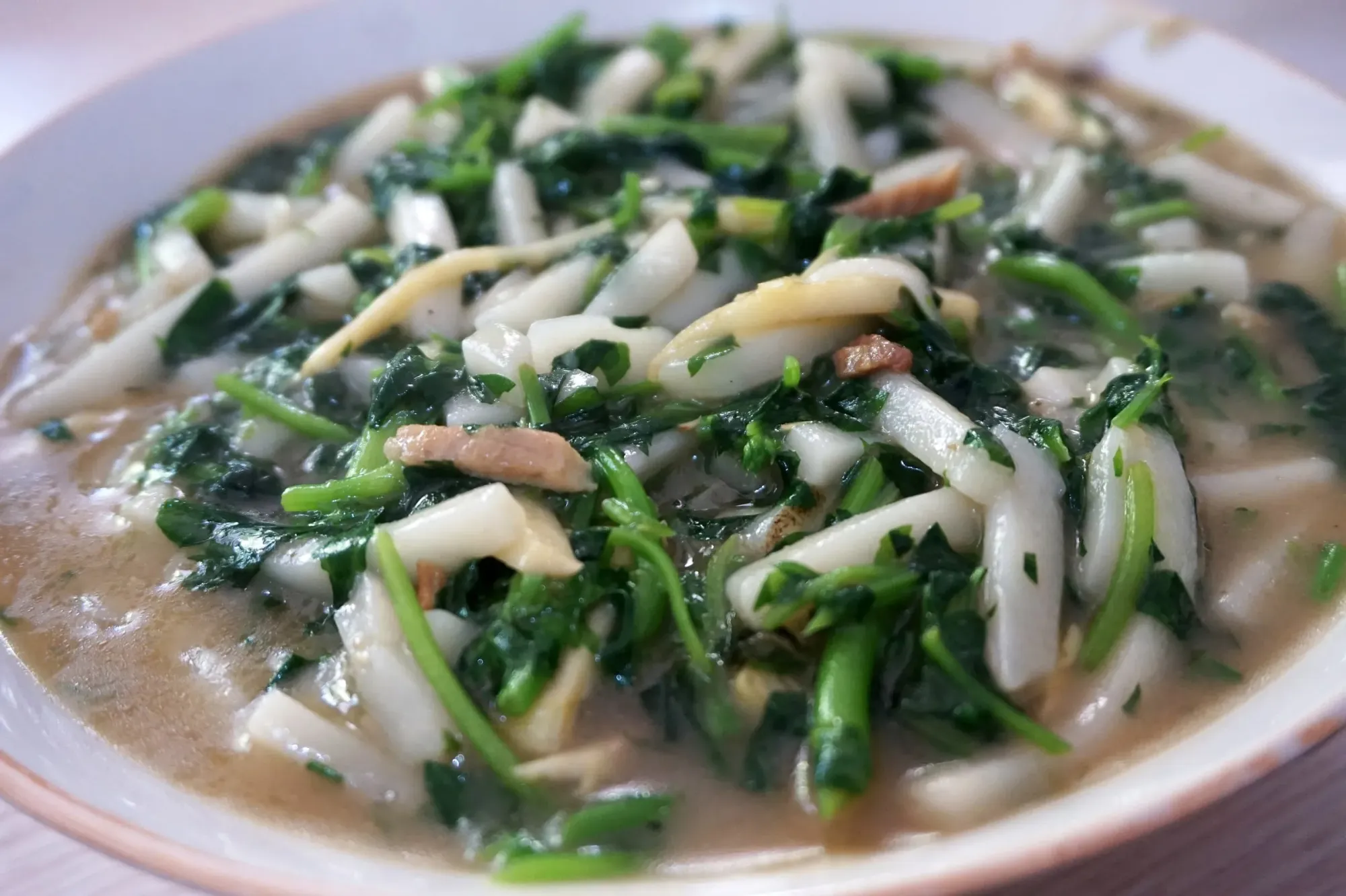
“I can go without rice, but not without rice cakes,” people in Xinchang like to say. Rice cakes are everywhere in Xinchang, from roadside stalls to five-star hotels, and the most common way to eat them is fried.
Why “with broth”
Xinchang’s rice cakes are made from local japonica or indica rice; they are dense and very chewy, and they can be pan-fried, deep-fried, stir-fried, grilled or cooked in soup. What sets Xinchang fried rice cakes apart is that they come “with broth.” As the owner of one rice-cake shop in Xinchang put it, after stir-frying you add plenty of water and bring it to a hard boil so the cakes soak up the stock, then add soft tofu and whatever vegetables are in season, and finish with ribbons of egg.
Timing matters too. The Xinchang fried rice cake trade association says the frying should take five to six minutes: any less and the cakes stay hard, any more and the broth boils away. Favorite versions in the shops include rice cakes with milk vetch greens, with wine-lees pork, with bamboo shoots and greens, and with crab.
Rice cakes go back a long way in Xinchang. The county lies on the upper reaches of the Shan stream, where the water runs fast, and its banks were lined with water-powered mortars — the main tool for making rice cakes in the old days. By the Ming and Qing dynasties, every family in Xinchang made rice cakes for the New Year.
From one plate to shops across China
In March 2017 Xinchang decided to build an industry around its fried rice cakes and set aside 10 million yuan a year for branding, training and grants for new shops. The county formed a trade association, held fried rice cake competitions, trained cooks for free, and opened model shops under “six unified” rules for the trademark, the method, shop standards and more.
Zhejiang Online reported that within little more than a year Xinchang had opened more than 180 model shops around China, including in highway service areas and university canteens, adding 120 million yuan to farmers’ incomes. By the end of 2021 there were 497 licensed shops, reaching 160 highway service areas in 22 provinces.
The dish has collected honors along the way: one of Zhejiang’s top ten farmhouse snacks in 2017, a collective trademark for “Xinchang fried rice cakes” and a geographical-indication certification mark for “Xinchang rice cakes” in 2020, and a gold award at Zhejiang’s first farmhouse snack competition in 2021.
Spring pancakes, huolatou and taro dumplings
Breakfast in Xinchang means spring pancakes. Xinhua reported that among the town’s countless snack signs, spring pancakes rank in the top three; a good one is thin enough to see light through, crisp at the edge and chewy in the middle.
Huolatou, also written guolatou, is a pancake that is crisp outside and soft within, brushed with a little lard and scattered with scallions and dried shrimp — one bite and you taste pancake, egg and lard all at once. Taro dumplings pair sweet, soft taro with a savory meat filling, and some shops serve them with homemade chili sauce and rose vinegar.
To try more, head for two streets. South Street, in the heart of the old town, has dozens of snack shops and is lit up at night, with triangular dumplings, steamed soup buns and guolatou; Wozhou Road, 780 meters long, is the town’s best-known food street.
Before you leave, pick up a bag of Xiaojingsheng, a small-seeded local peanut — tiny, fragrant and crunchy, with a Chinese geographical indication.
Xinchang and Shengzhou are neighbors, and both love fried rice cakes. For the Shengzhou version, see Shengzhou Fried Rice Cakes.
Questions & answers
What makes Xinchang fried rice cakes different?
They are cooked “with broth” — after stir-frying, plenty of water goes in and is brought to a hard boil so the cakes soak up the stock, then they are finished with soft tofu, seasonal vegetables and ribbons of egg. The frying itself should take five to six minutes.
What do people in Xinchang eat for breakfast?
Spring pancakes, huolatou and taro dumplings are all common. A good spring pancake is thin enough to see light through, with a crisp edge; huolatou is brushed with lard and scattered with scallions and dried shrimp; taro dumplings pair sweet, soft taro with a meat filling.
Where should I go for snacks in Xinchang?
South Street in the heart of the old town has dozens of snack shops and is busy at night; Wozhou Road, 780 meters long, is the town’s best-known food street.
What is Xiaojingsheng?
A small-seeded peanut grown in Xinchang, tiny, fragrant and crunchy, with a Chinese geographical indication.