Chen Hongshou, the Old Lotus of Zhuji
Chen Hongshou (1598 or 1599–1652), called Laolian, Old Lotus, was a figure painter of the late Ming and early Qing from Zhuji, by local accounts from Fengqiao. His Nine Songs, Water Margin cards and Western Chamber were cut in wood and widely copied; after the Ming fell he was for a time a monk.
Chen Hongshou (1598 or 1599–1652), known as Laolian, “Old Lotus,” was a painter of the late Ming and early Qing from Zhuji in Zhejiang, best known for his figures. The early Qing scholar Zhu Yizun put it simply: “Chen Hongshou, courtesy name Zhanghou, was a man of Zhuji in Zhejiang.” Zhuji’s local history office is more precise: in 2023 it wrote that Fengqiao, in the northeast of Zhuji, is the hometown of its Three Worthies, Wang Mian, Yang Weizhen and Chen Hongshou.
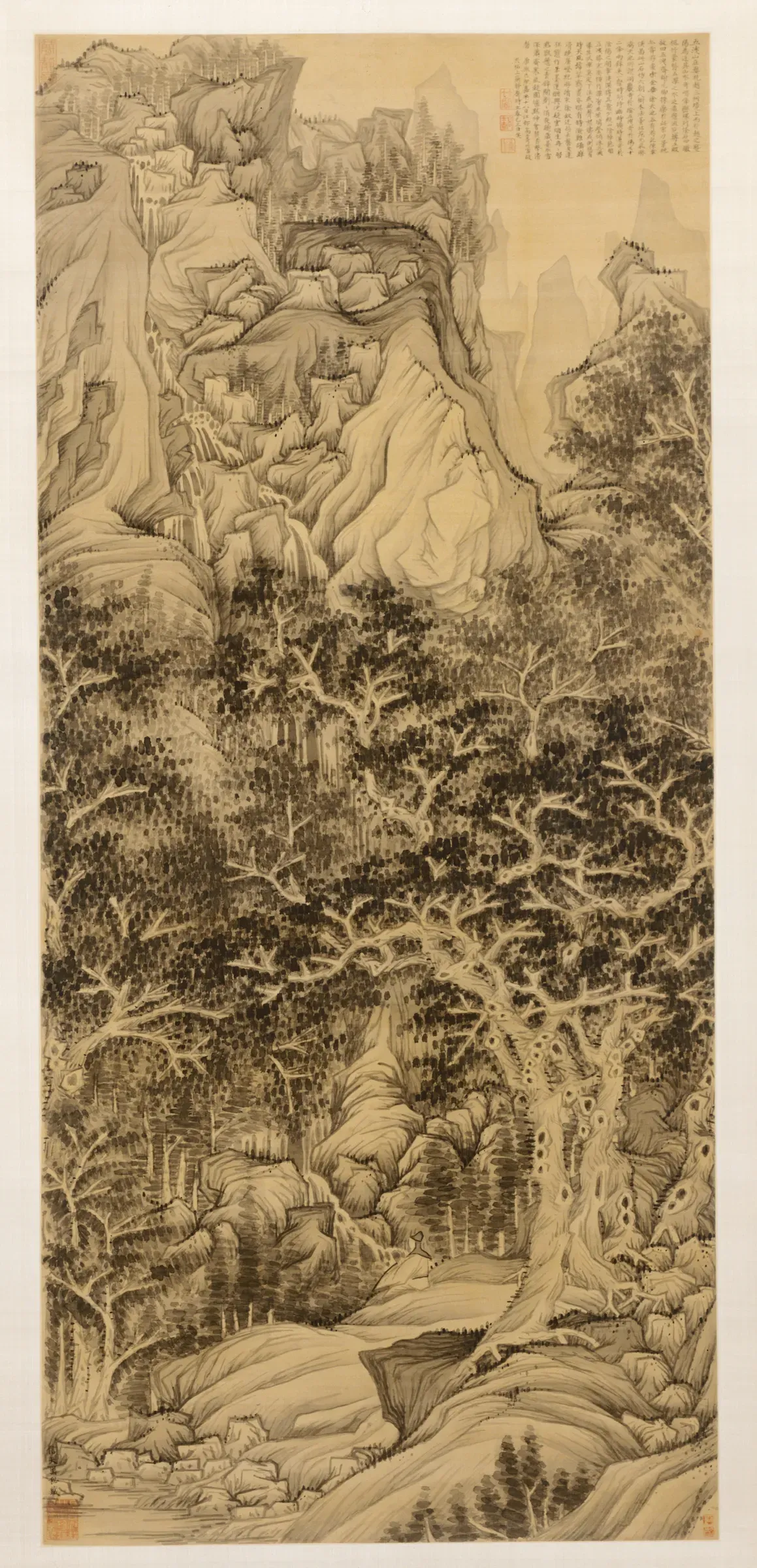
His forty heroes of the Water Margin were first drawn as cards for a drinking game; his only known self-portrait is in the National Palace Museum in Taipei; and the Cleveland Museum of Art holds his painting of the Wuxie mountain in Zhuji.
The Chens of Fengqiao
According to The Paper in 2022, he came from Chenjia village in Fengqiao. The Chens were a family of officials: his grandfather, Chen Xingxue, rose to be a provincial administration commissioner, while his father, Chen Yuchao, held no office but was a friend of writers such as Xu Wei and Chen Jiru. Britannica says his father died when he was nine, and an uncle saw to his education.
Sources disagree on the year of his birth. The National Palace Museum in Taipei gives 1598; the Palace Museum in Beijing, the Shanghai Museum and Britannica give 1599; the Metropolitan Museum of Art in New York and the Cleveland Museum of Art write “1598/99.” On his home they differ only in detail: old biographies and the museums in Beijing, Shanghai and Taipei say Zhuji, while local accounts and recent reports name Fengqiao and Chenjia village.
Learning to paint, and the capital
According to The Paper, he went to Hangzhou at ten to study with the painters Lan Ying and Sun Di. The Draft History of Qing says that, told his copy of a Zhou Fang beauty was better than the original, he said: “That is why it falls short. My painting pleases too easily, so my skill is not yet complete.”
Later he studied with the scholar Liu Zongzhou. In 1642, Zhu Yizun says, he bought a place at the Imperial Academy, and the next year he went home; the Palace Museum says he served at court in Beijing as a secretary, and the Draft History of Qing says he was called to that post and soon resigned, while Mao Qiling says he declined the emperor’s summons. In the capital he and the painter Cui Zizhong were paired as “Chen of the South and Cui of the North.”
After the Ming: Huichi and Laolian
The Ming fell in 1644. The Palace Museum says that, to escape the Qing troops, he became a monk for a time at Yunmen Temple in Shaoxing, calling himself Huichi and Laochi; Britannica dates this to 1646. Later he returned to lay life and lived by selling paintings in Hangzhou. He died in 1652; accounts of how he died differ, The Paper noted in 2022.
His names changed with his life. His childhood name, according to the World Digital Library, was Lianzi, “lotus seed.” The National Palace Museum in Taipei says he first called himself Lian Shami, the Lotus Novitiate, then Laolian, and after the fall of the Ming Huichi, “Regretfully late” in its translation, and Wuchi. Mao Qiling says he took the name Old Lotus because he loved to paint lotuses; the Draft History of Qing makes it his early name, while Zhu Yizun counts it, with Huichi, among the names he used after joining the monks.
Designs for woodblock prints
He also drew designs for book illustrations and playing cards, which carvers cut into woodblocks. The earliest are the Nine Songs. According to Chinese Wikipedia, he drew eleven figures for them and a picture of Qu Yuan chanting as he walks in the winter of 1616, at nineteen. They illustrated Lai Qinzhi’s commentary on the Songs of Chu when it was printed in 1638, The Paper reported in 2022.
His Western Chamber pictures are in a late Ming edition, the Secret Edition of the Northern Western Chamber of Mr. Zhang Shenzhi. The National Palace Museum in Taipei says Chen was one of its thirty-two “fellow editors” and drew a portrait of Yingying and five scenes, cut by Xiang Nanzhou. In “Stealing a Look at the Letter,” the maid Hongniang peeps from behind a screen, a finger to her lips, as Yingying reads her letter.
The Water Margin cards and the antique cards
Yezi, “leaves,” were playing cards. The Water Margin cards, says the World Digital Library’s description of the National Library of China’s copy, were for a drinking game: a player drew a card and drank as its picture and written rule directed.
His friend Zhang Dai tells how the cards came about in Tao’an mengyi. Zhou Kongjia asked Zhang Dai to hurry Chen along: “Kongjia begged, I pressed, and after four months it was done.” In the foreword he wrote for the set, Zhang Dai says Chen “painted forty men of the Water Margin to provide for Kongjia’s family of eight.” Earlier in the same entry, he writes that everything in them is ancient, from faces to weapons, yet call out “Song Jiang!” or “Wu Yong!” and the figures seem to answer.
The National Library’s copy gives no date, and accounts differ on the year. The Paper’s report of September 28, 2022, on an exhibition in Shaoxing said he made them at 28; Chinese Wikipedia lists them under 1633; the World Digital Library’s description calls them a masterpiece of the early Qing. The early Qing editor Zhang Chao noted in Yuchu xinzhi that painters of lanterns and of little banquet screens all used them as models.
The antique cards, Bogu yezi, were among his last works: The Paper reported that the set of forty-eight was made the year before he died, in 1651. This time, according to Chinese Wikipedia, he was earning a living for his own household of twenty, and the cards show figures of the past whose stories turn on wealth and poverty, from Tao Zhugong to Tao Yuanming. Tao Zhugong, Lord Zhu of Tao, is Fan Li, the minister of the Xi Shi story.
Where his paintings are
Of the paintings under his name that we found in the British Museum’s online collection, only an album leaf of 1650 is listed as his work; the others are given as claimed to be by him, or from his workshop or school. These are the works we checked on the museums’ own websites:
- Palace Museum, Beijing: Yang Shen Wearing Flowers, the Ming writer drunk in his Yunnan exile, face powdered and flowers in his hair, which the museum calls typical of Chen’s mature figures; also Lotus and Mandarin Ducks.
- Shanghai Museum: Leaning on a Censer Cage, a woman resting against a cage over an incense burner as a child chases a butterfly; and An Elegant Gathering, a handscroll he signed as the monk Hui.
- National Palace Museum, Taipei: Immortal of Longevity Under Tall Pines, 1635, which the museum calls his only known self-portrait: he is the man in the violet robe and red shoes.
- Metropolitan Museum of Art, New York: Bodhisattva Guanyin in the Form of the Buddha Mother, 1620, in which, the museum says, the deity appears as a winsome young woman.
- Cleveland Museum of Art: The Mountain of Five Cataracts, about 1630, and Lady Xuanwen Giving Instruction on the Rites of Zhou, 1638, painted for his aunt’s sixtieth birthday.
- British Museum: the album leaf of 1650, a landscape in the manner of Mi Fu.
When we checked in November 2026, the works in New York, Cleveland and London were not on view; the Met and Cleveland publish free images of theirs. We have not found whether the others are on display, so check with the museum before you go.
What the Qing writers said
Zhu Yizun says that as a young man he was “astonished and delighted” whenever he came by a painting of Chen’s. In his joint life of Chen and Cui Zizhong he laments: “What a pity that they are remembered only for their paintings!”
The Qing critic Zhang Geng went further in his Guochao huazheng lu, a record of the dynasty’s painters. As The Paper quoted it in 2022, it says that in power and scope Chen’s figures stand above those of Qiu Ying and Tang Yin: “in the three hundred years of the Ming there was no brushwork like this.” The Draft History of Qing also places his figures above Qiu’s and Tang’s.
Looking for Chen Hongshou in Zhuji
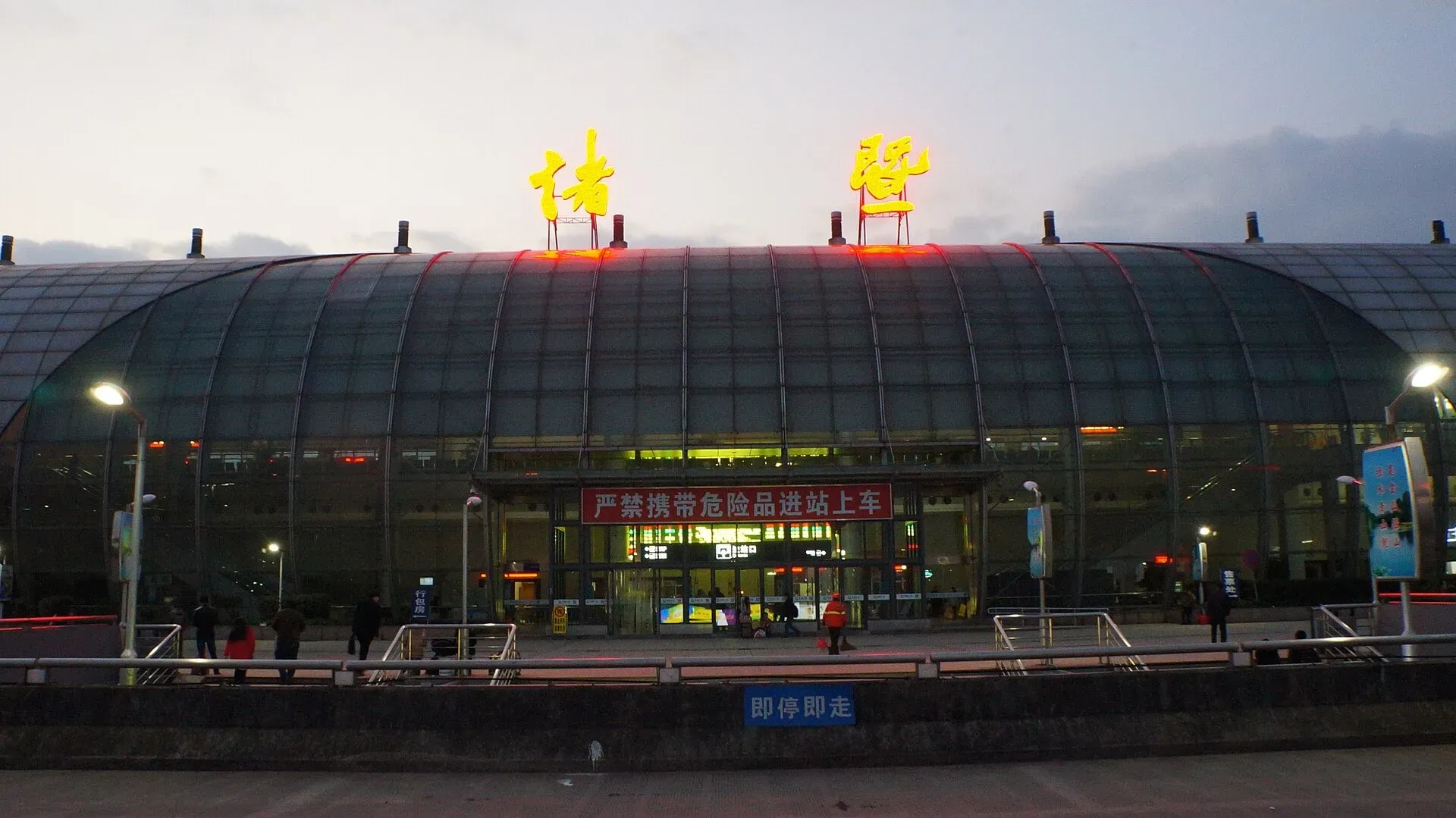
On April 30, 2025, the Three Worthies Museum in Fengqiao, devoted to Wang Mian, Yang Weizhen and Chen Hongshou, opened its doors; China Daily reported at the time that it displayed their manuscripts, calligraphy and paintings. Zhuji’s local history office listed a former home of Chen Hongshou among Fengqiao’s historic sites in 2023. We have not found the museum’s hours or prices, or whether the former home is open to visitors, so ask locally before you go. Fengqiao is about 29 km from Zhuji station, roughly half an hour by car; see Places to Visit.
The Zhuji Museum holds family pieces too: The Paper reported that the 2022 exhibition in Shaoxing showed its portraits of an ancestor five generations back and his wife, the tomb inscription of Chen’s mother and a large plaque in Chen’s hand, “Shui mu yong nian.” We have not found whether they are on display.
Cleveland’s Mountain of Five Cataracts shows Wuxie in Zhuji. An inscription on it by the collector Gao Shiqi, which the museum dates to 1699, says in the museum’s translation that the mountain is “quite close to Jiyang,” that is, Zhuji, and that “Chen Hongshou painted here.” Wuxie is in the hills of northwestern Zhuji; see Places to Visit.
For Fengqiao’s other painter, see Wang Mian and His Ink Plum Blossoms; for the journey, see Getting to Zhuji.
Questions & answers
Where was Chen Hongshou from?
Zhuji. Zhu Yizun’s early Qing biography calls him “a man of Zhuji in Zhejiang,” and the Palace Museum in Beijing, the Shanghai Museum and the National Palace Museum in Taipei all say Zhuji. Local accounts and recent reports go further: Zhuji’s local history office wrote in 2023 that Fengqiao is the hometown of its Three Worthies, Wang Mian, Yang Weizhen and Chen Hongshou, and The Paper reported in 2022 that he came from Chenjia village in Fengqiao.
Why is Chen Hongshou called Chen Laolian?
Laolian, “Old Lotus,” was one of the names he gave himself. Mao Qiling says he loved to paint lotuses; the National Palace Museum in Taipei says he first called himself the Lotus Novitiate and later the Old Lotus; and his childhood name was Lianzi, “lotus seed.” After the fall of the Ming he also called himself Huichi, which the museum translates as “Regretfully late.”
What are Chen Hongshou’s Water Margin cards?
A set of playing cards he designed, cut in wood and printed for a drinking game, showing forty heroes of the Water Margin. His friend Zhang Dai says Zhou Kongjia asked for them, to provide for his family of eight, and that they took four months. The National Library of China’s copy gives no date, and accounts differ on the year.
When did Chen Hongshou live?
In the late Ming and early Qing. He was born in 1598 or 1599 (sources differ), was in his forties when the Ming fell in 1644, and died in 1652.
Where can I see Chen Hongshou’s paintings?
The Palace Museum in Beijing, the Shanghai Museum, the National Palace Museum in Taipei, the Metropolitan Museum of Art, the Cleveland Museum of Art and the British Museum all hold his work, and Taipei’s Immortal of Longevity Under Tall Pines is his only known self-portrait. When we checked in November 2026, the pieces in New York, Cleveland and London were not on view, so check with the museum before you go. In Zhuji there is the Fengqiao Three Worthies Museum; ask locally about opening hours, and see Places to Visit.
Sources
- 英文为本站翻译。朱彝尊的传依维基文库《曝书亭集》卷六十四《崔子忠陈洪绶合传》;毛奇龄的《陈老莲别传》和张潮的评语依维基文库《虞初新志》卷十三;张岱的话依维基文库《陶庵梦忆》卷六《水浒牌》。《国朝画征录》的评语转引自澎湃新闻 2022 年 9 月 28 日的报道,我们没有找到这部书可靠的在线全文。高士奇的题跋依克利夫兰艺术博物馆网页上的英译。枫桥离诸暨站的距离与本站《去哪儿走走》一致,是按 OpenStreetMap 路网估算的车程。
- 曝书亭集 卷六十四(朱彝尊《崔子忠陈洪绶合传》)· 维基文库
- 虞初新志 卷十三(毛奇龄《陈老莲别传》)· 维基文库
- 陶庵梦忆 卷六(水浒牌)· 维基文库
- 清史稿 卷五百四 列传二百九十一 艺术三 · 维基文库
- 陈洪绶升庵簪花图轴 · 故宫博物院
- 陈洪绶荷花鸳鸯图轴 · 故宫博物院
- 明 陈洪绶 斜倚薰笼图轴 · 上海博物馆
- 明 陈洪绶 雅集图卷 · 上海博物馆
- 明陈洪绶乔松仙寿图 轴 · 国立故宫博物院(台北)
- 张深之先生正北西厢秘本 · 国立故宫博物院“匠心笔蕴——院藏明清版画特展”网站
- Bodhisattva Guanyin in the Form of the Buddha Mother · The Metropolitan Museum of Art(2026 年 11 月查阅)
- The Mountain of Five Cataracts · Cleveland Museum of Art(2026 年 11 月查阅)
- Lady Xuanwen Giving Instruction on the Rites of Zhou · Cleveland Museum of Art(2026 年 11 月查阅)
- Landscape,1650 年的册页 · British Museum(2026 年 11 月查阅)
- Flower Vase(Workshop of Chen Hongshou, probably)· British Museum
- The Hundred Immortals(Claimed to be by Chen Hongshou)· British Museum
- Lady and maids(School of/style of Chen Hongshou)· British Museum
- Chen Hongshou · Encyclopaedia Britannica
- 水滸葉子 · Library of Congress(世界数字图书馆 World Digital Library 的记录,原件藏中国国家图书馆)
- 張深之先生正北西廂秘本 · Library of Congress(World Digital Library,原件藏中国国家图书馆)
- 现场|在绍兴,直面陈老莲的高古奇骇与古雅清丽 · 澎湃新闻(李梅),2022 年 9 月 28 日
- “老莲之画,一代绝作”:故宫上博藏名迹相遇绍兴 · 澎湃新闻(宗和),2022 年 9 月 23 日
- 中国历史文化名镇——诸暨市枫桥镇 · 浙江在线(社科在线,诸暨市史志研究室供稿),2023 年 11 月 23 日
- 千年古镇再添文化地标 诸暨枫桥三贤馆开馆 · 中国日报网(腾讯新闻),2025 年 5 月 6 日
- 陈洪绶 · 维基百科
- 博古葉子 · 维基百科
- 范蠡 · 维基百科