Wang Mian and His Ink Plum Blossoms
Wang Mian, the Yuan dynasty master of plum blossoms in ink, was from Zhuji; Liqiao, a village in Fengqiao, is called his hometown today. A cowherd who read by temple lamplight, he refused office under the Yuan and lived among his plum trees, painting for rice. His plum poem is widely known, while the tale of him teaching himself to paint lotuses comes from the novel The Scholars and is far from the record.
Wang Mian was a painter and poet of the Yuan dynasty, best known for plum blossoms in ink. Where was he from? The official Ming History is plain: “Wang Mian, courtesy name Yuanzhang, was a man of Zhuji.” Modern accounts go further: an article in People’s Weekly places him in Fengqiao, a town in the northeast of Zhuji, and in 2025 Chao News called Liqiao, a village in Fengqiao, “Wang Mian’s hometown.”
The Shanghai Museum, the Metropolitan Museum of Art in New York and the Cleveland Museum of Art give his dates as 1287–1359, though according to Chinese Wikipedia the scholar Jiang Kehan argued in 1957 for a birth in 1310.
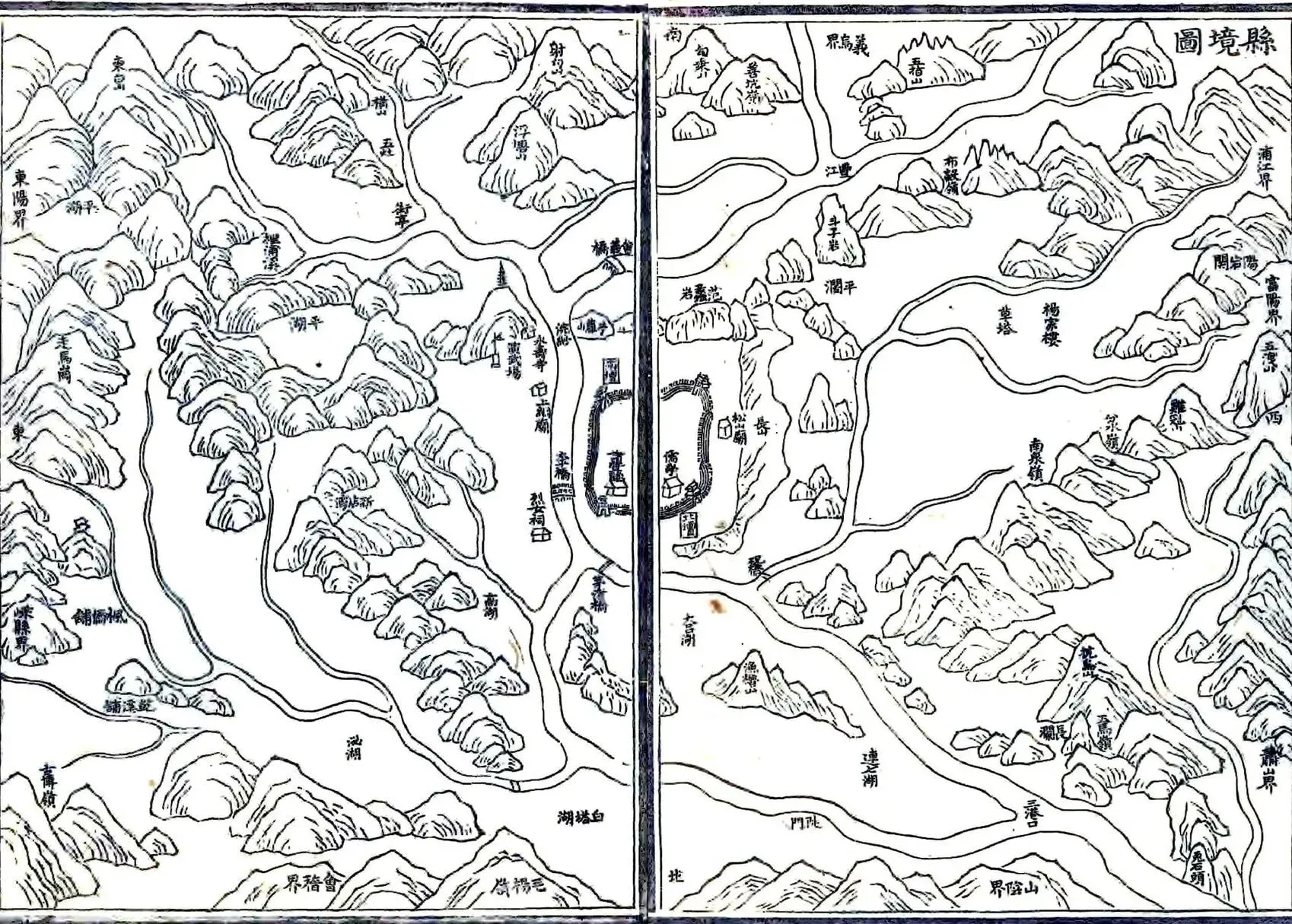
On this 1773 county map, south is at the top; on the left, below the middle and near the Shengxian border, it marks “Fengqiao pu,” the post station at Fengqiao.
The boy who herded cattle
Wang Mian came from a farming family. According to the early Ming scholar Song Lian, who wrote his life, his father sent him at seven or eight to graze the cows on the field ridges, but he slipped into the schoolroom to listen to the pupils. He came home at dusk without the cow, says the Ming History; his father beat him, and he went back anyway. His mother said: “If the boy is this obsessed, why not let him be?”
So he went to live in a Buddhist temple. At night, Song Lian writes, he sat on a Buddha’s knee and read aloud by the ever-burning lamp until dawn, as calm as if the fierce clay statues were not there. The scholar Han Xing heard of him and took him as a student, and in time, says the Ming History, he became a scholar versed in all the classics.
Plum trees instead of office
He failed the imperial examinations several times and gave them up. Song Lian says he travelled east into the old land of Wu, then north to the capital, Dadu, today’s Beijing, where he stayed with Taibuhua, a senior official of the Imperial Library. Offered a recommendation for a post, he refused: “You are a fool, sir! Within ten years foxes and hares will roam this place. Why take a salary?” That same day he made ready to go south.
Back in the south he settled with his wife and children in the Jiuli hills, planted a thousand plum trees and half as many peach and apricot, named his house the Plum Blossom Hut and called himself its master. People came one after another for his plum paintings, and he charged in rice by the length of the scroll. To those who laughed, he said: “I do it to feed myself. Do you think I enjoy painting for others?”
Song Lian and the Ming History both say that when Zhu Yuanzhang, the future founder of the Ming, took Wuzhou, centered on today’s Jinhua, he sought Wang Mian out and made him an adviser — and one night Wang Mian fell ill and died. The museums give the year as 1359.
The Scholars: Wang Mian learns to paint
For many readers, though, Wang Mian is a character in a novel. The Scholars, by the Qing writer Wu Jingzi (1701–1754), opens with him: “This man was named Wang Mian, and he lived in a village in Zhuji county.” His father dies when he is seven; at ten he herds the buffalo of the Qin family next door and saves his snack money for old books. One day in the plum-rain season, after a heavy shower:
On the lake were a dozen or so lotus flowers, clear water dripping from their buds and beads of water rolling to and fro on the leaves.“Is there anything in the world that can’t be learned?” he thinks. “Why don’t I paint some myself?” He sends to town for rouge and white lead, and “after three months, their spirit and their color were true in every way”; soon “the whole county of Zhuji knew him as a master of boneless flower painting.” He avoids the officials who court him and is visited by Zhu Yuanzhang, called the King of Wu; hearing that the court means to give him office, he slips away by night into the Kuaiji hills, where he later dies.
Much of this departs from the record. In the biographies his father was alive and beat him for losing a cow, and he was famous for plum blossoms; the novel’s Wang Mian paints lotuses and other flowers, and the chapter never mentions a plum blossom. Song Lian and the Ming History have Zhu Yuanzhang appoint him an adviser, but the novel has him flee the post, and ends his story: “How absurd that scholars nowadays all call him Adviser Wang! When did Wang Mian ever serve a single day as an official?” That jab has a source. In the early Qing, Zhu Yizun wrote another life of Wang Mian, which says that Zhu Yuanzhang “appointed him adviser, but Wang Mian died,” and complains that since Song Lian’s biography everyone has called him the Adviser, “yet when did he ever serve a single day as adviser?” The same life says that he painted plum blossoms in rouge, in the “boneless” manner. The boy who taught himself to paint lotuses belongs to the novel, not to history.
The poem Ink Plum
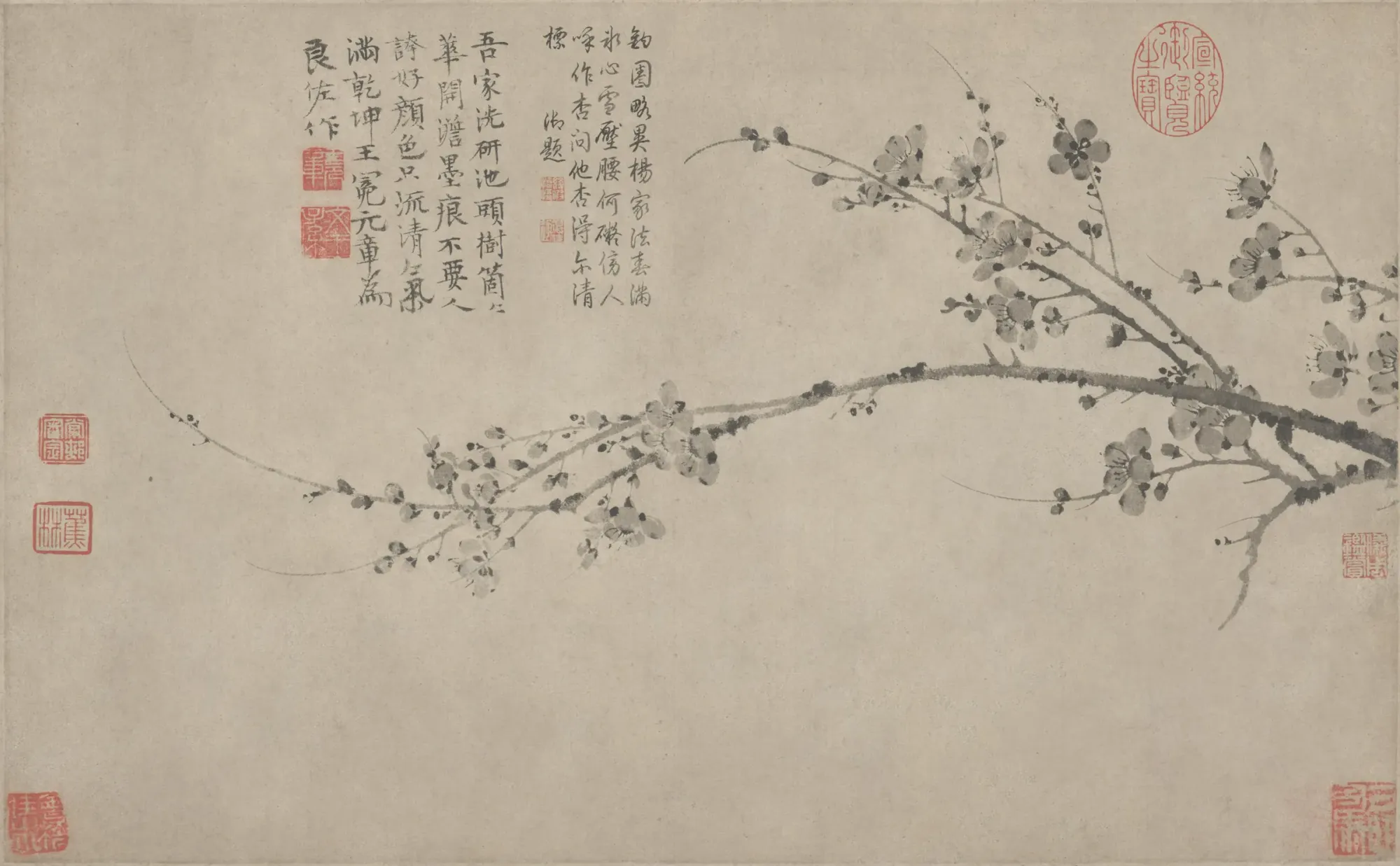
An ink plum is a plum blossom painted in ink alone. In the Palace Museum in Beijing, a handscroll of works by five Yuan painters includes Wang Mian’s Ink Plum, on paper, 31.9 by 50.9 centimeters: a single branch, petals dabbed in pale ink, sepals and stamens dotted in dark. He wrote a poem on it, signed “Wang Mian Yuanzhang, for Liangzuo,” with his seals “Yuanzhang” and “Descendant of King Wen.”
The poem is his well-known Ink Plum. In the collections of his poems it reads:
The tree by my family’s inkstone-washing pond:
every blossom opens in pale traces of ink.
It asks no one to praise its pretty colors,
and wants only to leave pure air filling heaven and earth.The wording varies slightly between editions, and on the Palace Museum painting the last line has liú 流, “to flow,” for liú 留, “to leave”: the two sound alike. The Palace Museum reads the picture as the painter declaring his own purity and aloofness. The Metropolitan Museum of Art adds that under Mongol rule a plum flowering in midwinter had become a symbol of purity and endurance, and that Wang Mian’s plums became the main model for plum painters of the Ming and Qing.
Where his paintings are
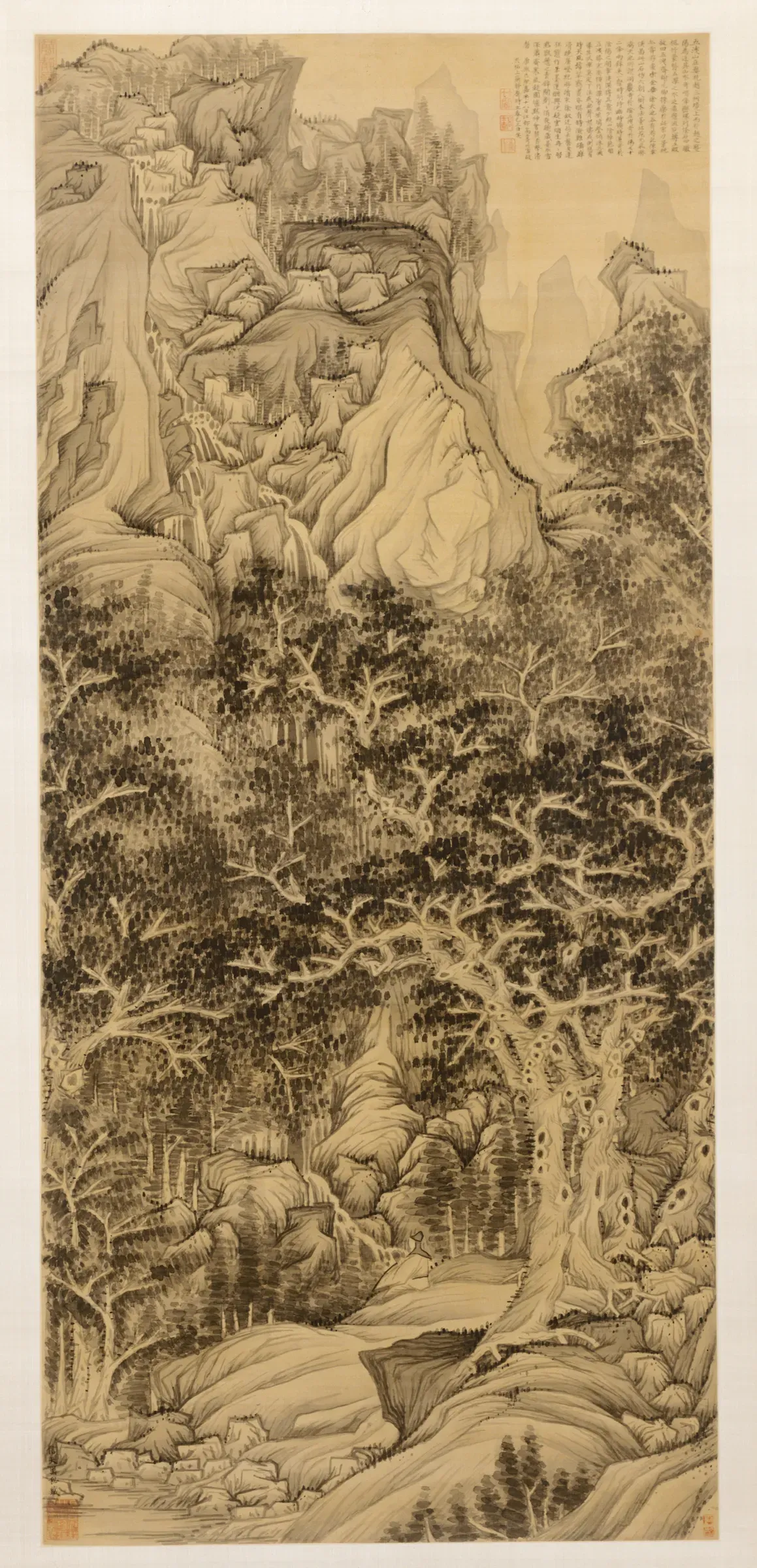
Few of his paintings survive, the Cleveland Museum of Art notes, but they show that ink-plum painting had fully matured by his time. These are the ones we found:
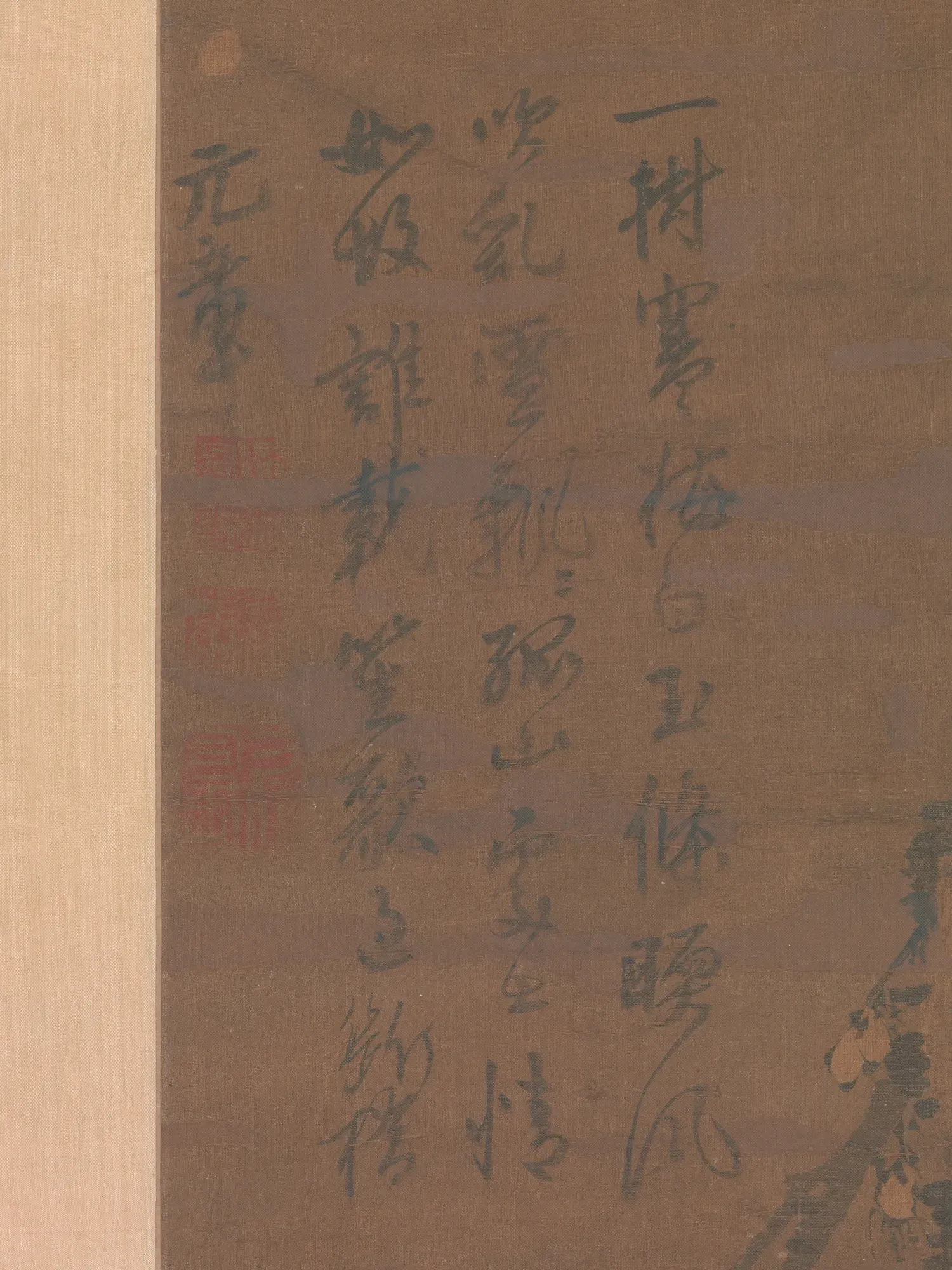
- Palace Museum, Beijing: the Ink Plum above.
- Shanghai Museum: Ink Plum, a hanging scroll of 1355, painted in his 69th year, the museum says, with answering poems by Ming writers such as Wen Zhengming and Tang Yin on its mounting; and a plum handscroll of 1346.
- National Palace Museum, Taipei: Secluded Valley, Early Spring, an album leaf.
- Metropolitan Museum of Art, New York: Fragrant Snow at Broken Bridge, a hanging scroll on silk.
- Cleveland Museum of Art: A Prunus in the Moonlight, a hanging scroll on silk.
- Kyoto National Museum: an ink plum “attributed to Wang Mian.”
Seals cut in soft stone
Wang Mian also cut seals, and later writers credit him with starting the use of stone for them. The Ming writer Lang Ying says in his Qixiu Leigao that seals used to be cast in bronze, until “at the end of the Yuan, Wang Mian of Kuaiji carved them in huaru stone.” The early Qing scholar Zhu Yizun wrote that Han seals were cast, that ivory, rhinoceros horn, giant clam shell and agate came later, and that it was Wang Mian “who first changed to huaru stone.” Ruan Kuisheng’s Qing notebook Chayu Kehua agrees: “At the end of the Yuan, Wang Mian of Zhuji, who called himself the Mountain Farmer Who Boils Stones, began carving private seals in huaru stone.” Xu Ke’s Qingbai Leichao adds that the stone came from Mount Baohua in Tiantai, and People’s Weekly also called it his invention in 2021. All of these were written centuries later; we have found no account from his own time.
Looking for Wang Mian in Zhuji
Zhuji’s local history office wrote in 2023 that Wang Mian, the Yuan writer Yang Weizhen and Chen Hongshou, a painter of the late Ming and early Qing, all came from Fengqiao, in the northeast of Zhuji, and are known as the Three Worthies of Fengqiao. The town’s Three Worthies Museum opened on April 30, 2025, with their manuscripts, calligraphy and paintings and, China Daily reported, digital light displays and immersive scenes. We have not found its opening hours or ticket prices.
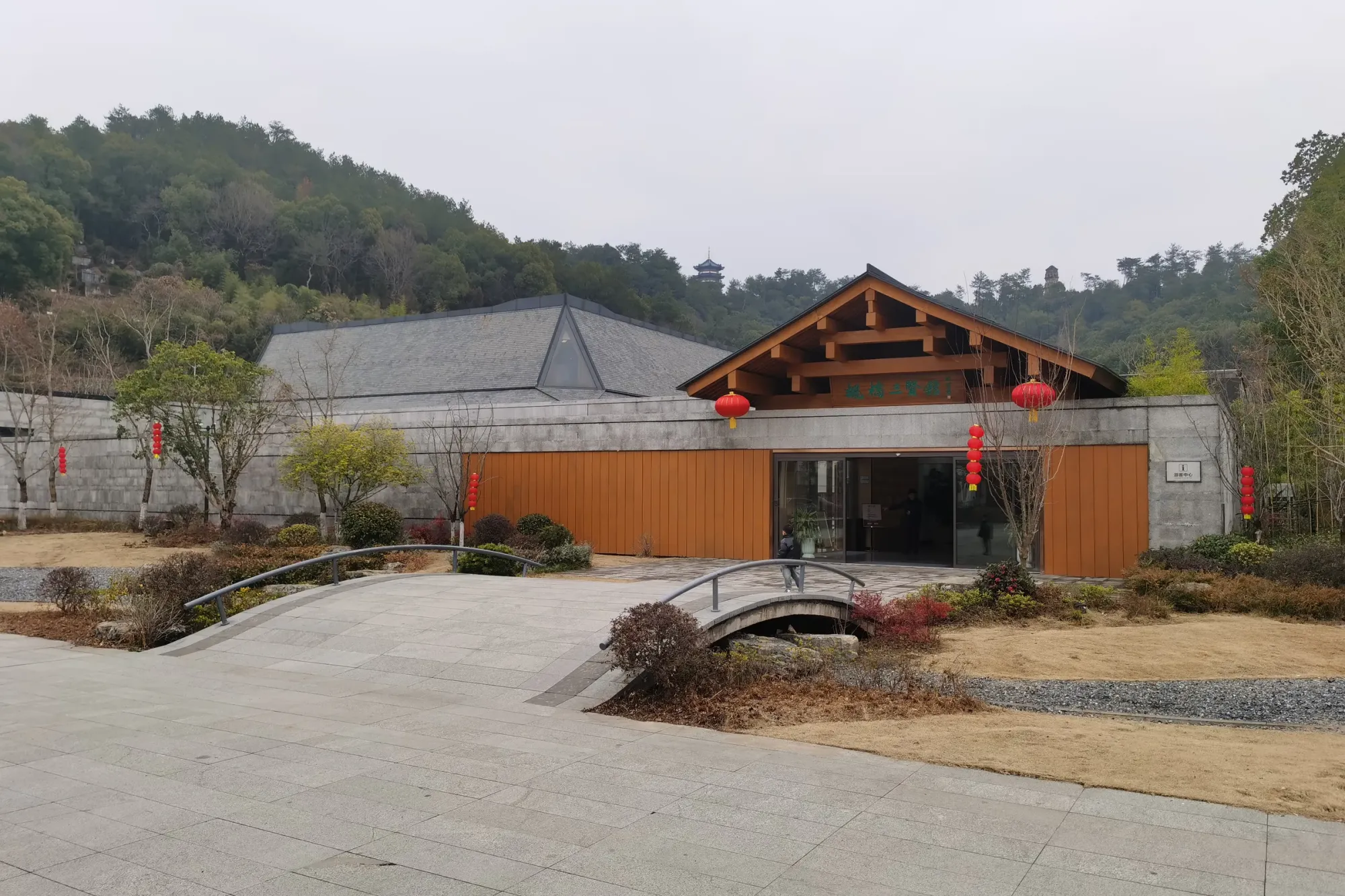
In August 2025 Chao News called Liqiao, a village in Fengqiao, Wang Mian’s hometown. A 2024 report on China.com by students on a summer project mentions a former residence of his in Liqiao; we have not found whether it is open to visitors. Nor have we found where the Jiuli hills are today, or whether anything of the Plum Blossom Hut survives.
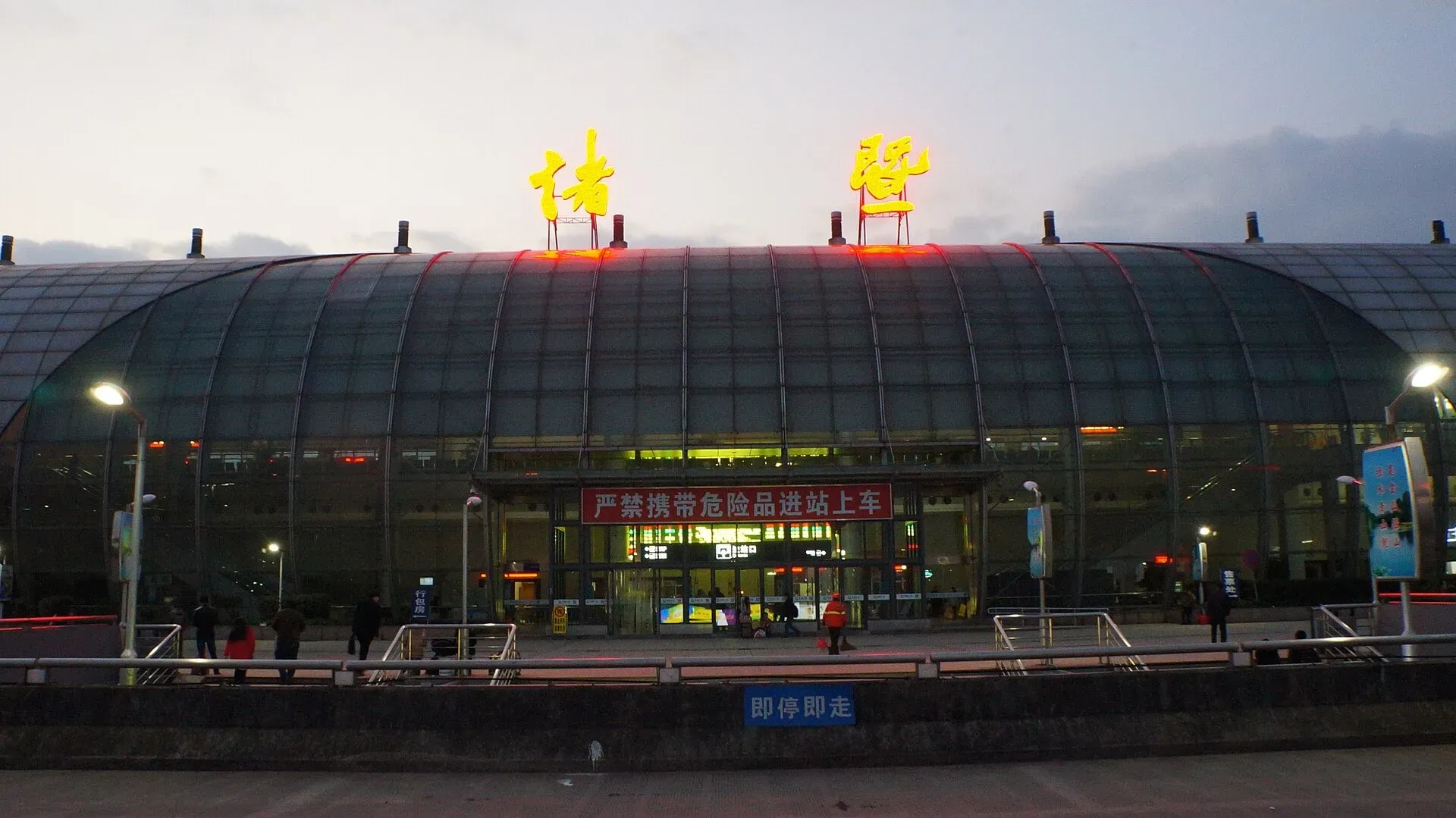
Fengqiao is about 29 km from Zhuji station, roughly half an hour by car. For its other sights, see Places to Visit; for the journey, Getting to Zhuji; and for Zhuji’s other famous figure, Xi Shi, Xi Shi’s Hometown.
The paintings listed above are in Beijing, Shanghai, Taipei, New York, Cleveland and Kyoto. When we checked the Met’s and Cleveland’s websites on November 5, 2026, their scrolls were not on view, but both museums publish images of them online, free to use. The Shanghai Museum’s collection page gives the location of its 1355 scroll as the Chinese Painting Gallery but does not say whether it is on view now, and we have not found whether the others are on display, so check with the museum before you go.
Questions & answers
Where was Wang Mian from?
Zhuji. The Ming History and the biography by Song Lian, written in the early Ming, both call him a man of Zhuji, and The Scholars has him living in a village in Zhuji county. Zhuji’s local history office and People’s Weekly place him in Fengqiao, in the northeast of Zhuji, and in 2025 Chao News called Liqiao, a village in Fengqiao, his hometown. He called himself the Mountain Farmer of Kuaiji, and some Ming and Qing writers call him Wang Mian of Kuaiji; Zhuji lies on the western side of the Kuaiji hills.
Did Wang Mian really teach himself to paint lotuses?
That is the novel’s story, from the first chapter of The Scholars, written by Wu Jingzi in the Qing dynasty. The Wang Mian of the biographies was famous for plum blossoms, and his father was still alive when he herded cattle. What Song Lian and the Ming History record is the cowherd slipping into the schoolroom to listen, and reading at night on a Buddha’s knee by the temple lamp.
What does Wang Mian’s poem Ink Plum say?
In full, “The tree by my family’s inkstone-washing pond — every blossom opens in pale traces of ink. It asks no one to praise its pretty colors, and wants only to leave pure air filling heaven and earth.” The Palace Museum in Beijing reads it as the painter declaring, through the ink plum, his own purity and his distance from the world.
When did Wang Mian live?
In the Yuan dynasty. The Shanghai Museum, the Metropolitan Museum of Art and the Cleveland Museum of Art give his dates as 1287–1359, though according to Wikipedia one scholar has argued that he was born in 1310. Song Lian and the Ming History both say that after Zhu Yuanzhang took Wuzhou he made Wang Mian an adviser, and that one night Wang fell ill and died.
What is there to see of Wang Mian in Zhuji?
The Fengqiao Three Worthies Museum opened in Fengqiao on April 30, 2025, with manuscripts, calligraphy and paintings by Wang Mian, Yang Weizhen and Chen Hongshou, China Daily reported at the time; Liqiao village in the same town is called his hometown. We have not found the museum’s hours or prices, or whether the former residence in the village is open, so ask locally before you go. Fengqiao is about 29 km from Zhuji station; see Places to Visit.
Sources
- 英文为本站翻译。《明史》的王冕传在卷二百八十五《文苑一》;宋濂写的传,依维基文库《竹斋集》(四库全书本)卷首的录文(四库本把“泰不华”改作“泰哈布哈”,本文用通行的写法);《墨梅》诗依维基文库的录文,画上的题字依故宫博物院的藏品介绍。枫桥离诸暨站的距离与本站《去哪儿走走》一致,是按 OpenStreetMap 路网估算的车程。
- 明史 卷二百八十五 文苑一 · 维基文库
- 竹斋集(四库全书本,卷首有宋濂所撰传)· 维基文库
- 墨梅(王冕)· 维基文库
- 儒林外史 第一回 · 维基文库
- 曝书亭集 卷四十三(朱彝尊《衎斋印谱跋》)· 维基文库
- 曝书亭集 卷六十四(朱彝尊《王冕传》)· 维基文库
- 七修类稿 卷二十四 · 维基文库
- 茶余客话 卷十九 · 维基文库
- 清稗类钞(花乳石)· 维基文库
- 陶说 卷五 · 维基文库
- 赵雍等元五家合绘卷 · 故宫博物院
- 元 王冕 墨梅图轴 · 上海博物馆
- 元 王冕 墨梅图 赵奕 行书梅花诗 合卷 · 上海博物馆
- 集古名绘 册 元王冕幽谷先春 · 国立故宫博物院(台湾数位典藏联合目录)
- Fragrant Snow at Broken Bridge · The Metropolitan Museum of Art(2026 年 11 月 5 日查阅)
- A Prunus in the Moonlight · Cleveland Museum of Art(2026 年 11 月 5 日查阅)
- Ink Plum Blossoms, attributed to Wang Mian · Kyoto National Museum
- 王冕:一生只作墨梅香 · 人民周刊(人民网,逸舟),2021 年 10 月 19 日
- 中国历史文化名镇——诸暨市枫桥镇 · 浙江在线(社科在线,诸暨市史志研究室供稿),2023 年 11 月 23 日
- 千年古镇再添文化地标 诸暨枫桥三贤馆开馆 · 中国日报网(腾讯新闻),2025 年 5 月 6 日
- 走进“王冕的四季” 诸暨文化特派员上了一堂生动的艺术课 · 潮新闻,2025 年 8 月 22 日
- “枫”彩美丽栎桥村,唱响田园交响曲 · 中华网(财讯网),2024 年 7 月 22 日
- 王冕 · 维基百科
- Wang Mian · Wikipedia
- 儒林外史 · 维基百科
- 吴敬梓 · 维基百科
- 婺州 · 维基百科