Tiantai Mountain
On May 19, 1613, Xu Xiake set out from Ninghai for Mount Tiantai — the day China now celebrates as China Tourism Day. On Huading Peak he wondered why the flowers at the top had not yet opened; at the Stone Bridge falls he walked across a natural stone bridge little more than a foot wide. Four centuries later, these are still the two places on Mount Tiantai most worth the trip.
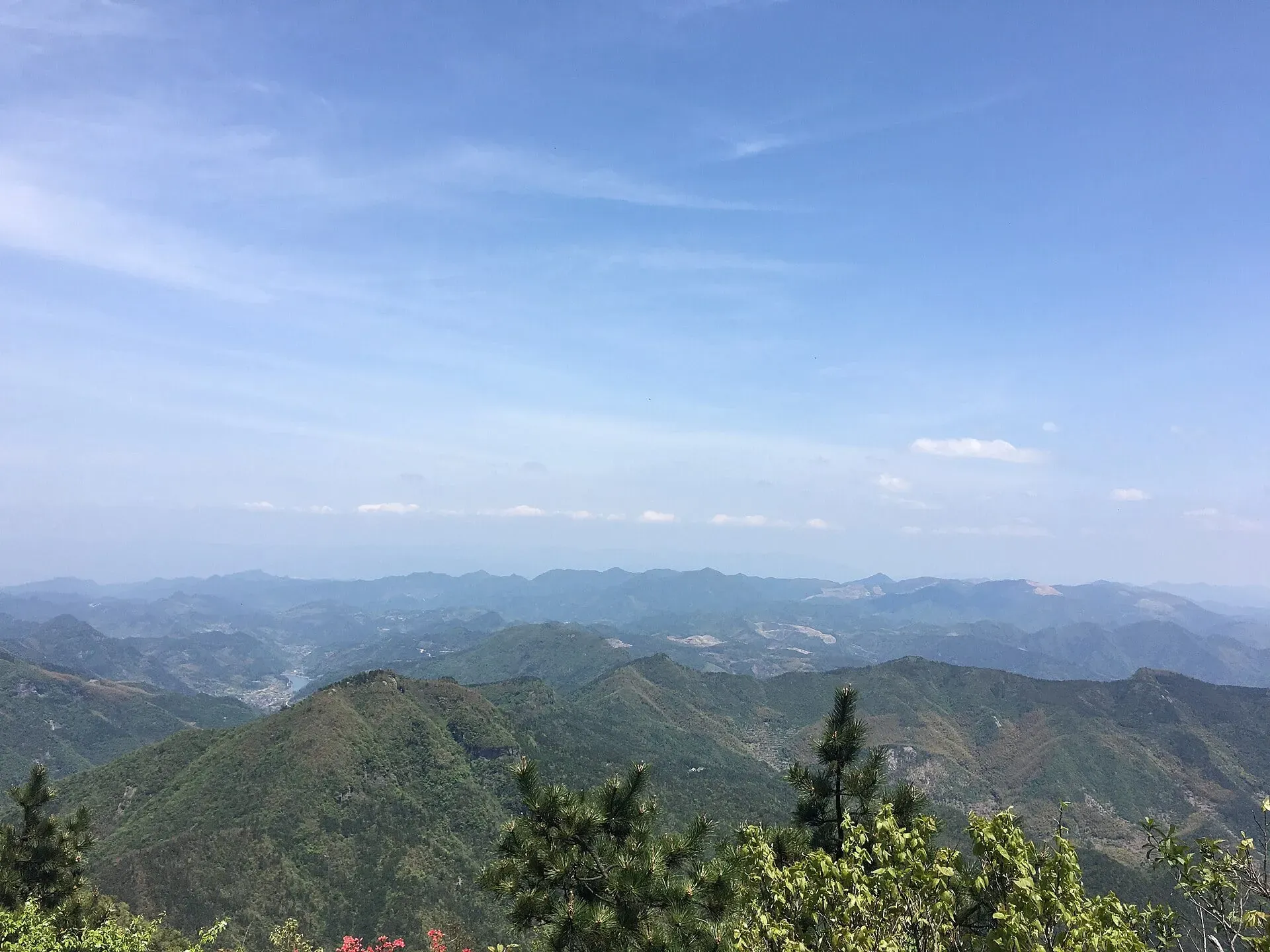
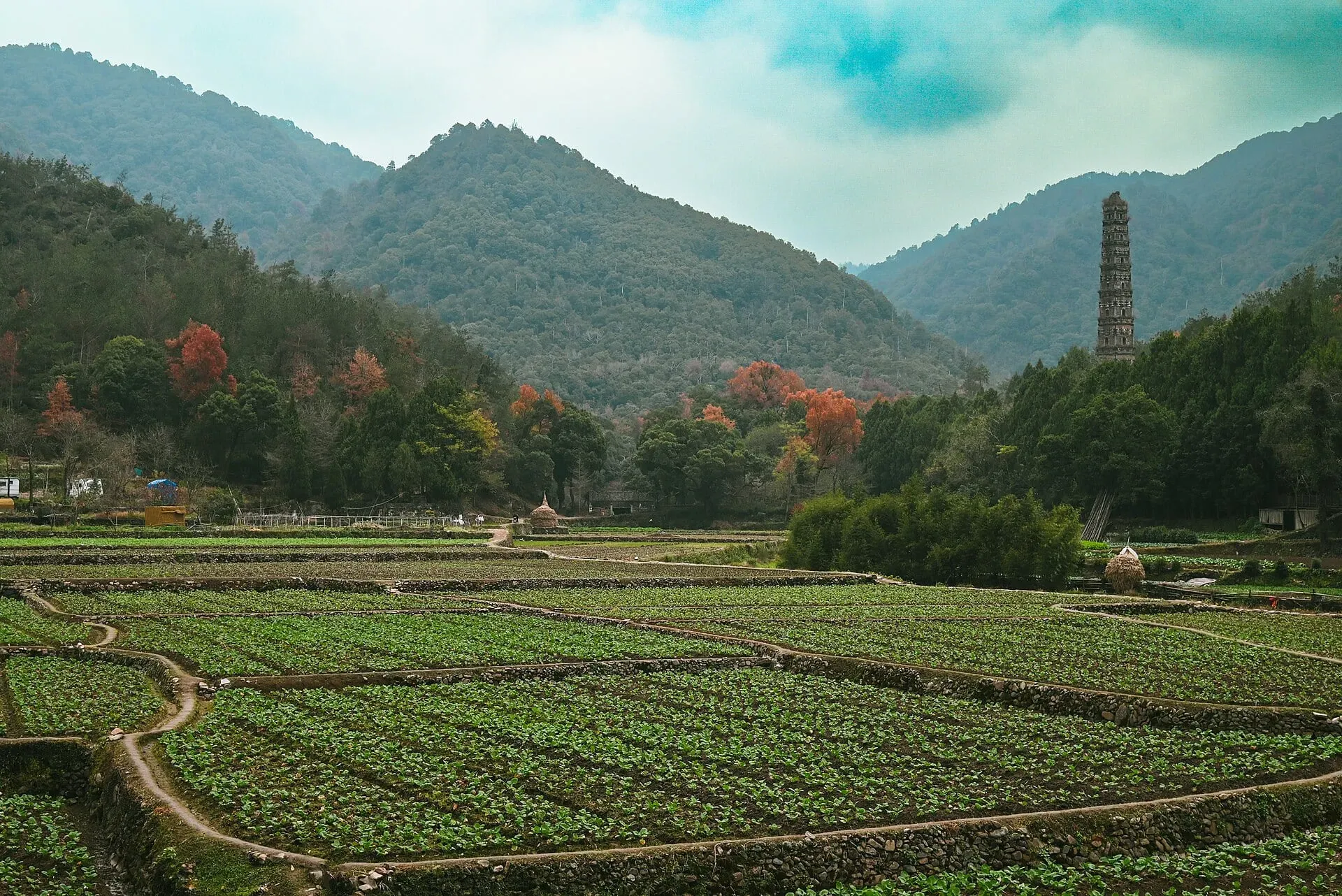
Mount Tiantai rises north and northeast of Tiantai town. Its highest peak, Huading, is 1,098 meters, and its ridges divide the waters of the Yong, the Cao’e and the Ling rivers. The mountain is said to have eight tiers, alike on all four sides, and to lie beneath the stars called the Three Terraces — hence its name, Tiantai, the Terrace of Heaven. In the Eastern Jin, Sun Chuo wrote a rhapsody on a journey to Mount Tiantai that later went into the Selections of Refined Literature, and the mountain’s fame was made; in the Tang, Meng Haoran wrote from his boat, “If you ask where I am going now — to Tiantai, to see the Stone Bridge.”
In 2015 the Mount Tiantai scenic area was made a national 5A scenic area, China’s highest rating. Its two great sights are the Stone Bridge falls and Huading Peak — and more than four hundred years ago, the Ming traveler Xu Xiake began his famous travel diaries with both.
May 19, 1613
The first entry in The Travel Diaries of Xu Xiake is his diary of Mount Tiantai. It opens like this:
On the last day of the third month of the guichou year, I left Ninghai by the west gate. The clouds had cleared and the sun shone; the people and the mountain light alike seemed glad.The last day of the third month of 1613, in the Wanli reign of the Ming, was May 19 in the Western calendar. Xu, then 26, set out from the west gate of Ninghai and walked thirty li to Lianghuang, where he heard that tigers prowled the road and had hurt dozens of people that month, so he stopped for the night; the next day he walked into Mount Tiantai. He climbed Huading, saw the Stone Bridge falls, came down to Guoqing Temple, and went on to Mingyan and Hanyan, where the poet-monks Hanshan and Shide had lived — nine days in the mountains in all.
In 2011 the State Council made May 19, the date that opens the diary, China Tourism Day.
Ninghai and Tiantai tell the day’s origins differently. According to China News Service in 2011, Ninghai proposed May 19 as a national tourism day in writing as early as 2000, has held a Xu Xiake festival every year since 2002, and calls itself the birthplace of China Tourism Day. On the Tiantai side, the scholar Lin Guogan argued in 2010 that May 20 — the day Xu actually entered Mount Tiantai — was the better choice, and that April Tiantai County made May 20 its own Mount Tiantai Tourism Day. According to an article on rmzxw.com.cn, the news site of the national political advisory body, the State Council settled on May 19 because it had been proposed earlier; on the first China Tourism Day in 2011, Ninghai and Tiantai shared the national celebrations.
Xu came to Mount Tiantai three times in his life: after 1613 he returned twice in 1632, walking Huading, the Stone Bridge, Hanyan, Mingyan and more all over again.
Huading: why the flowers at the top had not opened
On the morning of May 22 the sky cleared, and Xu decided to climb to the summit. On the way into the mountains he had seen azaleas in full bloom; on Huading he found something else:
The grass lay flat and withered; the mountain was high and the wind cold, and frost stood an inch thick on the grass. All around, the peaks caught the light, and the flowering trees glittered like jade as far as the eye could see. On the slopes the mountain flowers were in full bloom, yet on the summit they had not opened — held back, no doubt, by the height and the cold.Flowers open on the slopes but not on the top: Xu put it down to altitude and cold. Local historians in Taizhou see in this passage how height and temperature shape plant life — and the start of Xu’s career as a scientific observer.
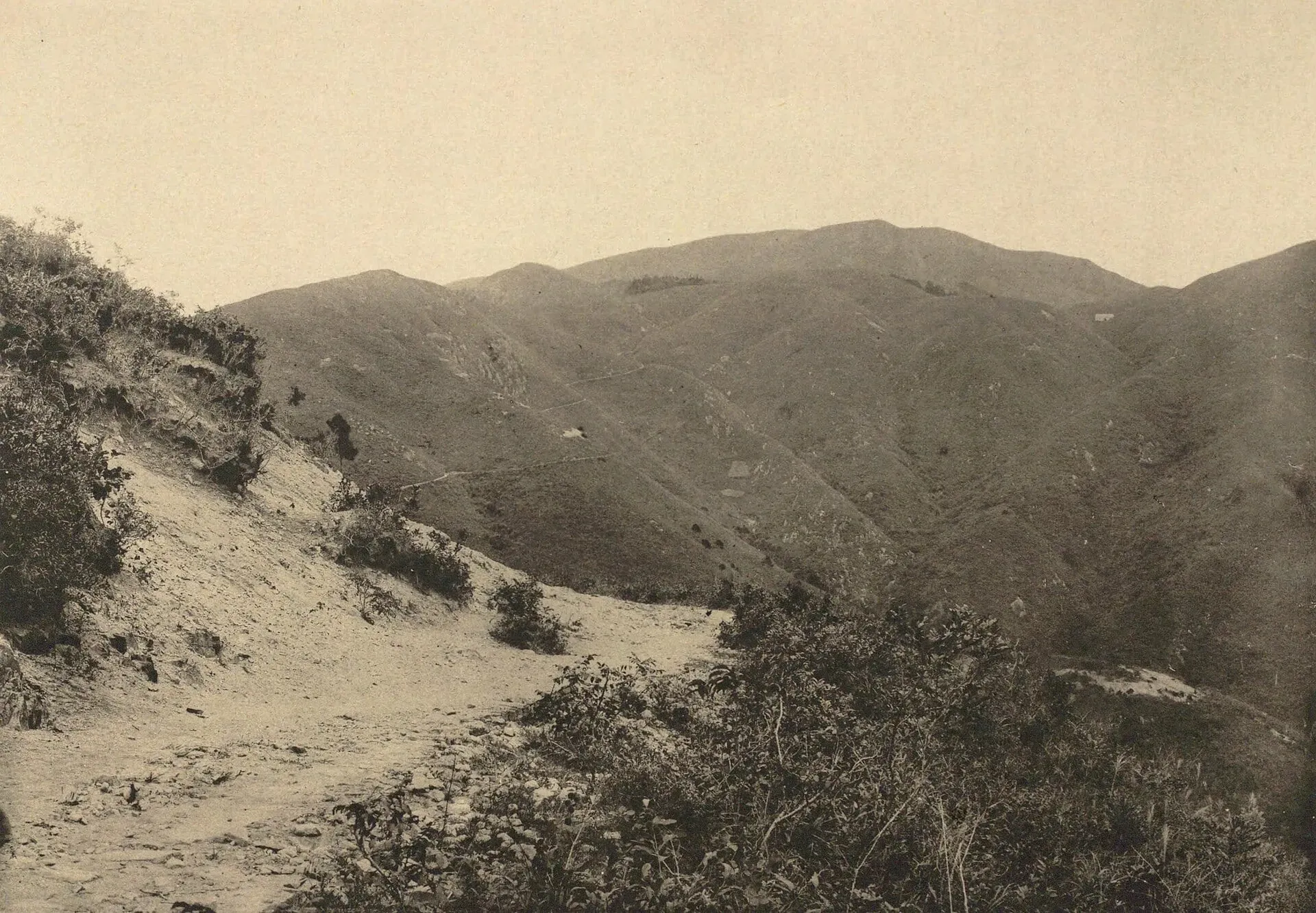
The next day, walking down from the Stone Bridge to Guoqing Temple, he crossed ridge after ridge without ever reaching level ground, and only then, he wrote, did he understand “how high Huading is — not far from heaven!”
The Stone Bridge falls: a bridge a foot wide
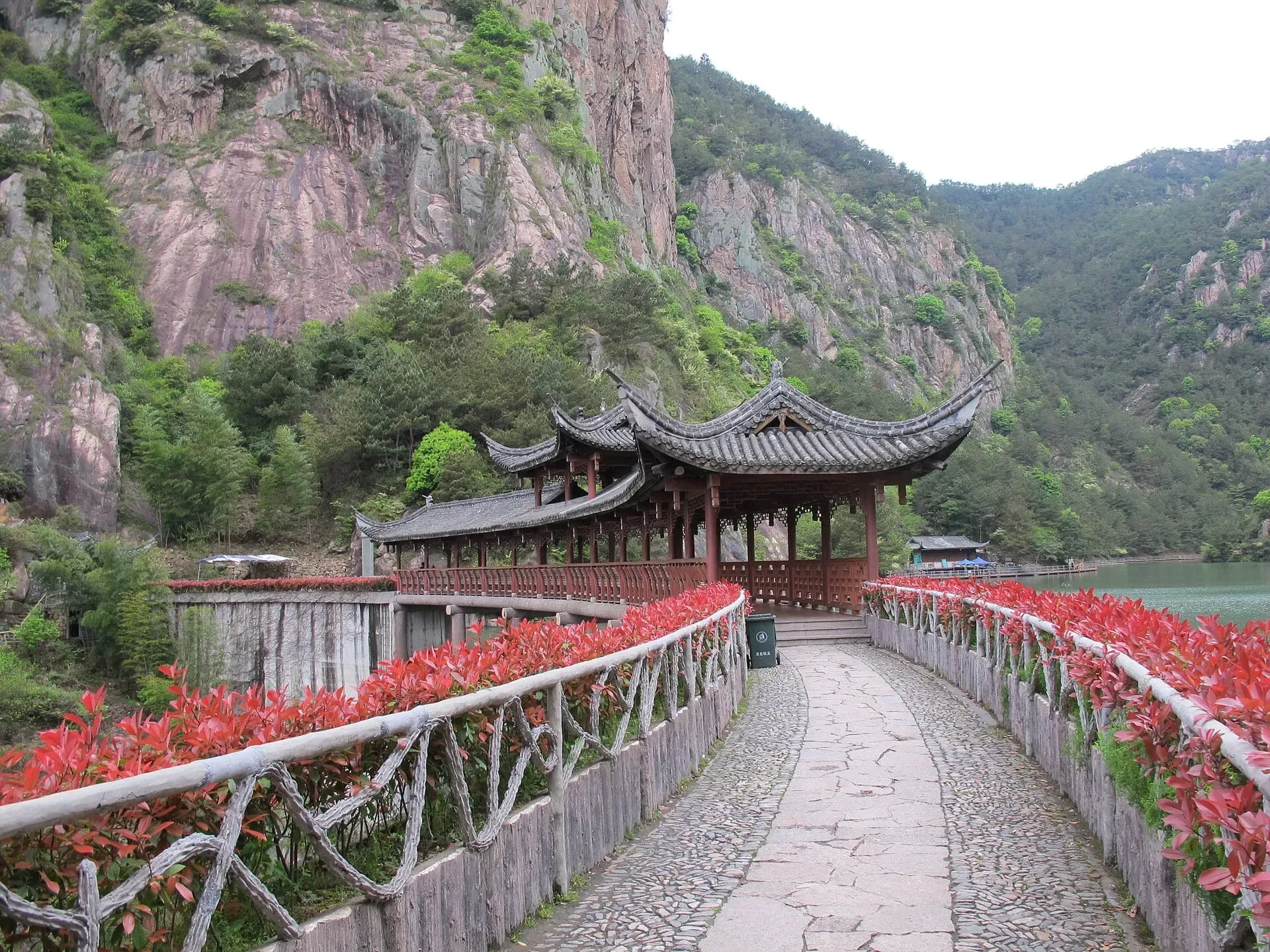
The Stone Bridge falls are in the hills about 14.5 km northeast of Tiantai town. Streams running down from Huading join and cut through the gap between two hills; across the top of the falls lies a natural stone bridge, and the water passes beneath it to drop more than 30 meters into a deep pool. The Song calligrapher Mi Fu carved “The Greatest Wonder” here, and in the late Qing Kang Youwei carved “Stone Bridge Falls.” This is the Stone Bridge that Meng Haoran set out to see.
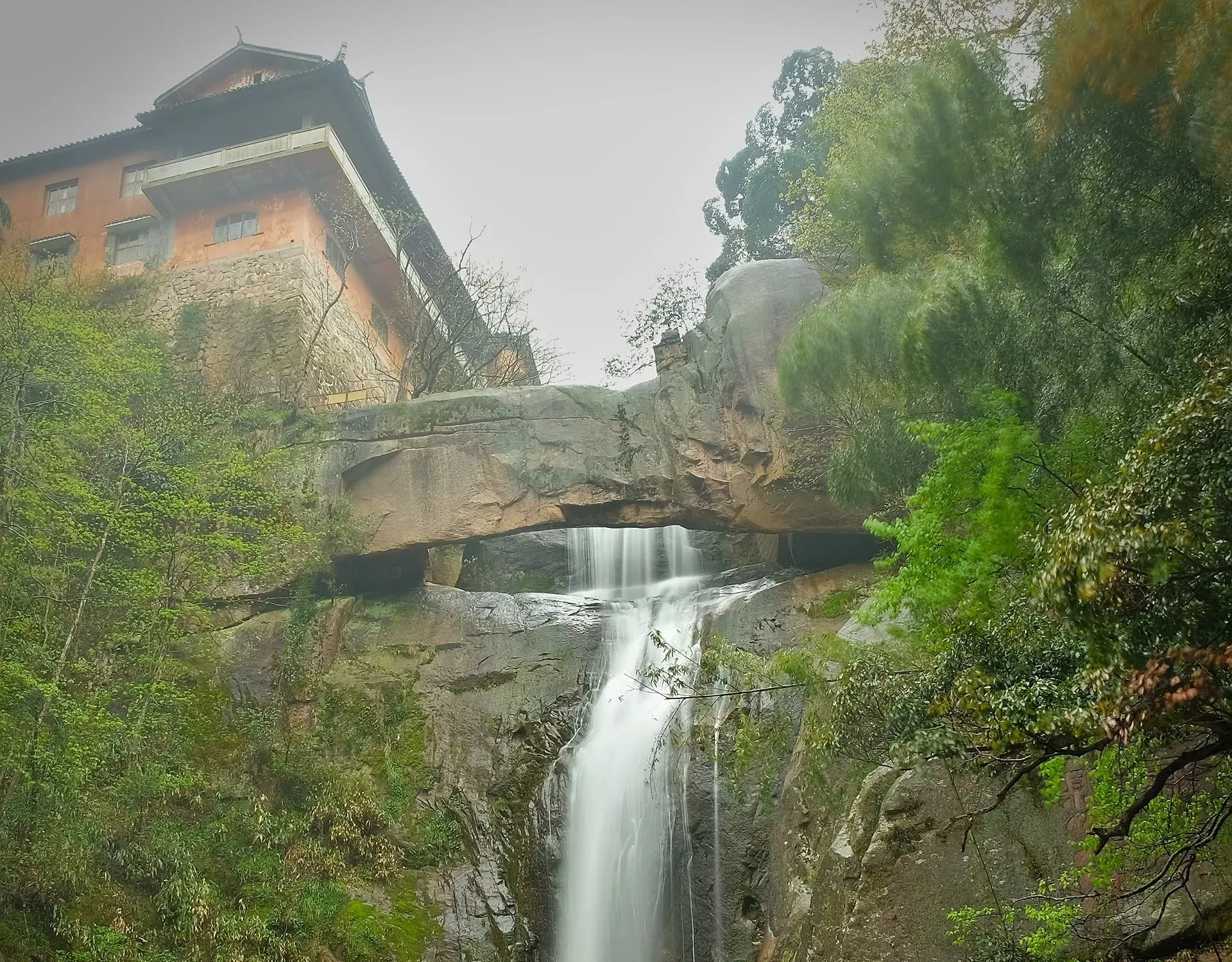
Xu arrived late in the afternoon and first went downstream to see the Broken Bridge and the Pearl Curtain falls. By the time he came back it was dark, and he stopped on the Xianfa Bridge “to watch the stone bridge lying like a rainbow and the falls spraying snow — I could hardly bear to go to bed.” The next morning, without stopping for breakfast, he walked out onto the stone bridge:
The bridge is a little over a foot wide and three zhang long, laid across the gap between two hills. Two falls come in from the left of the pavilion, join at the bridge and plunge together, thundering like a river bursting its banks, a hundred zhang and more. I walked out along the bridge and looked down into the deep pool; every hair on my body stood on end.At the far end a great boulder blocked the way, so he walked back. The Upper and Lower Fangguang temples he mentions in his diary stand above and below the falls.
Going up the mountain
The Stone Bridge is northeast of town: about 13 km and twenty minutes by car from Guoqing Temple, or about 22 km and half an hour from Tiantaishan station.
It is much colder on the mountain than in town — Xu found frost on Huading in late May — so bring a jacket in spring and autumn. Tickets, opening hours and transport up the mountain change, so check with the scenic area before you go.
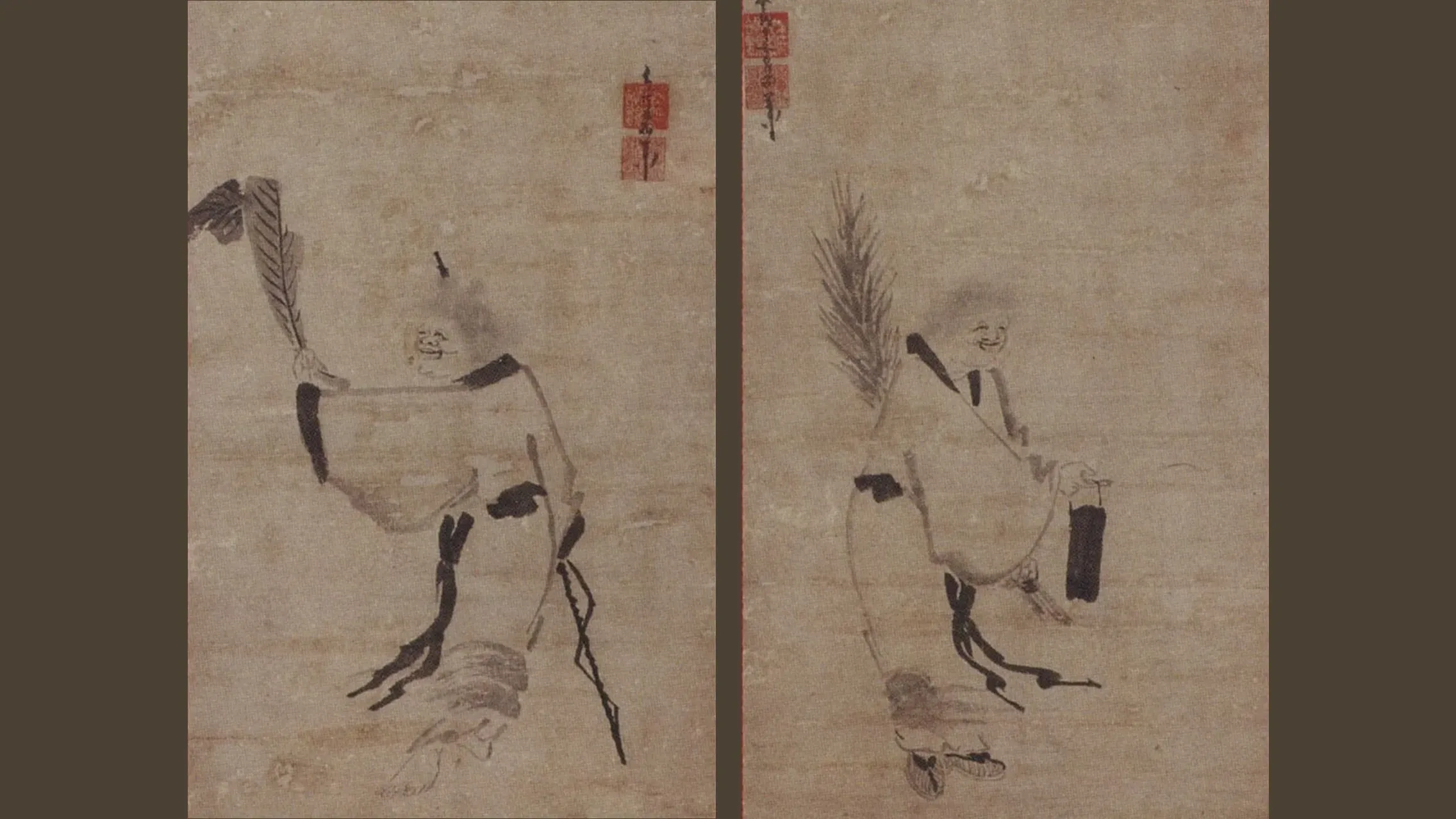
Guoqing Temple is at the foot of the mountain and fits into the same day — see Guoqing Temple. For the story of Hanshan and Shide, see Hanshan and Shide.
Questions & answers
Where is Mount Tiantai?
In Tiantai County, Taizhou, Zhejiang, north and northeast of the county town; its highest peak, Huading, is 1,098 meters. Tiantaishan station is about an hour by train from Hangzhou East — see Getting to Tiantai.
Where are the Stone Bridge falls, and how high are they?
In the hills about 14.5 km northeast of Tiantai town. The stream passes beneath a natural stone bridge and drops more than 30 meters into a deep pool. It is about twenty minutes’ drive from Guoqing Temple.
Why is China Tourism Day on May 19?
The first entry in Xu Xiake’s travel diaries, his Tiantai diary, is dated the last day of the third month of 1613 — May 19 in the Western calendar. In 2011 the State Council made that day China Tourism Day.
Did China Tourism Day start in Ninghai or Tiantai?
Both claim it. Ninghai, where Xu set out, proposed May 19 as early as 2000 and calls itself the day’s birthplace; Tiantai points out that the diary is about Mount Tiantai, which Xu actually entered on May 20, and calls itself the source. On the first China Tourism Day in 2011, the two shared the national celebrations.
How many times did Xu Xiake visit Mount Tiantai?
Three times — once in 1613 and twice in 1632. The diary of the first trip opens his collected travels; the diaries of the other two were combined as a second Tiantai diary.
Is the Tiantai Mountain Grand Waterfall the same as the Stone Bridge falls?
No. The Grand Waterfall is in the Qiongtai Xiangu scenic area. According to Hangzhou.com.cn in 2021, it is a chain of falls with a total drop of 325 meters, about 11 km by taxi from Tiantaishan station. The Stone Bridge falls are in the hills northeast of town, where a natural stone bridge spans the top of the waterfall — the one Xu Xiake walked across. See Tiantai Mountain Grand Waterfall.
Sources
- 车程是按 OpenStreetMap 路网估算的开车时间。徐霞客的话引自《徐霞客游记·游天台山日记》,孟浩然的诗出自《全唐诗》卷一百六十。英文为本站翻译。
- 徐霞客遊記/遊天台山日記 · 维基文库
- 中国旅游日发源地 徐霞客游记开篇地——天台山 · 中国台州网,2023 年 4 月 6 日
- 天台山:中国旅游日从浙江出发 · 人民政协网,2026 年 5 月 19 日
- 宁海:中国旅游日发祥地 · 中新网,2011 年 4 月 13 日
- 加A不加价 · 杭州日报(杭州网),2015 年 10 月 16 日
- 嵊州、新昌、天台通高铁啦!杭绍台铁路昨试运行 · 杭州网,2021 年 11 月 27 日
- 台州地区志 · 第四十四章 风景名胜 · 第一节 山岳名胜 · 台州史志网
- 天台山 · 维基百科
- 石梁飞瀑 · 维基百科
- 中国旅游日 · 维基百科
- 全唐诗 卷一百六十(孟浩然)· 维基文库