Xianju’s Eight Bowls and Street Snacks
Xianju’s Eight Bowls are its traditional banquet for guests, eight dishes each named for one of the Eight Immortals, though sources pair Immortals and dishes in two ways. On the street there are wheat cakes, shaobing, topped noodles and maci, and a thick soup on the fourteenth night of the new year.
Besides the yangmei of June, the food people in Xianju often name is the Eight Bowls (八大碗, ba da wan): the eight dishes a household sets before its guests, each named for one of the Eight Immortals of Chinese legend. Which Immortal goes with which dish is not settled — we found two lists, and they agree on only three dishes. Beyond the banquet, Xianju’s streets have wheat cakes, shaobing, topped noodles and maci, and on the fourteenth night of the new year it is the custom to eat a bowl of thick soup.
What the Eight Bowls are
The Shenxianju scenic area’s official website, in 2018, called the Eight Bowls the proper menu with which Xianju families entertained guests, served as an upper four and a lower four. The upper four go with wine and the lower four with rice, the food account Huang Xiaochu wrote on The Paper’s platform in 2021, and all eight are local country dishes. In the old days, according to a 2020 article by the Sohu account Tingchaoting, the bowls came out only for weddings, celebrations and family gatherings: a square table was laid, four-chi benches set around it, and guests seated by generation and rank before the bowls were served in turn.
It belongs to the New Year too. Writing in 2015 about New Year in rural Xianju, the Taizhou Evening News described the offering to the gods and ancestors on the afternoon of New Year’s Eve: a half-cooked pig’s head on the square table, and around it chicken, duck and the Eight Bowls. The Zhejiang government’s English website wrote in 2021 that the Eight Bowls, eight dishes of meat, fish, tofu and other things, are what visitors to Xianju most often eat. And in 2026, the county’s news account Xianju Release reported, the crew of Zhongguo zhi Lu, a documentary series made by China Media Group’s English-language global programs center with Chile’s national television, tasted them for an episode on Xianju.
We found no intangible heritage list, at any level, that includes the Eight Bowls. One of the eight, Xianju paoxiang, is on Zhejiang’s list of the hundred best rural snacks, newly announced when Taizhou Release, the city’s official news account, reported it in January 2021.
Two lists of the Immortals’ dishes
We found two ways of pairing the Immortals with the dishes. The first is in a 2020 round-up of Taizhou food on Zhejiang Online, credited to the provincial news account Zhejiang Release and Taizhou’s culture and tourism account, and in a 2021 article by the travel account Feekr: He Xiangu’s lotus seeds, Han Xiangzi’s sea cucumber, Cao Guojiu’s paoxiang, Han Zhongli’s turned-bowl pork, Iron-Crutch Li’s big fish, Lan Caihe’s beaten pork, Lü Dongbin’s tofu and Zhang Guolao’s pork skin (roupi pao in Feekr’s version).
The second uses short names — Caihe’s lotus seeds, Xiangzi’s sea cucumber, Zhongli’s turned-bowl pork, Guojiu’s paoxiang, Dongbin’s big fish, Tieguai’s beaten pork, Xiangu’s pork-skin dish — and ends with tofu, written “Guolao (国老) tofu” on the Shenxianju website and by Huang Xiaochu, and “Guolao (果老) tofu,” that is, Zhang Guolao’s, in a 2021 article by the Shangliu studio on The Paper’s platform, in a 2018 article by the Zongheng Zhejiang account, and by Xianju Release in 2026; Tingchaoting uses both. Caihe (采荷, “picking lotus”) sounds the same as the Caihe (采和) in Lan Caihe’s name; the full names in brackets in the table below are our reading. The Shangliu article, Tingchaoting and Xianju Release also divide these eight into an upper and a lower four, in the same way.
Only three pairings are the same in both: Han Xiangzi’s sea cucumber, Han Zhongli’s pork and Cao Guojiu’s paoxiang. The lotus seeds, the big fish, the beaten pork, the tofu and the pork skin each go to a different Immortal in each list. We found nothing that shows which list is older or which is right, so the table gives both.
What is in the bowls
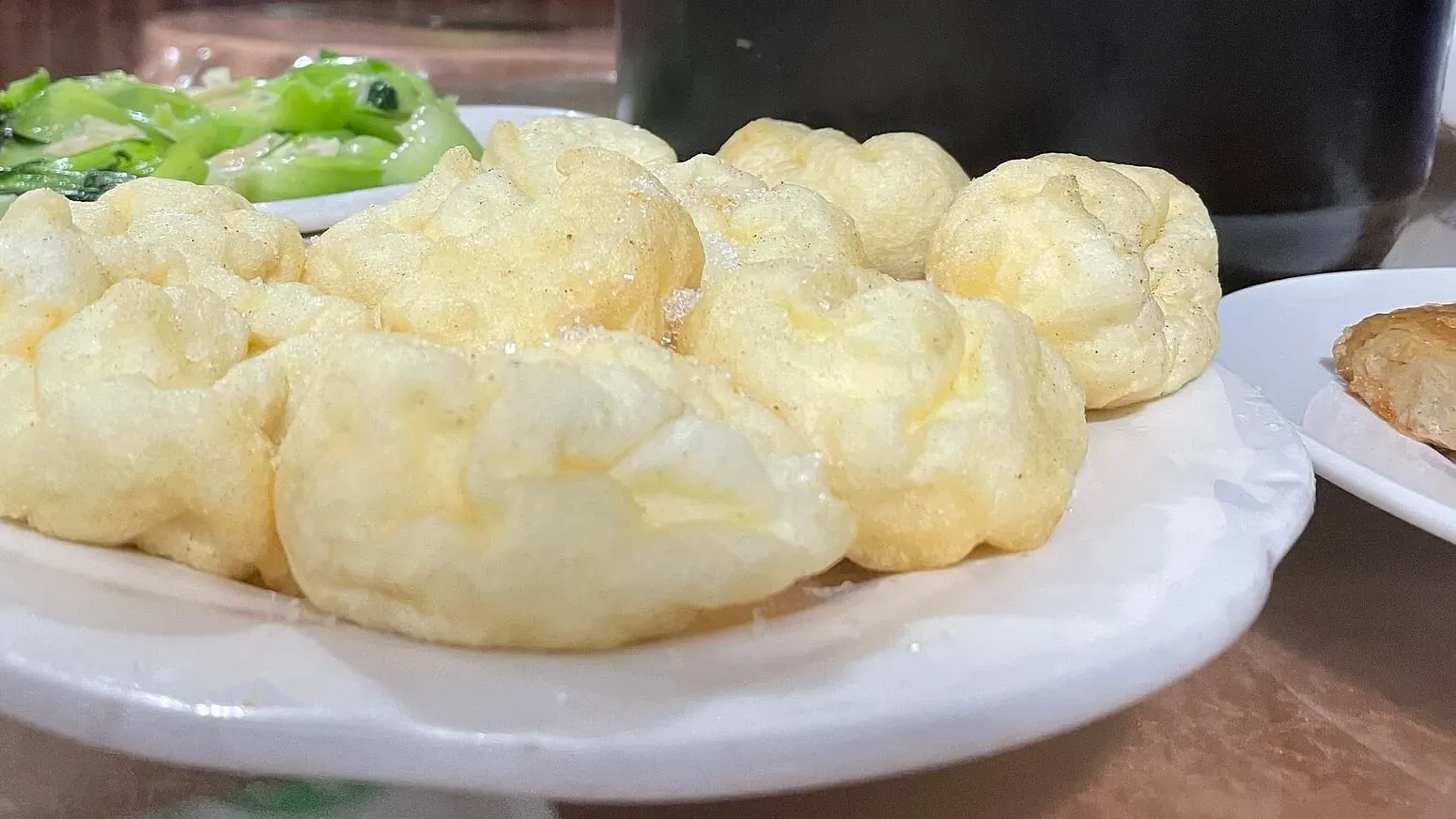
Paoxiang (泡鲞) is the dish the sources say most about. In the Xianju dialect, Taizhou Release explained in 2021, pao means to deep-fry — a fried dough stick is a “pao’d” dough stick — and xiang is the yellow croaker of the Taizhou coast, gutted, split and dried in the sun or over a fire. The Shenxianju website described the dish in 2018: good flour mixed with egg, salt, cooking wine and other seasonings into a batter, rested for two or three hours, then dropped into hot oil with bits of fish in it, coming out golden-red, shaped like a cream puff, light outside and tender within; too hot and it scorches, too cool and it will not come out smooth and round. Huang Xiaochu describes it as dough wrapped around dried salt fish and fried crisp outside, chewy inside. A Xianju saying, “Your family is doing paoxiang and fish maw,” means your family is holding a wedding or some other celebration.
The same website traces paoxiang at banquets over the years: in the lean years just after 1949, one full bowl on the table was respectable; then the puffs grew until they needed two bowls; by the 1980s they came in the tub used for rice at banquets; and by the mid-1990s a feast ran to twenty-odd dishes rather than eight, and paoxiang shrank and lost its starring role. At New Year in rural Xianju, the Taizhou Evening News wrote in 2015, paoxiang and fried tofu puffs are made the night before New Year’s Eve, coming out of the oil by the basketful.
Qiaorou (敲肉), or qiaoqiao rou, “beaten pork,” is pork beaten flat: “meat really beaten flat and loose,” in Huang Xiaochu’s words. In a 2025 Zhejiang Online report a stallholder makes it in moments: heat, a quick stir-fry, water, then the slices of meat, and a steaming bowl is ready.
Fanwan rou (翻碗肉) means, word for word, “turned-bowl pork”; Huang Xiaochu says it is simply big, rich pieces of red-braised pork. The bowl called “lotus seeds” is given on the Shenxianju website as lotus seeds or white hyacinth beans, and Huang Xiaochu calls it a sweet dish of white hyacinth beans. For the sea cucumber, the website says, rou shen may be used instead; we found nothing that says what that is. For the big fish, the tofu and the pork-skin dish (roupi pao), we found no source that describes their ingredients or how they are cooked.
An older set of eight
The Shenxianju website’s 2018 article gives the traditional Eight Bowls as a different set. The upper four: lotus seeds (or white hyacinth beans), sea cucumber (or rou shen), fish maw (or beaten pork) and turned-bowl pork. The lower four: bamboo shoots (or water bamboo, or dried shoots), stir-fried pork (strips of tofu with shredded pork, or shiitake), mutton (or shredded cuttlefish), and a hotchpotch also called changshi — pork tripe, intestines and the like with tofu, cut into irregular pieces. Paoxiang and the pork-skin dish, the article says, both Xianju specialities, stood outside the eight, and once all the dishes were served, greens were eaten to clear the palate. At the end of the legend it tells, it adds that wedding feasts took up the Immortals’ eight signature dishes from then on, and that “the names of the Eight Bowls were changed” to theirs.
We found this account only on the scenic area’s website, which does not say when the names were changed, so it is best read as the scenic area’s version. And another page on the same website says that the traditional Eight Bowls had paoxiang as the main dish, served first; Taizhou Release in 2021 and the Xianju County Women’s Federation in 2020 repeat the same passage, with that sentence word for word. Comparing the lists: in the split given by the Shangliu article, Tingchaoting and Xianju Release, the Immortals’ upper four are the same four dishes as the older upper four (taking beaten pork for the third), while the lower four are entirely different.
A legend set in Potan
Why the bowls carry the Immortals’ names is told in legend, in at least two versions. In the Shenxianju website’s 2018 telling, the Eight Immortals, on their way back to Shenxianju after crossing the sea and battling the Dragon King, saw music and lanterns in the neighboring village of Potan and came down on their clouds to join in: the richest man in the village, a squire named Wu, was marrying off his daughter. On a whim, each Immortal cooked one fine dish in celebration. Soon the people of Xianju were calling their square dining tables Eight Immortals tables, and serving the Immortals’ eight dishes at every wedding, under the respectful name of the Eight Bowls. The Shangliu article of 2021 and Zongheng Zhejiang in 2018 tell the same Potan wedding story.
Tingchaoting told another version in 2020: the Immortals, having angered the Dragon King of the Eastern Sea and fought him long without winning, were tired and hungry when they drifted over Xianju, smelled something good, and saw a family of eight around a square table, drinking and playing finger-guessing games. They came down, the hospitable family invited them to sit and eat, and each Immortal cooked a fine dish in celebration; ever since, people in Xianju have called the square table the Eight Immortals table, seating eight and serving eight dishes. Huang Xiaochu tells this version too in 2021. Whether it was in Potan that the Immortals caught the smell, Tingchaoting admits, “we cannot know.”
The table and the order of dishes
The Eight Bowls call for an Eight Immortals table and four-chi benches, though the sources size the table differently. The Shenxianju website says the table is square, three chi six cun on each side by the carpenter’s Luban ruler, which it gives as one meter, and that the four benches are four chi long, two people to a side, eight in all. The Shangliu article gives the table as three chi on each side and the benches as four chi, with two to a bench, “no more, no fewer” than eight. The website adds that a full banquet of the Eight Bowls runs to sixteen to twenty-four dishes, known as “eight large and eight fine.”
Alongside the Eight Bowls, according to Tingchaoting in 2020, there is usually the local three-yellow chicken; before the meal come a “prosperity tea” and topped noodles, and wheat cakes are the staple at the end.
Wheat cakes, shaobing and topped noodles
The Eight Bowls are a banquet; on the street, people eat snacks. Shaobing, wheat cakes and beaten pork are Xianju’s calling card, Zhejiang Online reported in 2025, adding that in the Yangtze River Delta alone there are about 10,000 Xianju snack shops, employing more than 30,000 people, with a turnover of about 10 billion yuan a year.
Maibing (麦饼), the wheat cake, is everyday food. The Xianju County Women’s Federation, citing the county gazetteer in 2025, wrote that a Xianju household keeping a guest for a meal would serve topped noodles, wheat cakes or maize cakes; the wheat cake was filled with salt pork and dried greens, rolled out as wide as a bamboo rain hat, fried golden on both sides and carried out on a wooden tray. Fillings today include pickled greens with pork, tofu with pork, dried radish shreds and shredded pumpkin, and one wheat cake with a bowl of plain rice porridge makes breakfast. They come sweet or savory, Feekr wrote in 2021, the sweet ones with brown sugar and the savory ones with whatever vegetables are in season, fried on a flat griddle. Neighboring Tiantai has its meatball wheat cake; see Jiaobingtong.
In Xianju, the 2020 Zhejiang Online round-up said, shaobing, the baked filled bun, is the “unchallenged king” of street food, and an old barrel oven breathing steam and an old baker with scarred hands are all it takes; the filling must be well-chosen pork shoulder, according to Zongheng Zhejiang in 2018, and fresh from the oven, the Shangliu article says, it smells of pork, scallion and dried greens. Xianju shaobing has traveled: according to Chao News in 2023, Zhu Shougen of Xiaye village in Danzhu township opened his first Agen Shaobing shop in Xiasha, Hangzhou, in 2013, and by the time of the report the brand had more than 500 shops.
Jiaotou mian (浇头面), topped noodles, are noodles for guests. In the old days, the Shenxianju website wrote in 2018, when relatives or visitors arrived the host served a bowl of topped noodles, and a mother-in-law receiving her son-in-law cooked him a generous bowl with two eggs or a big piece of meat hidden at the bottom. The topping — strips of egg, bamboo shoot and pork, day-lily buds, tofu skin, fried tofu puffs, shredded carrot — is stir-fried, then braised briefly and ladled with its juices over noodles of rice or wheat, as each person prefers. The Zhejiang government’s English website, in 2021, also named topped noodles as something not to miss in Xianju.
Xianju’s chickens come up too: the county has raised them for more than 300 years, the 2020 Zhejiang Online round-up said, and the Shangliu article says they are left to range on the hillsides. For how Xianju chickens fit into the yangmei orchards, see Xianju Yangmei.
Maci, and the soup of the fourteenth night
Maci (麻糍) is made of glutinous rice. Xianju families must have it for New Year, the Shangliu article says: the rice is worked together with red bean paste or a vegetable filling and fried or toasted, crisp outside, soft and chewy within without sticking to the teeth, and pounding maci together at festival time is part of the fun. In Xianju it takes two people to pound, Zongheng Zhejiang wrote in 2018, and the fillings run to bamboo shoots, carrot, pickled greens and chili, inside a crisp fried shell. In the countryside, the Taizhou Evening News wrote in 2015, New Year begins in the twelfth month with making rice cakes and pounding maci — heavy work, and men’s work.
This site’s Xianju page also lists two kinds of sticky rice cake among the street snacks; its Chinese text names them as wufan maci, made black with leaf juice, and egg maci. We have not yet found a dated source that writes about either one in Xianju itself; those we found are about other parts of Taizhou, or about Taizhou as a whole. The 2020 Zhejiang Online round-up puts wufan maci under Tiantai and egg maci under Wenling. In Chaoji village, Beiyang Town, Huangyan, every household makes wufan maci on the eighth day of the fourth lunar month, Chao News reported in 2023 — the day, legend says, a heavenly ox came down to earth — and Zhejiang Online in 2022 quoted a Linhai folk verse for that day, when the plough oxen used to rest and were fed wufan maci as a treat. We found nothing on whether Xianju keeps the same day.
On the fourteenth night of the first month, Xianju eats soup. The night before the Lantern Festival, the Shangliu article says, everyone in Xianju has fourteenth-night soup, usually meat and vegetables stirred with sweet-potato starch into a thick soup, so that the new year will be “geng” better still — a pun on geng (羹), soup, and geng (更), even more. According to a man from the county town quoted by Zhejiang Online in 2025, the eastern part of the county, around Xiage, keeps the Lantern Festival on the fourteenth and the west, around Hengxi, on the fifteenth, but east and west alike eat soup on the fourteenth night; on the fifteenth the west also eats a salty-sour porridge of rice with taro, sweet potato, pork bones, fried tofu puffs, red beans and paoxiang. The same report says that in Linhai the fourteenth-night soup is called zaogeng; see Zaogeng and Danqing Yangwei. At a New Year fair in Xianju’s Nanfeng subdistrict in 2024, the soup was among the traditional Xianju foods on the stalls, with youyuan, paoxiang and fansu (油圆、翻酥).
The Shangliu article also mentions mantou gan, a crisp snack of brown-sugar steamed buns cut into thick slices and slowly dried.
Eating them in Xianju
Book the Eight Bowls ahead. Even today, Tingchaoting wrote in 2020, you cannot have them on the spot: you book ahead so the restaurant can get the ingredients ready, because the beaten pork and the lotus seeds have to be prepared and soaked in advance. The article mentioned a restaurant called Xianju Eight Bowls by the car park at Potan Old Town. When we checked Trip.com on November 18, 2026, a restaurant listed as 仙居八大碗(白塔神仙居店), the “Baita Shenxianju” branch, with an address at Shenxianju, was marked “temporarily closed, opening hours to be confirmed.” Its name and address place it at Shenxianju, not by the Potan car park; how the two are related we do not know, and we found no restaurant open in 2026 that publishes an Eight Bowls menu and price. By tradition a table seats eight; we found nothing on whether restaurants serve smaller parties or what a table costs. Ask locally before you go.
Snacks are easier, though Zhejiang Online reported in 2025 that most of Xianju’s shaobing, wheat-cake and beaten-pork shops are in the county town, out of visitors’ way. The same report described a snack park in Xiacui Shangzhai village, in Baita, the town that is home to Shenxianju: it opened for a trial run at the end of March 2025, with more than 40 stalls on the ground floor making over 100 kinds of snacks, seats for five or six hundred, and beaten pork among them. That was the picture in 2025, so check before you go.
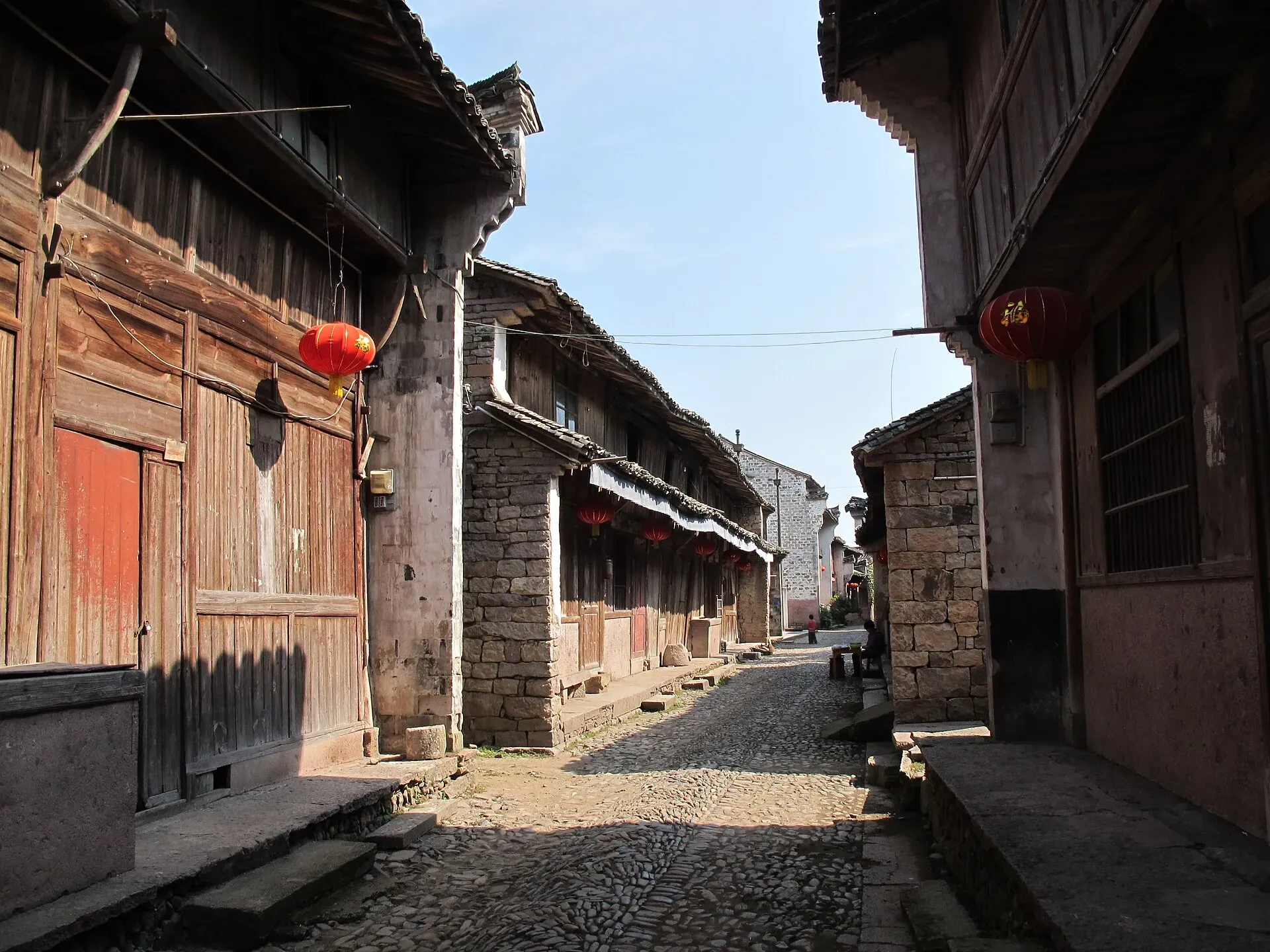
For Potan’s old street and its lanterns, see Potan Old Town and the Boneless Lanterns; for more to see in the county, Places to Visit; and for the journey, Getting to Xianju.
Questions & answers
What are Xianju’s Eight Bowls?
Xianju’s traditional banquet for guests — eight dishes in an upper and a lower four, each named for one of the Eight Immortals. It was laid out for weddings and family gatherings, eight people to a square table.
Which eight dishes are they?
Usually lotus seeds, sea cucumber, beaten pork, turned-bowl pork, a big fish, a pork-skin dish, paoxiang and tofu. Sources pair them with the Immortals differently — Han Xiangzi’s sea cucumber, Han Zhongli’s pork and Cao Guojiu’s paoxiang are the same in both lists, the other five are not — and the Shenxianju scenic area’s website lists a different set of eight, adding, in the legend it tells, that the names of the Eight Bowls were changed to the Immortals’.
What is paoxiang?
A fried dish. In the Xianju dialect pao means to deep-fry, and xiang is yellow croaker split and dried; paoxiang is a batter of egg and flour, with bits of fish in it, fried into golden puffs. In January 2021 Taizhou Release reported it among Zhejiang’s hundred best rural snacks.
What snacks is Xianju known for?
Wheat cakes, shaobing, topped noodles and maci are the ones most often named, with a thick soup on the fourteenth night of the new year. Shaobing, wheat cakes and beaten pork are Xianju’s calling card, Zhejiang Online reported in 2025.
Where can I eat the Eight Bowls?
We found no restaurant open in 2026 that publishes an Eight Bowls menu and price. A 2020 article advised booking ahead, since the beaten pork and the lotus seeds need preparing and soaking in advance. Ask locally before you go.
Sources
- 英文为本站翻译。Trip.com 的餐厅页面是 2026 年 11 月 18 日查阅的。
- 仙居八大碗 · 神仙居景区官方网站(浙江神仙居旅游集团有限公司主办),2018 年 1 月 23 日
- 仙居泡响(泡鲞)· 神仙居景区官方网站,2018 年 1 月 23 日
- 仙居浇头面 · 神仙居景区官方网站,2018 年 1 月 23 日
- 台州不得不推荐的美食,这个假期你尝到了吗?· 浙江在线台州频道(来源:浙江发布、台州文旅),2020 年 10 月 4 日
- 何以仙居?央视《中国之路》给你答案!仙居这次火到拉丁美洲 · 浙江在线台州频道(来源:仙居发布),2026 年 2 月 27 日
- 仙居不仅私藏了美景 这些藏在街头的美食也独具仙气 · 浙江在线台州频道(来源:纵横浙江公众号),2018 年 10 月 21 日
- 台州人春节习俗:仙居人的年味 · 浙江在线台州频道(台州晚报,周天勇),2015 年 2 月 14 日
- 5A级景区镇建起小吃产业园 仙居小吃要做大文章 · 浙江在线台州频道,2025 年 5 月 8 日
- 走南闯北的仙居人闯出了小吃一片天 · 浙江在线台州频道(来源:潮新闻),2023 年 4 月 28 日
- 元宵节限定!台州的羹站“C位” · 浙江在线台州频道,2025 年 2 月 12 日
- 蕃莳粉、土蜂蜜、土鸡蛋……仙居这个街道举办首届年货节 · 浙江在线台州频道,2024 年 2 月 7 日
- 这糯唧唧的味道是每一个台州人忘不掉的美食记忆 · 浙江在线台州频道(来源:潮新闻),2023 年 5 月 29 日
- 台州人文地理|这里的美食不止“糯叽叽” · 浙江在线台州频道,2022 年 11 月 5 日
- 台州12种小吃成为“浙江百强”,都是你儿时的味道!· 台州发布(澎湃号·政务),2021 年 1 月 5 日
- 妈妈的味道 | 仙居麦饼:以面为纸,烙写乡愁之味 · 仙居县妇女联合会(澎湃号·政务),2025 年 3 月 12 日
- 妈妈的味道·来尝一尝仙居的泡鲞和炸油酥吧!· 仙居县妇女联合会(澎湃号·政务),2020 年 6 月 4 日
- 舌尖上的美食浙江版,没它我不服 · 澎湃号·湃客(上流工作室),2021 年 9 月 13 日
- 《长津湖》的取景地,还是座隐藏的美食天堂 · 澎湃号·湃客(黄小厨),2021 年 10 月 9 日
- 仙居 | 是杨梅第一县,也是神仙玩水地 · 澎湃号·湃客(Feekr旅行),2021 年 10 月 2 日
- “仙味”传说丨寻味仙居“八大碗” · 搜狐号“听潮亭”,2020 年 11 月 2 日
- Food paradises along Jinhua-Taizhou railway · Zhejiang government English site (ezhejiang.gov.cn, presented by China Daily), July 6, 2021
- 仙居八大碗(白塔神仙居店) · Trip.com restaurant listing (read November 18, 2026)