Zheng Qian and the Tang Poets of Taizhou
In 757 Du Fu’s old friend Zheng Qian was banished to Taizhou, and two years later he died in Linhai. He taught here and is remembered as the father of learning in Taizhou; missing him, Du Fu wrote “Taizhou is wide, its sea dark and deep.” Luo Binwang of the early Tang served as assistant magistrate of Linhai, and the poet Ren Fan left behind the story of “half the river” on Jinzi Hill.
Taizhou lay thousands of li from Chang’an — to the Tang mind, the ends of the earth. Yet it was an old painter banished here whom Linhai has remembered for more than a thousand years, and whom Du Fu missed so much that he wrote, “Taizhou is wide, its sea dark and deep.” This is his story, and that of a few other Tang poets who passed through Linhai.
Zheng Qian’s three perfections
Zheng Qian (691–759), from Xingze near today’s Zhengzhou, excelled at poetry, calligraphy and painting, and knew both Li Bai and Du Fu. As a young man, the story goes, he lived at the Ci’en Temple in Chang’an and, too poor to buy paper, practiced calligraphy on the temple’s persimmon leaves until he had used up several roomfuls. Emperor Xuanzong admired him, wrote “Zheng Qian’s three perfections” on his painting of Cangzhou and made him an erudite of the Guangwen academy — hence the name Zheng Guangwen. He stayed poor in office; when guests came, Du Fu said, they sat in the cold without so much as a felt rug.
Banished to Taizhou
When the An Lushan Rebellion broke out, Zheng Qian was carried off by the rebels to Luoyang, where An Lushan made him a vice-director of waterways. He pleaded illness and never took up the post, and secretly sent word of his loyalty to Emperor Suzong. Even so, once the rebellion was put down he was convicted along with Wang Wei and others, and in 757 he was banished to Taizhou as an administrator of households.
Du Fu could not get there in time to see him off, and wrote a poem whose title says as much — “Seeing Off Zheng Qian, Banished to Taizhou; Grieving that He Fell into Rebel Hands in His Old Age, I Missed Our Farewell, and Put My Feelings into a Poem”:
Master Zheng, useless as an old tree, your hair turned to silk,
who, in your cups, would call yourself an old painter —
heartbroken on the day of your harsh sentence, ten thousand li away,
near death in your old age, just as the dynasty revives.
In your haste you have already set out on the long road;
by mischance I came too late to see you off.
This, I fear, is our last farewell, sir;
we will keep our friendship at the Nine Springs below.“This, I fear, is our last farewell” came true. On October 15, 759, Zheng Qian died in his official quarters in Taizhou, and the two never met again.
The father of learning in Taizhou
Zheng Qian spent only two years in Taizhou, but he opened a school and taught. Wikipedia notes that after him the people of Linhai “valued farming and study, education flourished and famous men came in numbers”: over the centuries Linhai produced 3 top scholars in the imperial exams and 357 jinshi graduates, 217 of them in the Song alone. Linhai remembers him as the father of learning in Taizhou.
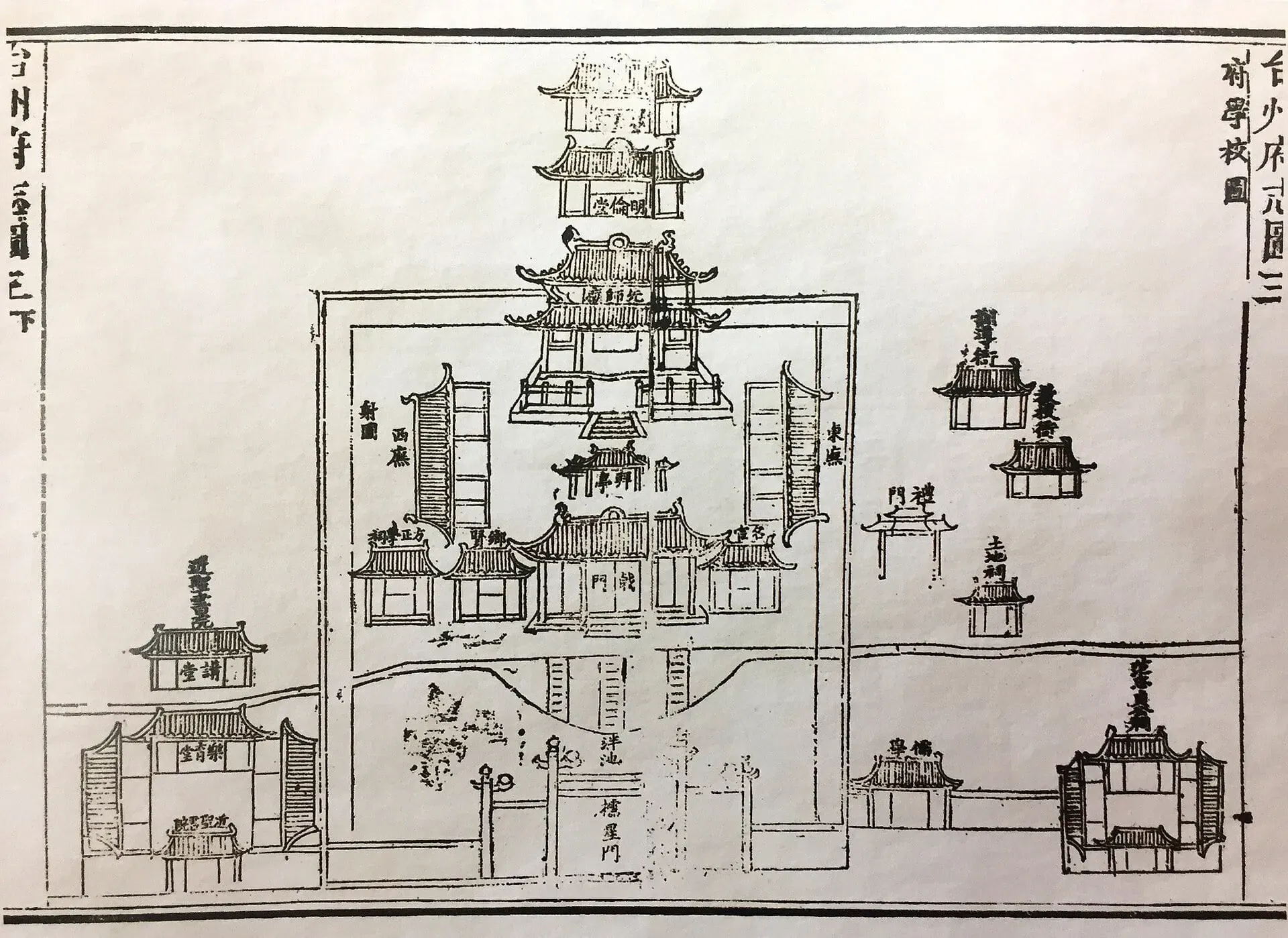
In 764 the people of Taizhou built a shrine to Zheng Guangwen in Linhai, at what is now the north end of Ziyang Street, and the town’s Guangwen Road and Zheng Qian Street are named after him. The Qing encyclopedia Gujin Tushu Jicheng records that Hucao Lane, east of the prefectural offices, is where he lived as an administrator. In 2002 Linhai put up a set of bronze reliefs on Chonghe Gate Square showing four people connected with the town: Luo Binwang, Zheng Qian, Wang Shixing and Qi Jiguang.
Du Fu’s longing
After Zheng Qian left, Du Fu kept thinking of him. In “For Zheng Qian,” he imagined the faraway place where his friend now lived:
Taizhou is wide, its sea dark and deep;
clouds and water forever join the green islands.
After the turmoil, two old friends shed parting tears;
in late spring, the exile drifts like duckweed.And in “Thinking of Zheng Qian in Taizhou” he wrote: “Tiantai lies beyond three rivers, where wind and waves rage day and night. Even if Master Zheng could come home, old and ill, he would not know the way.” In Du Fu’s imagination Taizhou was a wild land where “mountain ghosts hop on one leg and vipers are as long as trees,” and he feared his friend would be too old and sick to find his way back even if he were allowed to.
Luo of Linhai
More than seventy years before Zheng Qian, the early Tang poet Luo Binwang also held office in Linhai. One of the Four Paragons of the Early Tang, he is said to have written his famous “Ode to the Goose” at the age of seven. Falsely accused and jailed, he wrote “Ode to the Cicada in Prison”; on his release he was made assistant magistrate of Linhai, which is why later readers called him Luo of Linhai. He also wrote a poem titled “Long a Guest in Linhai.” Later he drafted the proclamation for Xu Jingye’s uprising against Empress Wu, and after its defeat he vanished from the record.
Ren Fan and “half the river”
Jinzi Hill has its own story about revising a poem. According to Xin Wenfang’s Biographies of Tang Talents, from the Yuan dynasty, the poet Ren Fan, who failed the imperial exams again and again, went to Jinzi Peak in Taizhou and wrote a poem on a temple wall:
On the summit, the new autumn brings a cool night;
cranes stir the pines, and the dew drips on my clothes.
The moon on the front peak lights the whole river;
a monk in the green haze opens his bamboo hut.A hundred li down the road, the more he thought about it, the more he felt “half the river” was better than “the whole river.” He hurried back to change it — and found that someone had already done so. The Ming collection Yaoshantang Waiji adds that when Ren Fan saw it he sighed, “Taizhou has people of talent.”
Gu Kuang’s home in Linhai
The mid-Tang poet Gu Kuang, courtesy name Bu Weng, also lived in Linhai and wrote three poems about his home there. One describes the house:
My home is by the temple between the twin peaks;
an autumn chime rings out, a lone wisp of smoke rises.
The hills run to the far shore, where the last birds have flown;
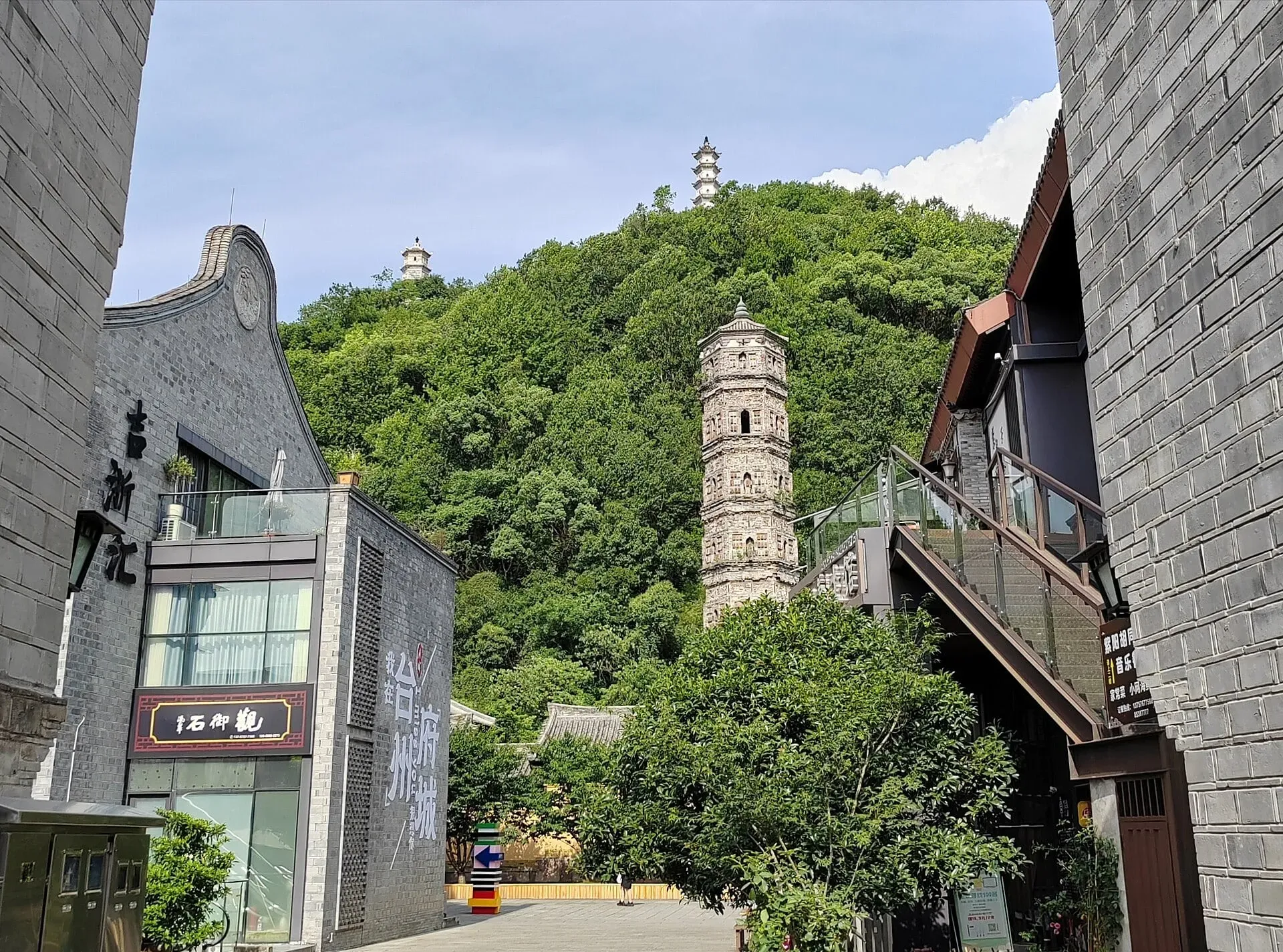
the moon climbs over the green woods, and I am not yet asleep.Another says: “It is not far from here to Linxi; from my tower I can see the red walls of Chicheng. Who knows, among those folded peaks and layered clouds, who else is crossing the Stone Bridge?” Chicheng and the Stone Bridge are both on Mount Tiantai to the north — see Mount Tiantai. The Bu Weng Pavilion, newly built on Jin Hill, honors Gu Kuang.
On the Tang Poetry Road, Linhai is one stop south of Tiantai — see the Tang Poetry Road.
Questions & answers
Who was Zheng Qian?
A Tang dynasty poet, painter and calligrapher (691–759) from Xingze near Zhengzhou, who knew both Li Bai and Du Fu. Emperor Xuanzong wrote “Zheng Qian’s three perfections” on one of his paintings and made him an erudite of the Guangwen academy, hence the name Zheng Guangwen. He was banished to Taizhou in 757 and died there two years later.
Why was Zheng Qian banished to Taizhou?
During the An Lushan Rebellion he was carried off to Luoyang by the rebels and given a post, which he avoided by pleading illness while secretly writing to Emperor Suzong. Even so, when the rebellion was put down he was convicted, and in 757 he was sent to Taizhou as a minor official.
Who wrote “Taizhou is wide, its sea dark and deep”?
Du Fu. It is the first line of a poem he wrote missing his old friend Zheng Qian, banished to Taizhou; it is in the Complete Tang Poems, juan 225.
Why is Luo Binwang called Luo of Linhai?
Luo Binwang, one of the Four Paragons of the Early Tang, was appointed assistant magistrate of Linhai after a spell in prison, so later readers called him Luo of Linhai. He also wrote a poem titled “Long a Guest in Linhai.”
What is the story of “half the river”?
According to the Yuan dynasty Biographies of Tang Talents, the poet Ren Fan wrote a poem on a temple wall on Jinzi Peak with the line “the moon on the front peak lights the whole river.” A hundred li down the road he decided “half the river” was better, and hurried back — to find that someone had already changed it.
Sources
- 杜甫的诗出自《全唐诗》卷二百二十五,《有怀台州郑十八司户》引自《方舆胜览》卷八和《隐居通议》卷七;任翻的故事出自《唐才子传》卷七和《尧山堂外纪》卷三十七;顾况诗出自《全唐诗》卷二百六十七。英文为本站翻译。
- 全唐詩/卷225(杜甫)· 维基文库
- 方輿勝覽 (四庫全書本)/卷08 · 维基文库
- 隱居通議 (四庫全書本)/卷07 · 维基文库
- 唐才子傳/卷7 · 维基文库
- 堯山堂外紀/卷037 · 维基文库
- 臨海所居 · 维基文库
- 久客臨海有懷 · 维基文库
- 欽定古今圖書集成/方輿彙編/職方典/第1001卷 · 维基文库
- 鄭虔 · 维基百科
- 临海市 · 维基百科
- 骆宾王 · 维基百科
- 任蕃 · 维基百科
- 临海(上)· 维舟(澎湃号),2020 年 7 月 16 日