The Butterfly Lovers and Yue Opera
One of China’s four great folk legends. Zhu Yingtai dresses as a man to go to school, loves her classmate Liang Shanbo and cannot marry him; in death they become butterflies. Six places claim the story, but the version most people know is the Yue opera’s, and Yue opera comes from Shengzhou.
The Butterfly Lovers, or Liang Zhu (梁祝), is the story of Liang Shanbo and Zhu Yingtai, one of China’s four great folk legends: Zhu Yingtai dresses as a man to go to school, falls in love with her classmate Liang Shanbo and cannot marry him, and in the best-known telling the two become a pair of butterflies after death. The story belongs to no single place — Ningbo, Shangyu, Hangzhou, Yixing, Jining and Runan all claim a share of it — but of all the plays about the lovers, a 2024 article on Guangming Online notes, the Yue opera’s is the best known, and Yue opera comes from Shengzhou.
This guide covers the story as the Yue opera tells it, what the oldest records actually say, how different places lay claim to it, and how the opera, the 1954 film and the 1959 violin concerto carried it across China and abroad. For the history of Yue opera itself, see The Birthplace of Yue Opera.
The story, scene by scene
In the Yue opera, the names of the scenes add up to a summary of the plot. Here it is as the opera tells it; the scene names follow an essay by the Shanghai Yue Opera House actress Li Xudan in Xinmin Weekly in 2023, He Zhanhao’s recollections and a 2017 report by The Paper, and the plot follows the Chinese and English Wikipedia.
- Sworn brothers at the grass bridge: Zhu Yingtai, daughter of the Zhu family of Shangyu, talks her father into letting her study in Hangzhou disguised as a man. On the way she meets Liang Shanbo, a scholar from Kuaiji (today’s Shaoxing), and they swear brotherhood at a grass bridge.
- Three years at school: they study side by side for three years, and Liang never notices that his friend is a woman.
- Seeing her off for eighteen li: a letter calls Zhu home. Before she leaves she tells the headmaster’s wife the truth and asks her to give Liang a jade fan pendant, in effect arranging her own match. Liang walks her eighteen li; on the way she hints at who she is with mandarin ducks and other sights, and he misses every hint, so she tells him she has a sister at home whom he may marry.
- Meeting in the tower: when Liang reaches the Zhu house, he learns that the “sister” is Yingtai herself, and that her family has promised her to Ma Wencai. Face to face in the tower, they vow to be together in life and death.
- Liang’s deathbed: Liang goes home, falls ill and dies.
- Mourning at the grave, becoming butterflies: on Zhu’s wedding day a gale stops the bridal procession at Liang’s grave. She steps down to mourn him, the grave splits open, she throws herself in, and a pair of butterflies flies out, never to part again.
In her essay, Li Xudan points out that the opera’s Zhu Yingtai drives almost every turn of the plot herself, from going to school in disguise and arranging her own match to the meeting in the tower and the leap into the grave.
The oldest records
Accounts of the legend usually list a string of “earliest records”: the Shidao Sifan Zhi by Liang Zaiyan and the Xuanshi Zhi by Zhang Du, both of the Tang; the Qiandao Siming Tujing, a Southern Song gazetteer of the Ningbo area; and a temple inscription signed by Li Maocheng. We were able to read only some of these ourselves, so we take them one at a time. Where we have not seen the book, we rely on “Looking for Zhu Yingtai,” an essay by a writer signing as Gechang, published by The Paper in 2023 and reprinted by China Writer.
The Shidao Sifan Zhi. According to “Looking for Zhu Yingtai,” this was a geography written by Liang Zaiyan around the reign of Empress Wu (684–705). It has long been lost, and the Qing scholars who gathered its surviving fragments did not find this entry. All it says of the lovers is one line, first known from a quotation in the Southern Song gazetteer; the essay adds that the monk Zishan’s commentary on the Shichao Shi, an anthology compiled in Goryeo Korea, also quotes the entry, in slightly different words:
The righteous wife Zhu Yingtai shares a tomb with Liang Shanbo.The Qiandao Siming Tujing. This gazetteer of the Ningbo area was finished in 1169. Under “Tomb of the Righteous Wife” in its second chapter it says (as transcribed in “Looking for Zhu Yingtai”; Wikipedia quotes the same words):
The Tomb of the Righteous Wife is where Liang Shanbo and Zhu Yingtai were buried together. It lies ten li west of the county town, behind the Jiedai cloister, and a temple to them still stands. An old record says the two studied together when young, and that for all of three years Shanbo never knew that Yingtai was a woman.The county here is Yin, in today’s Ningbo. By this time the story has the three years of schooling, the friend who never guesses, and the shared grave — but no butterflies.
The Xuanshi Zhi. Many web pages quote a longer passage and attribute it to the Xuanshi Zhi, a late Tang collection of strange tales by Zhang Du. We searched the ten chapters and the supplement of the Xuanshi Zhi as transcribed on Wikisource and did not find it, and “Looking for Zhu Yingtai” likewise says the surviving text has nothing about the lovers. Where we did find the passage is in the Tongsu Bian, a Qing dictionary of popular sayings by Zhai Hao, in its 37th chapter (the book’s preface is dated 1751), under the heading “Liang Shanbo visits a friend,” with the Xuanshi Zhi named as its source. Its account of the wedding journey reads:
Zhu went to be married into the Ma family. When her boat passed the grave, wind and waves would not let it go on. Learning that this was Shanbo’s grave, she went ashore and wailed; the earth suddenly split open, and she was buried with him. Xie An, chancellor of the Jin, petitioned the throne to name it the Tomb of the Righteous Wife.The same entry says that Liang Shanbo later became magistrate of Yin, died of illness and was buried west of the town of Mao. Whether the passage really goes back to the Tang, we cannot say.
The temple record of the Loyal and Righteous King. This inscription is signed by Li Maocheng, prefect of Mingzhou (Ningbo) in the years 1107–1110. According to “Looking for Zhu Yingtai,” its full text is found in the ninth chapter of a Qing gazetteer of Yin county from the Kangxi reign; none of the Song and Yuan gazetteers of Ningbo include it, and a Ming gazetteer of the Chenghua reign (1465–1487) only mentions that Li wrote a record, without quoting it. The essay’s author suspects it is a forgery. We have not seen a reliable edition of it.
When the butterflies appear
The Ningbo records above speak only of schooling and a shared grave. According to “Looking for Zhu Yingtai,” the butterflies turn up in Yixing. The Xianchun Piling Zhi, a gazetteer of the Changzhou area completed in 1268, has an entry on Zhuling, on Mount Shanquan in Yixing, in its 27th chapter. It quotes an older line of verse: “The butterflies that filled the garden have flown out of sight; at Bixian only the reading platform is left.” Then it adds:
Folk tradition has it that Yingtai was in fact a girl, who studied with Liang Shanbo as a child and later turned into a butterfly. The tale seems absurd.The essay’s author argues that the transformation grew out of lines like the one about the garden full of butterflies, and only later moved into the Ningbo story. A 2024 article on Guangming Online likewise says the butterflies took shape in Yixing. In Ningbo, according to the passage from the Shixiao Lu, a notebook by Xu Shupi of the late Ming and early Qing, quoted by Wikipedia, two orange trees stood in front of Liang Shanbo’s temple, and the brightly colored butterflies that hatched from grubs in them were called “Liang” by women and children. We found no dated record of the transformation earlier than 1268.
The places that claim the lovers
On May 20, 2006, the State Council published China’s first national list of intangible cultural heritage, and “the Liang–Zhu legend” became item 7 of the folk literature section (I-7), nominated by six places: Ningbo, Hangzhou and Shangyu in Zhejiang, Yixing in Jiangsu, Jining in Shandong and Runan in Henan. On the official intangible heritage website all six are recorded as new entries of that first batch, and we found no later extension. The site says the legend has spread mainly in these six places, where many tombs, steles and temples on the theme have been built.
Each place claims something different. All of what follows are claims:
- Ningbo: the Tomb of the Righteous Wife of the 1169 gazetteer lay ten li west of the Yin county town. According to Wikipedia, a Jin dynasty tomb found in 1997 near the Liang Shanbo Temple in Gaoqiao, Ningbo, was for a time called the Liang–Zhu site and was later renamed the Jin tomb of Jiulongxu. Ningbo’s listing is looked after by the company that runs the Ningbo Liang–Zhu Culture Park.
- Shangyu: the passage quoted in the Tongsu Bian calls Zhu Yingtai “a daughter of the Zhu family of Shangyu,” and the best-known telling makes her one too.
- Hangzhou: the Yue opera and some older accounts send the lovers to school in Hangzhou: the Shixiao Lu, as quoted by Wikipedia, says they “studied together in Hangzhou for three years.” We did not find which sites Hangzhou pointed to in its nomination.
- Yixing: near the Shanjuan caves stands a stele of the Bixian Retreat, said to be where Zhu Yingtai studied. According to “Looking for Zhu Yingtai,” when Zhou Bida visited the Shanquan Temple in 1167 he noted an old stele saying the temple had been founded on Zhu Yingtai’s estate, bought by Emperor Wu of Qi; in 867 Li Pin petitioned the throne and redeemed and rebuilt the abandoned temple with his own salary. The 2024 Guangming Online article calls the Southern Dynasties record of the Shanjuan Temple (483–493) “the earliest written record of the lovers found and verified so far,” and lists a Liang village, a Ma village, a grass bridge and an eighteen-li road of farewell in the area, along with a butterfly-watching festival every year on the 28th day of the third lunar month. We have not seen the temple record itself.
- Jining: according to Wikipedia, a stele titled “Record of the Liang–Zhu Tomb,” dated 1516, was dug up beside Weishan Lake in 1995.
- Runan: according to the 1997 county gazetteer quoted by Wikipedia, Runan’s version is set in the Western Jin: Liang Shanbo comes from Liang village, studies at the Hongluo Mountain academy and meets Zhu Yingtai at Cao (grass) Bridge, and he is buried beside the road at Ma village.
The Guangming Online article calls the search for the story’s birthplace “rather difficult,” and “Looking for Zhu Yingtai” says the Ningbo and Yixing camps have argued for a century. We do not take sides. Shengzhou is not among the six, and we found no Liang–Zhu sites there: what Shengzhou gave the story is a play.
How it became a Yue opera classic
Yue opera was staging the story while its troupes were still all male. The 2024 Guangming Online article says a three-part Liang Shanbo and Zhu Yingtai opened at the Xinjingyuan theatre in Shanghai in 1919, “marking the formal birth of the Yue opera Liang Zhu”; Wikipedia instead says Bai Yumei and Wang Yongchun put together a three-part version in 1917. We found no original material to check either.
Once women’s troupes took over, Yuan Xuefen first played the story opposite Ma Zhanghua as Liang Zhu Aishi, “The Sad Tale of Liang and Zhu,” according to Wikipedia. On January 29, 1945, Zhejiang Online reported in 2017, Yuan Xuefen and Fan Ruijuan first performed it together at the Jiuxing Theatre in Shanghai. The Paper, reporting the same year, also gives 1945 and the Jiuxing Theatre, and says that in Liang’s deathbed scene Fan and her fiddler took a traditional mode and blended in a Peking opera one to create a new mode, the xianxia diao, which became a hallmark of her Fan school of singing.
Both stars came from Shengzhou. According to Zhejiang Online in 2017, Yuan Xuefen, born in 1922, came from what is now Ganlin in Shengzhou, the same township as Dongwang, the village where Yue opera was born; Fan Ruijuan was born in 1924 in Huangze, which is also part of Shengzhou today.
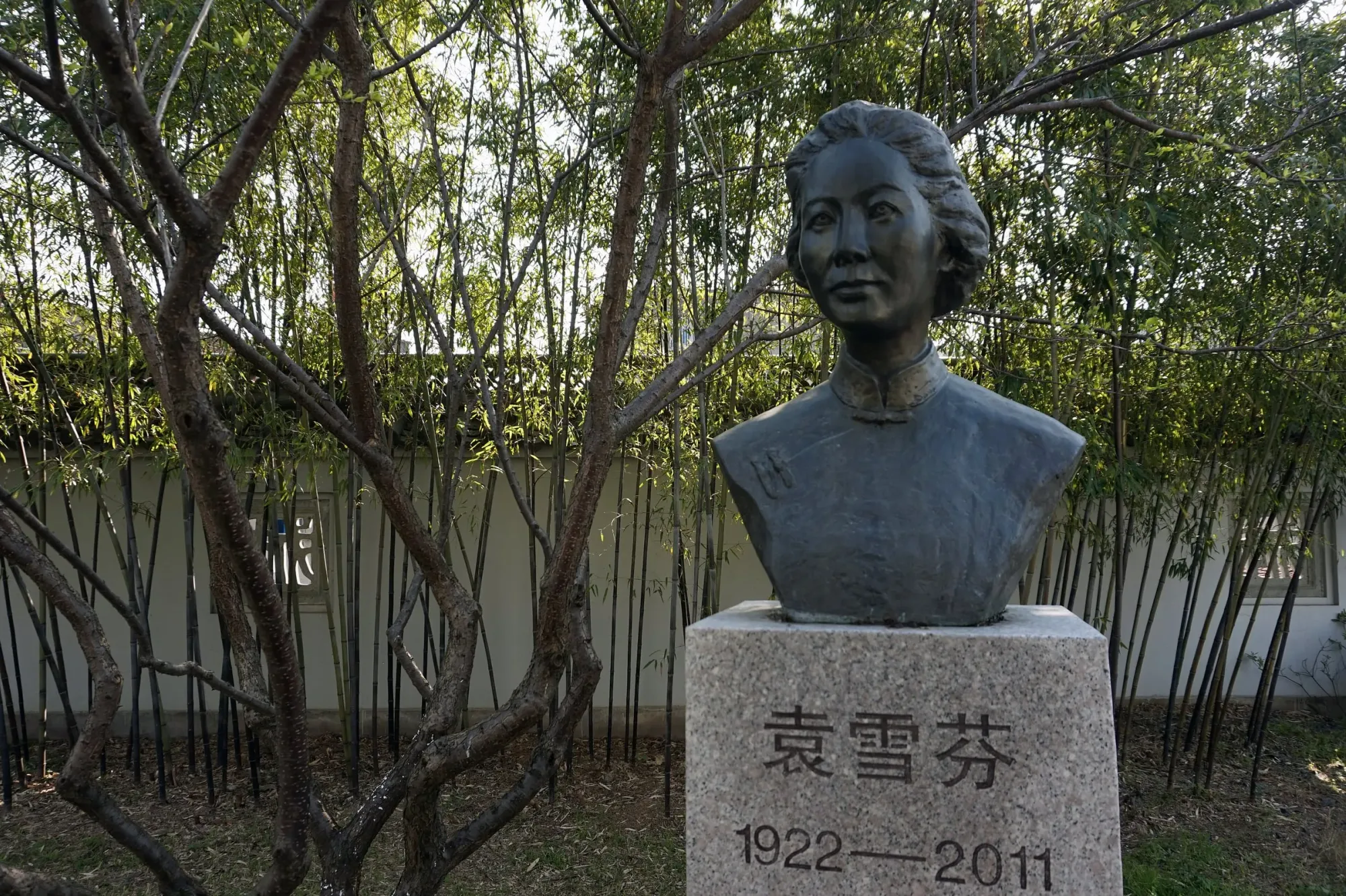
After 1949, the Dongshan troupe that Fan Ruijuan had formed with Fu Quanxiang was merged in 1951 into the state-run East China Experimental Yue Opera Troupe, the forerunner of the Shanghai Yue Opera House (The Paper, 2017). In 1952, according to a 2025 article in the Beijing Youth Daily, Yuan and Fan took the play to the first national festival of traditional opera, where it was widely praised; Wikipedia says Fan won a first-class performer’s award there, and a 2017 Shangguan News report, reposted on the official intangible heritage website, says Fu Quanxiang won one too, for this play. We found no reliable record of what the festival awarded the play itself.
The script in common use since then, Xinmin Evening News reported in 2022, was dictated by Yuan Xuefen and Fan Ruijuan, written down by Xu Jin and others and directed by Huang Sha; the paper dates this version to the Shanghai Yue Opera House’s staging of 1955. We found no reliable credit for who revised the play in the early 1950s.
The 1954 color film
In October 1953, The Paper reported in 2017, the Shanghai Film Studio filmed the Yue opera Liang Shanbo and Zhu Yingtai in color. A 2019 article in Xinmin Evening News names Sang Hu and Huang Sha as directors, with Yuan Xuefen and Fan Ruijuan in the lead roles, and dates its release to August 24, 1954; the same paper reported in 2022 that from August 25, 1954, it ran in 22 Shanghai cinemas, including the Grand and the Metropol, for more than 1,000 first-run screenings seen by nearly 1.55 million people.
Sources word its “first” differently. The Paper in 2017 and Xinmin Evening News in 2019 call it the People’s Republic’s first color opera film, and the Beijing Youth Daily article of 2025 calls it the People’s Republic’s first color film. The 2019 article also notes that China’s first color film was an earlier Peking opera film, Sheng Si Hen, of 1948, so the “first” refers to films made after 1949.
The Geneva stories are widely told; all come from later accounts and are best read as anecdotes. According to a 2021 history column in the People’s Daily overseas edition, during the Geneva Conference of 1954 the Chinese delegation screened the film at a lakeside hotel in Geneva on the evening of May 20, and at Zhou Enlai’s suggestion the invitation read: “Please enjoy a color opera film — China’s Romeo and Juliet.” On June 8 Zhou showed it to the British delegation led by Anthony Eden. A 2022 article on the website of China’s Foreign Ministry says that after Zhou met Charlie Chaplin on July 18 that year, he invited him to see the film too; Chaplin was moved to tears, said “The film is wonderful; I hope you make more films like it,” and met Fan Ruijuan, who played Liang Shanbo.
Abroad, the 2019 Xinmin Evening News article says it was shown at the Cannes Film Festival on May 9, 1955, and opened in Paris on the 27th, the first film of the People’s Republic released in France; the 2022 report says it was distributed to 14 countries and regions, including Canada and Hong Kong, and ran for 187 days in Hong Kong alone. A 2026 report by Chao News says it won a prize for music films at the 8th Karlovy Vary International Film Festival in 1954. An article in the English-language magazine Chinese Literature in 1955 also says the film won a prize at the eighth international film festival, held at Karlovy Vary in Czechoslovakia in 1954, without naming the prize; the festival’s own page for 1954 is still being prepared, and we found no festival record of the award.
The Yue opera inside the violin concerto
The 1959 Butterfly Lovers Violin Concerto is introduced in The Birthplace of Yue Opera. Here we add a few things that He Zhanhao, one of its two composers, has recounted himself.
He Zhanhao was born in Zhuji in 1933, according to a Beijing Evening News report reprinted by China News in 2009. In his own account, published by The Paper in 2019, he was a violinist and yangqin player in the orchestra of the Zhejiang Yue Opera Troupe before he entered the Shanghai Conservatory in 1957. In August 1958 he and five fellow students, among them Ding Zhinuo and Yu Lina, formed a group to make the violin more Chinese, and he first wrote a string quartet on Yue opera tunes called Liang Zhu; only later did he write the concerto with Chen Gang of the composition department, working together from February to May 1959.
The love theme, he says, was “stolen” from Yue opera. Its first phrase takes the sung cry “Meimei ya” (“Oh, sister”) with which Jia Baoyu greets Lin Daiyu in Yin Guifang’s Yue opera Dream of the Red Chamber; the whole melody follows the four-line pattern of opening, development, turn and close of Jiangnan folk songs, and each line borrows tender turns from Yue opera’s chidiao mode. He adds that the concerto also draws on Peking opera, Shao opera (shaoju) and Suzhou Kunqu.
The butterflies nearly went missing. He Zhanhao recalls that the first draft had no transformation, because he thought young people in the new China should not believe the dead turn into butterflies. Meng Bo, the conservatory’s Party secretary, told them that romance in art is people’s longing for beauty, not superstition, and that they must write the butterflies, and write them more beautifully still. The title came from Ding Shande, the vice-president: “Abroad they have Romeo and Juliet; we have Liang Shanbo and Zhu Yingtai. Isn’t that fine?”
The concerto was first tried out in the conservatory’s hall on May 4, with He Zhanhao as soloist and Chen Gang at the piano. Its formal premiere came on May 27, 1959, at the Lyceum Theatre in Shanghai, with Yu Lina as soloist and Fan Chengwu conducting the student orchestra of the conservatory (He Zhanhao’s account; China News, 2009). A 2021 article by the Xuhui district political consultative conference adds that it was a 3 p.m. concert in a month of music and dance performances in Shanghai, and that Yu Lina was 18. He Zhanhao adds that, by their content, the sections can also be called the sworn brotherhood at the grass bridge, three years at school, farewell at the pavilion, Zhu’s defiance of the marriage, and the butterflies.
Other versions
Beyond Yue opera, almost every form of Chinese theatre has its Liang Zhu. These are a few we could source:
- Peking opera: according to the Beijing Evening News in 2024, the China Peking Opera Company staged In the Shade of the Willow (《柳荫记》) in 1953, Ma Yanxiang’s adaptation of the Sichuan opera of the same name, with Ye Shenglan as Liang and Du Jinfang as Zhu; the same year Cheng Yanqiu created his Yingtai Defies the Marriage. We found no account of whether the Yue opera and the Sichuan opera borrowed from each other.
- A Huangmei opera film: the Shaw Brothers’ The Love Eterne (1963), made in Hong Kong, written and directed by Li Han-hsiang, with Betty Loh Ti as Zhu and Ivy Ling Po as Liang, every song sung in the Huangmei style. According to Wikipedia it won six awards at the second Golden Horse Awards, Best Feature Film among them.
- New Yue opera versions: the 2024 Guangming Online article says the Zhejiang Xiaobaihua Yue Opera Troupe staged a new Liang Zhu in 2006 that wove in the violin concerto, followed by a youth version in 2024.
The Butterfly Lovers in Shengzhou today
In Shengzhou you meet the lovers through Yue opera. For Dongwang Village, where the opera was born, and the Yue Opera Town around Shijia’ao with its Yue Opera Museum, see Seeing Yue opera in Shengzhou; to fit them into a day or two, see Following the Tang Poets Through Shengzhou. The bamboo model of an old opera stage woven by the Shengzhou craftsman Yu Zhanggen has two actors on it playing this very story; see Shengzhou bamboo weaving.
We found no regular, scheduled performances of Liang Zhu in Shengzhou. Ask locally before you go what is on at the Yue Opera Town and the village stages. For other places in Shengzhou, see Places to Visit; for the journey, see Getting There.
Questions & answers
What is the story of the Butterfly Lovers?
As the Yue opera tells it, Zhu Yingtai dresses as a man to study in Hangzhou, meets Liang Shanbo on the way and swears brotherhood with him at a grass bridge, and studies beside him for three years without his guessing she is a woman. When she is called home he walks her eighteen li; by the time he reaches her house, she has been promised to the Ma family. Liang dies of grief. On her wedding day Zhu stops to mourn at his grave, the grave splits open, she throws herself in, and a pair of butterflies flies out.
Where is the Butterfly Lovers story from?
Many places claim it. When the legend joined China’s first national list of intangible heritage in 2006, six places nominated it — Ningbo, Hangzhou and Shangyu in Zhejiang, Yixing in Jiangsu, Jining in Shandong and Runan in Henan. A Southern Song gazetteer puts the lovers’ shared tomb in Yin county, today’s Ningbo, many accounts make Zhu Yingtai a woman of Shangyu, and Yixing has a “place where Zhu Yingtai studied.” Where the story began has never been settled.
Is the Butterfly Lovers a true story?
There is no way to prove it. The oldest text is a single line, “the righteous wife Zhu Yingtai shares a tomb with Liang Shanbo,” known only from later books that quote it. A Jin dynasty tomb found in Ningbo in 1997 was for a time called the Liang–Zhu site, and was later renamed the Jin tomb of Jiulongxu. We tell it as a legend.
When did the butterflies enter the story?
The Tang and Song records from Ningbo have the shared schooling and the shared grave, but no butterflies. The earliest mention we found is in a gazetteer of the Changzhou area completed in 1268, whose entry on Mount Shanquan in Yixing reports a folk belief that Yingtai “studied with Liang Shanbo as a child and later turned into a butterfly” — and adds that the tale seems absurd.
What does Shengzhou have to do with the Butterfly Lovers?
The story is not Shengzhou’s, but the best-known play of it is. The version most people know is the Yue opera, and Yue opera was born in Shengzhou in 1906; Yuan Xuefen and Fan Ruijuan, who first staged it together in 1945 and later filmed it, were both from Shengzhou.
Who made and starred in the 1954 Yue opera film?
The Shanghai Film Studio shot it in 1953, directed by Sang Hu and Huang Sha, with Yuan Xuefen as Zhu Yingtai and Fan Ruijuan as Liang Shanbo. It opened in Shanghai in August 1954.
Sources
- 英文为本站翻译。《通俗编》卷三十七依维基文库的录文,书前周天度的序作于乾隆十六年(1751 年);维基文库录文作“井埋”,本文依文意和维基百科的引文作“并埋”。《宣室志》的查核,用的是维基文库录入的十卷和补遗一卷。《十道四蕃志》《乾道四明图经》《咸淳毗陵志》和《义忠王庙记》,我们没有读到原书,引文依中国作家网转载的《寻找祝英台》一文,《乾道四明图经》的引文与维基百科所引相同;《识小录》的引文依维基百科。《咸淳毗陵志》卷二十七“祝陵”条的诗句,《寻找祝英台》按通行的标点引作“碧藓”,文中录此志相关条目时作“碧鲜”,并说此志卷二十九“碑碣”作“碧藓庵”;维基百科的引文也作“碧鲜”,本文从之。
- 国务院关于公布第一批国家级非物质文化遗产名录的通知(国发〔2006〕18 号)· 中国政府网,2006 年 6 月 2 日
- 梁祝传说(Ⅰ-7,申报地区浙江省宁波市)· 中国非物质文化遗产网
- 梁祝传说(Ⅰ-7,申报地区浙江省上虞市)· 中国非物质文化遗产网
- 梁祝传说(Ⅰ-7,申报地区浙江省杭州市)· 中国非物质文化遗产网
- 梁祝传说(Ⅰ-7,申报地区江苏省宜兴市)· 中国非物质文化遗产网
- 梁祝传说(Ⅰ-7,申报地区山东省济宁市)· 中国非物质文化遗产网
- 梁祝传说(Ⅰ-7,申报地区河南省汝南县)· 中国非物质文化遗产网
- 寻找祝英台 · 中国作家网(转载澎湃新闻,个厂),2023 年 5 月 9 日
- 通俗编 卷三十七 故事 · 维基文库
- 通俗编 序(周天度)· 维基文库
- 宣室志 · 维基文库
- 梁山伯与祝英台:传承千年的中国式浪漫 · 光明网(王靖雨、雷瑜),2024 年 9 月 5 日
- 上越70年:经典够辉煌 新创需努力 · 北京青年报(光明网转载,颜全毅),2025 年 7 月 17 日
- 93岁越剧表演艺术家范瑞娟去世,遗愿不设灵堂不办追悼会 · 澎湃新闻(潘妤),2017 年 2 月 17 日
- 93岁的范瑞娟去世!全国最赞的梁山伯化蝶西飞 · 浙江在线(刘慧、朱婧;环球网转载),2017 年 2 月 17 日
- 著名越剧表演艺术家傅全香病逝,享年94岁 · 中国非物质文化遗产网(来源:上观新闻),2017 年 10 月 25 日
- 越剧电影五部经典(《梁山伯与祝英台》等;版面 PDF)· 新民晚报,2019 年 8 月 18 日第 11 版
- 上海越剧院在宛平剧院驻演《梁祝》(版面 PDF)· 新民晚报,2022 年 8 月 14 日
- 李旭丹谈小剧场徐王版越剧《梁祝》(艺术栏目,李旭丹撰稿;版面 PDF)· 新民周刊,2023 年 3 月 20 日
- “东方式的细腻演出”(党史撷英)· 人民日报海外版,2021 年 2 月 11 日第 5 版
- 影片好极了,希望你们多拍这类片子 · 外交部网站,2022 年 8 月 24 日
- 浙学少年团约会浙江戏曲文化① | 越剧:水袖百廿,越音长流 · 潮新闻(王慧华),2026 年 5 月 9 日
- A Beautiful Folk Tale on the Screen(影片 Liang Shan-po and Chu Ying-tai 的介绍,未署名)· Chinese Literature(英文刊物),数字图书馆标为 1955 年 1 月 1 日的一期,第 209—210 页;pretraziva.rs 数字化扫描本
- Festival Archive 1954(页面只写着 The pages of this festival's year are under preparation.)· 卡罗维发利国际电影节网站
- 讲述 | 小提琴协奏曲《梁祝》诞生始末——何占豪最新忆述 · 澎湃新闻(澎湃号·政务,马信芳),2019 年 10 月 9 日
- 文史 | 小提琴协奏曲《梁祝》诞生 · 澎湃新闻(澎湃号·政务,徐汇区政协),2021 年 12 月 3 日
- 《梁祝》50年感动几代人 · 中新网(来源:北京晚报),2009 年 4 月 22 日
- 七十年前京剧舞台上的新编戏 · 北京晚报(京报网),2024 年 1 月 4 日
- 梁山伯與祝英台 · 维基百科
- Butterfly Lovers · Wikipedia
- 梁山伯与祝英台 (越剧) · 维基百科
- 范瑞娟 · 维基百科
- 袁雪芬 · 维基百科
- 梁祝小提琴协奏曲 · 维基百科
- 梁山伯與祝英台 (1963年電影) · 维基百科