Saichō, Eisai and Mount Tiantai
Saichō, founder of Japanese Tendai, came to Taizhou in 804, studied under Daosui at Longxing Temple in Linhai and under Xingman at Folong on Mount Tiantai, and went home in 805 with the school’s texts. Eisai studied Rinzai Zen at Wannian Temple from 1187. What the records say and what is left.
Saichō (767–822), who founded the Tendai school in Japan, and Eisai (1141–1215), who brought Rinzai Zen there, were Japanese monks who crossed the sea to study on Mount Tiantai. Saichō reached Taizhou in 804. In its prefectural city, today’s Linhai, he studied the Tiantai teachings under Daosui at Longxing Temple and had the school’s texts copied, and he went up the mountain to the master Xingman; when he sailed home in 805 he took 120 works in 345 fascicles from Taizhou alone. Eisai came twice, in 1168 and 1187, and on the second journey studied Linji Chan, Rinzai in Japanese, under Xu’an Huaichang at Wannian Temple on the mountain. Today Guoqing Temple has a pavilion of steles that Japanese Tendai built in 1982, Longxing Temple in Linhai was restored in 1998, and a few halls of Wannian Temple still stand.
Across the sea to Taizhou
Saichō came from Ōmi, today’s Shiga Prefecture, and trained on Mount Hiei, northeast of Kyoto. In 802, says the Nipponica encyclopedia, he was chosen to go to Tang China as a short-term student monk, a status Heibonsha’s World Encyclopedia explains as a brief study visit. In the seventh month of 804 he sailed with the Japanese embassy from Tanoura in Hizen, on Kyushu, taking his disciple Gishin as interpreter. Of the embassy’s four ships, Enryaku-ji says, only two reached China; the other one carried Kūkai, who went on to found the Shingon school.
His ship reached Mingzhou, today’s Ningbo, on the first day of the ninth month, says the Nipponica encyclopedia; a 2018 study by Tozaki Tetsuhiko puts the landing late in the eighth month. According to Tozaki, he rested there for a while because he was ill, set out on the fifteenth of the ninth month and arrived on the twenty-sixth at Linhai county, the seat of Taizhou prefecture. His travel document from Mingzhou told the counties on his way to provide boats, so Tozaki concludes that he went by water. These dates, like the other early dates here, are in the lunar calendar of the time.
In Linhai: Longxing Temple and Daosui
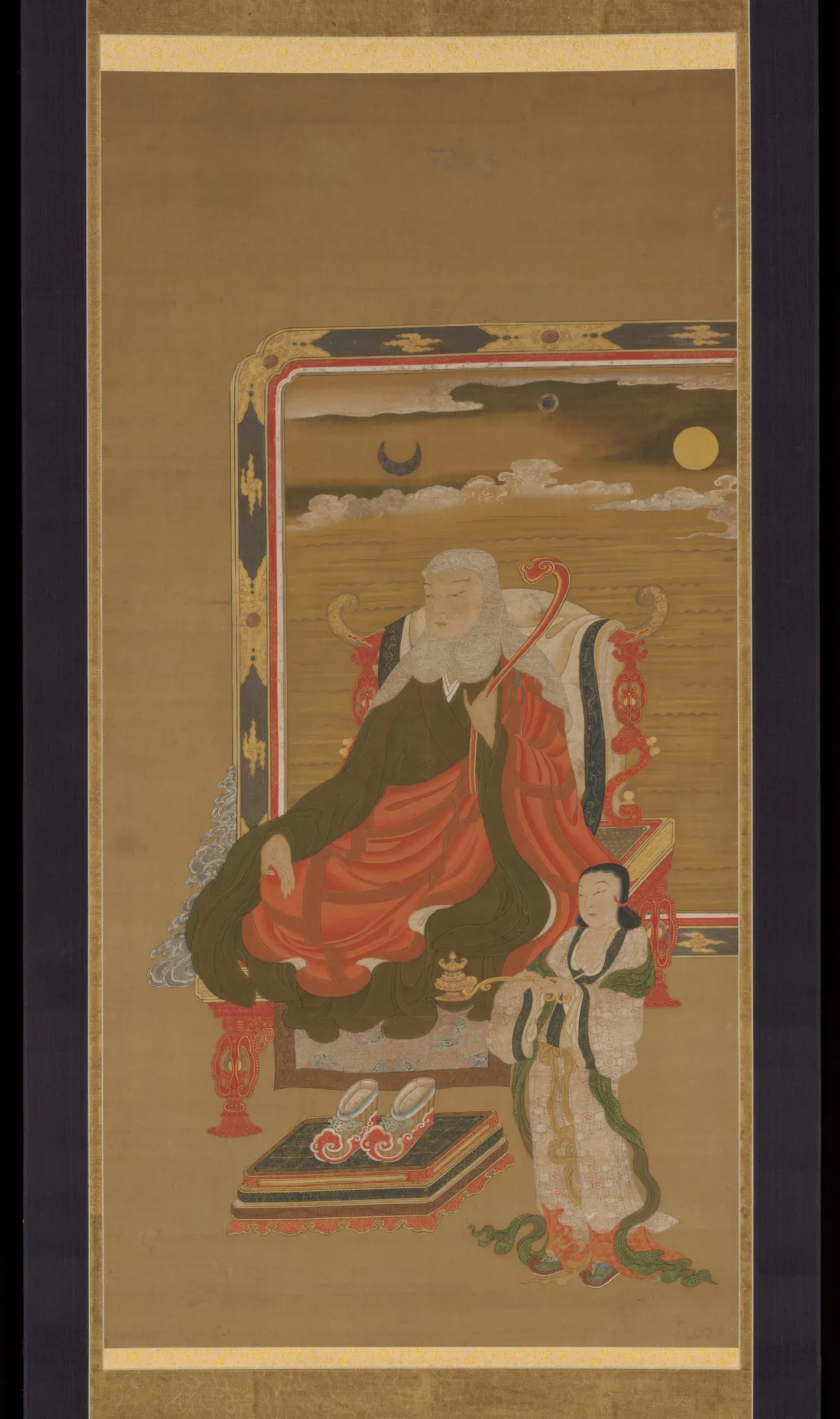
Lu Chun, the governor of Taizhou, received him. Both Tozaki and a 2021 article by Pei-ying Lin say that Lu Chun had invited Daosui, who lived on Mount Tiantai, to lecture on the Lotus Sutra and the Mohe Zhiguan at Longxing Temple in the city, and that this is where Saichō met him; the Nipponica encyclopedia, too, has Saichō learning the Tiantai teachings from Daosui at Longxing Temple in Taizhou. Daosui was a disciple of Zhanran — see Master Zhiyi.
The farewell preface that Wu Yi, a Taizhou official, wrote for Saichō, as Lin summarizes it, says that Saichō called on Lu Chun with gifts and money and that Lu, a Confucian scholar, gave the money back. Saichō asked to spend it on copying the Tiantai Zhiguan instead, and Lu had Daosui gather a team, which finished the work a month later. Saichō’s own catalogue of what he collected in Taizhou lists 120 works in 345 fascicles, “copied in full at the Pure Land Hall of Longxing Temple, Linhai county, Taizhou.”
The catalogue is dated the nineteenth day of the second month of 805 and signed by Daosui as “abbot of the Perfect School of Mount Tiantai.” A day later Lu Chun added a certificate of his own: “Though the ācārya Saichō comes from a foreign land, his nature is truly of the same source.” Saichō, he wrote, feared that students elsewhere would doubt his lineage, and so had asked for the prefecture’s seal as proof.
Lin argues that Daosui was an obscure figure to Chinese Buddhists and that later Tendai writings raised him into a leading representative of the Chinese school. On the Chinese side, the Song Biographies of Eminent Monks of 988 and the Fozu Tongji of 1269 both date Saichō’s visit to the twenty-first year of Zhenyuan, 805 (Lin notes that the Fozu Tongji has the year wrong: it should be 804); the Fozu Tongji counts Daosui as the tenth patriarch of the school and says that Saichō, back in Japan, “honored Master Sui from afar as his founding patriarch.”
On the mountain: Xingman at Folong
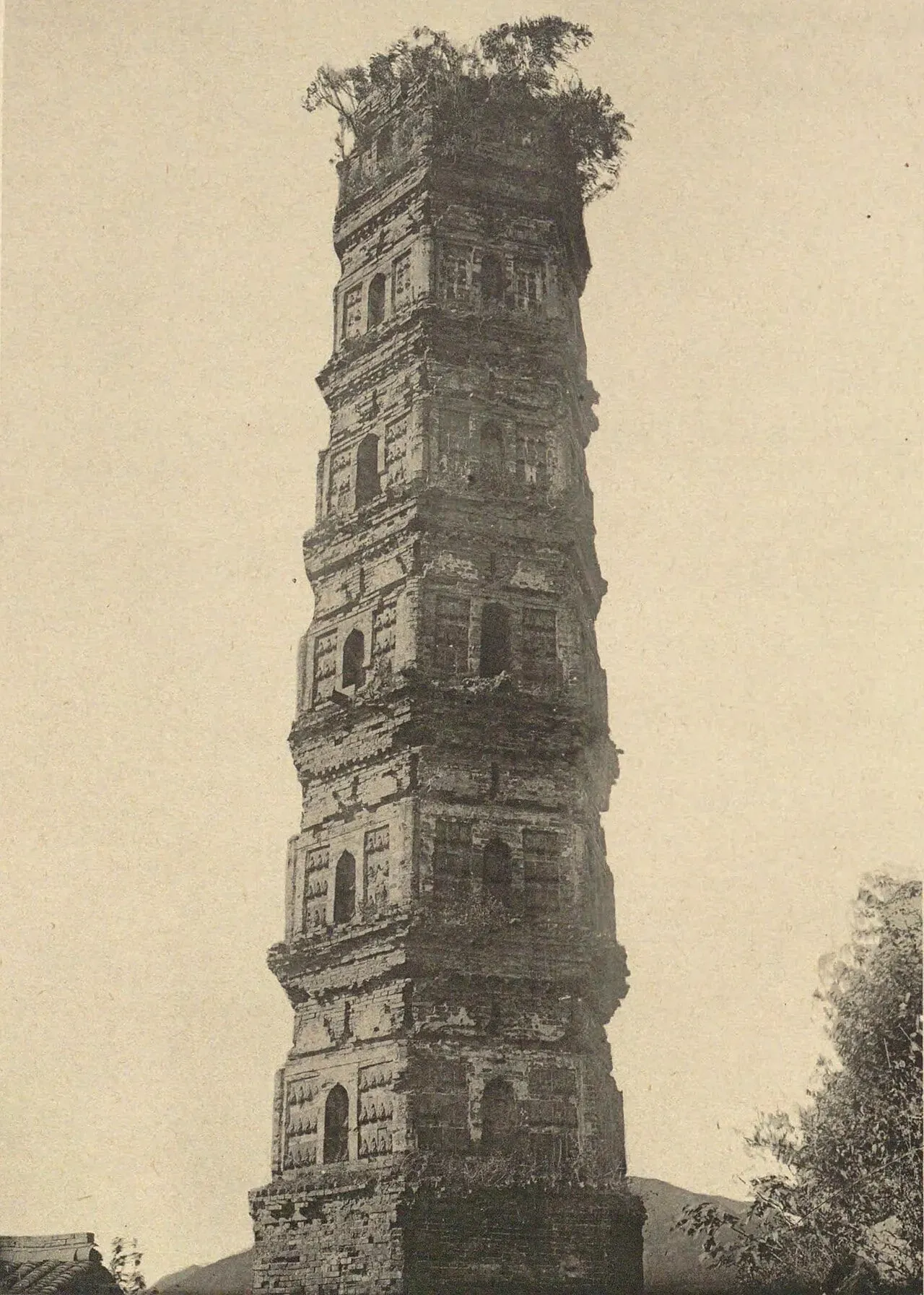
In the tenth month of 804 Saichō went up Mount Tiantai. Enryaku-ji and the Tendai school both say that on the mountain he studied the Tiantai teachings under “Daosui of Xiuchan Temple and Xingman of Folong Temple” and received meditation teachings from Xiaoran of Chanlin Temple; the 1995 county gazetteer says the same. Citing a verse of transmission, Japanese Wikipedia says that he met Xingman at Folong on the seventh day of the tenth month and received 82 fascicles of scripture and a sealed certificate from him. Folong is where Zhiyi meditated and lies buried — see Master Zhiyi.
Guoqing Temple, at the foot of the mountain, comes into the story too. On the seventh day of the twelfth month, says Japanese Wikipedia, Gishin, still a novice, received full ordination there, and the 1995 county gazetteer says that Saichō built a Zhiguan Court at Guoqing.
Back in Linhai for the precepts
Back in Taizhou from the mountain, Saichō spent more time copying scriptures and then received the Mahayana bodhisattva precepts from Daosui, says the English Wikipedia article on Daosui; the Nipponica encyclopedia, too, has him receiving the precepts from Daosui. The date and place rest on a later text: as Tozaki quotes it, the Naishō buppō sōjō kechimyakufu, a record of Saichō’s lineages, says that on the night of the second day of the third month of 805, in the Hall of the Pure Land of Utmost Bliss in the west wing of Longxing Temple, Linhai county, Saichō, Gishin and twenty-seven Chinese monks received the bodhisattva precepts of the Perfect Teaching together from Daosui. Articles by People’s Daily Online in 2015 and Linhai News in 2021 also place the ceremony at Longxing Temple, and Linhai News names the same hall in the west wing.
That record is not beyond doubt. Tozaki points out that the passages between the lineage charts of the kechimyakufu are generally held to have been added after Saichō’s death, and he goes so far as to suspect that the account of the ordination was put together from Wu Yi’s farewell preface. What is on record is that in the third month of 805 Lu Chun and the officials of Taizhou gave Saichō a farewell banquet, and that the guests included “the Tiantai monk Xingman” (Lin). Tozaki puts Saichō’s departure from Taizhou at about the third day of that month, while noting that the date needs more study.
From Tiantai to Tendai
From Taizhou Saichō went to Yuezhou, today’s Shaoxing, where, says Japanese Wikipedia, he received an esoteric initiation from Shunxiao at the Fengshan training hall on the eighteenth day of the fourth month. He sailed from Mingzhou on the eighteenth day of the fifth month and reached Tsushima, in Japan, on the fifth day of the sixth (Tozaki). Besides the 345 fascicles from Taizhou, the Nipponica encyclopedia says, he brought 115 fascicles of esoteric texts in 102 works from Yuezhou, and the memorial with which he presented his haul to the court, dated the fifteenth day of the seventh month of 805, gives the total as 230 works in 460 fascicles: the fascicles are the sum of the two catalogues (345 and 115), but the works come to eight more than their 222.
The Taizhou catalogue ends with three “other objects”: a meditation weight, a white horn ruyi scepter for preaching, and four wooden rulers of tamarisk and cypress from Xianglu Peak on Mount Tiantai. The memorial calls the weight “the meditation weight of the Great Master of Tiantai,” that is, of Zhiyi. Saichō is also said to have brought tea seeds home, but that is a tradition — see Tiantai Yunwu Tea.
Enryaku-ji dates the founding of Japanese Tendai to the twenty-sixth day of the first month of 806, when the court allowed the school two ordinands a year; only after Saichō’s death in 822 did Emperor Saga give the temple on Mount Hiei the name Enryaku-ji.
Tendai is simply the Japanese reading of the characters for Tiantai, and in English, says Wikipedia, the name is kept for the Japanese school. The two went different ways. As the editor of a 1987 special issue of the Japanese Journal of Religious Studies put it, Japanese Tendai stands on four pillars: esoteric Buddhism, meditation, the bodhisattva precepts, and the Perfect Teaching of Tiantai proper. Saichō also argued that Mahayana monks needed only the bodhisattva precepts to be ordained; permission came, Heibonsha’s World Encyclopedia says, only on the seventh day after his death.
Eisai at Wannian Temple
Eisai, also read Yōsai, came from Bitchū, today’s Okayama Prefecture, and studied the Tiantai teachings and esoteric Buddhism on Mount Hiei. He first went to Song China in the fourth month of 1168, says Heibonsha’s World Encyclopedia, met the Japanese monk Chōgen at Mingzhou, and visited Mount Tiantai and Mount Ayuwang. By the ninth month, says Japanese Wikipedia, he was home again, with Chōgen and others and sixty fascicles of Tiantai commentaries. That year, the Yamakawa dictionary of Japanese history says, he and Chōgen offered tea to the arhats at Wannian Temple — see Tiantai Yunwu Tea.
In the fourth month of 1187 he sailed again, hoping to go on to India to visit the places of the Buddha. The Song court at Lin’an refused him leave, Heibonsha’s World Encyclopedia says, and when his ship was blown back to shore he returned to Wannian Temple on Mount Tiantai and became a pupil of Xu’an Huaichang. When Huaichang moved to Jingde Temple on Mount Tiantong, Eisai followed him, received his certification in the Huanglong line of Linji Chan, and went home in the seventh month of 1191. English Wikipedia places his study under Huaichang at Jingde Temple only and does not mention Wannian.
The 1995 county gazetteer says that Eisai paid for temple repairs at Tiantai and gave Wannian a gate, two side halls, a large pond and a kitchen. Back in Japan he founded Shōfuku-ji in Hakata, Kennin-ji in Kyoto and Jufuku-ji in Kamakura (Digital Daijisen) and is honored as the founder of Japanese Rinzai. He never gave up his standing as a Tendai monk, says English Wikipedia, and Kennin-ji was at first a temple for the joint study of Zen, Tendai and Shingon, says Japanese Wikipedia. For the tea seeds he brought home and the Kissa Yōjōki he wrote in 1211, see Tiantai Yunwu Tea.
Others who came, and one who could not
Saichō and Eisai were not the only foreign monks to come to Taizhou and the mountain. These are a few for whom there is a record:
- Jianzhen: according to the Tō Daiwajō tōseiden, his Japanese biography, he once set out overland for Fuzhou to take ship from there, reached Guoqing Temple at dusk, and went on by Linhai and Huangyan towards Wenzhou; Linhai News wrote in 2021 that he stayed at Longxing Temple before his fourth attempt to sail.
- Ennin: he came with the embassy of 838 hoping to reach Mount Tiantai but was refused permission (Japanese Wikipedia, Nipponica) and went to Mount Wutai instead; Ensai, who came to China the same year, did reach Tiantai (county gazetteer, 1995).
- Enchin: he arrived in 853 and studied Tiantai commentaries with Wuwai at Guoqing Temple; in 856, the gazetteer says, he built a hall in Guoqing’s Zhiguan Court and named it “the Cloister of the Eminent Monks of Japan at Guoqing Temple on Mount Tiantai.”
- Uicheon: a Goryeo prince, he came to Song China in 1085 and visited Folong and Guoqing before going home (county gazetteer, 1995) — see Master Zhiyi.
- Jōjin: he came in 1072, aged sixty-two, climbed Mount Tiantai in the fifth month and wrote a diary of his pilgrimage to Tiantai and Wutai; he died in China (county gazetteer, Digital Daijisen). The gazetteer says he was buried at Guoqing; we found no other source for that.
- Dōgen: a disciple of Eisai’s disciple, he came in 1223, received the Dharma from Rujing on Mount Tiantong and went home to found Japan’s Sōtō school (English Wikipedia); the 1995 county gazetteer says he studied Chan with Yuannai at Wannian Temple and read a certificate of succession there, and the prefecture gazetteer also has him seeking the Dharma at Wannian.
What is there today
Guoqing Temple. Behind the Main Hall stands a pavilion of patriarchs’ steles that Japanese Tendai built; the second Tiantai county gazetteer and the Taizhou city gazetteer both date its completion to October 1982. It is the pavilion “The Milk of the Dharma for a Thousand Autumns” described in Guoqing Temple. According to the 1995 county gazetteer, its three steles are a hymn in praise of Zhiyi, a record of how Saichō received the teaching on Tiantai, and Xingman’s farewell poem to Saichō, and the pavilion was the work of Yamada Etai, the 253rd head of Enryaku-ji. The second gazetteer adds that a Memorial Hall of the Chinese and Korean Tiantai Patriarchs was finished at the temple in May 1995.
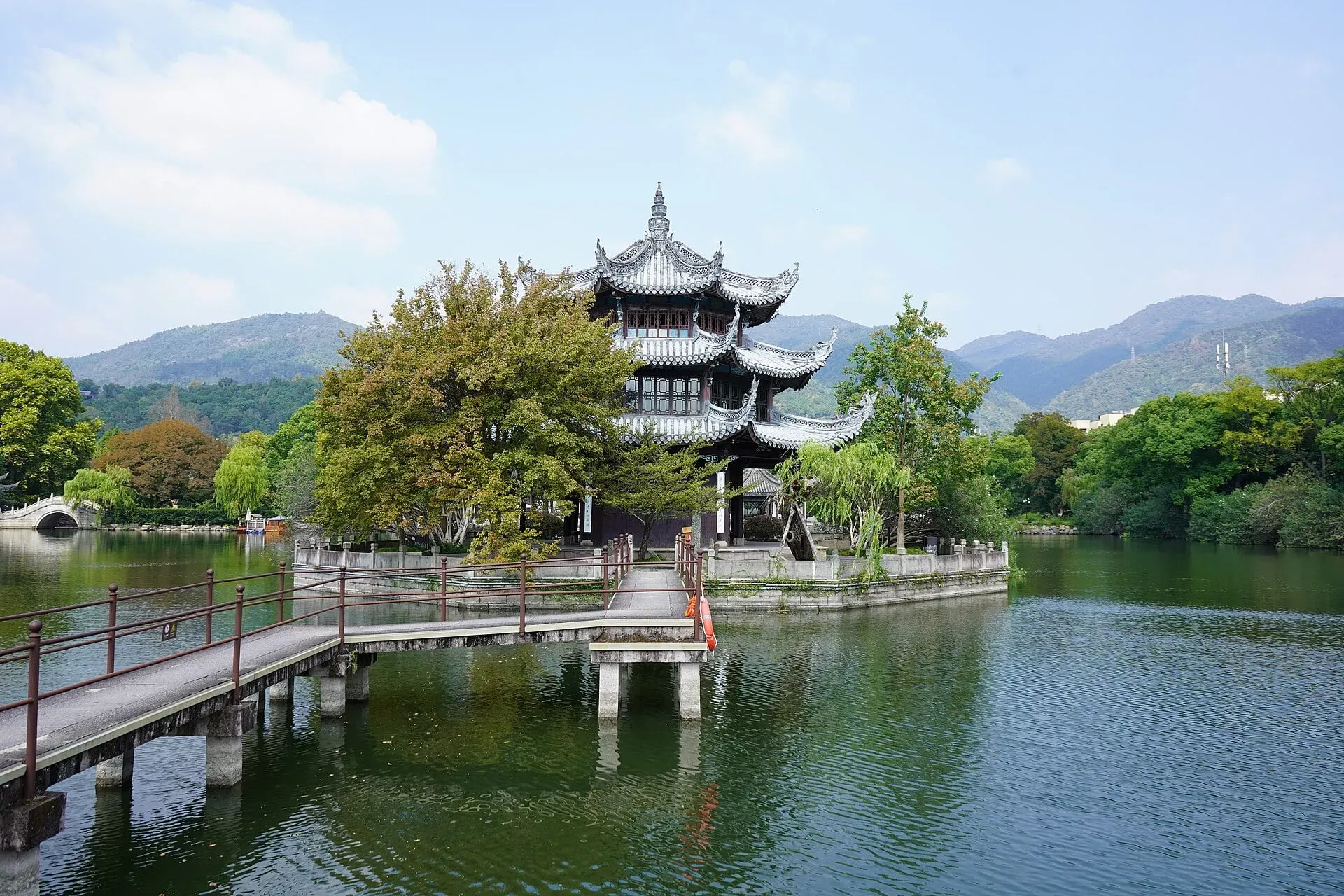
Longxing Temple, Linhai. It stands at the western foot of Jin Hill, at the south end of Ziyang Street; for its Thousand Buddha Pagoda, see Ziyang Street and the Old City. Linhai News wrote in 2021 that the temple was founded in 705 as Shenlong Temple and renamed Longxing in 707, and that of the eight temples of the old prefectural city it alone was restored, in 1998; it now has a hall dedicated to Jianzhen. A 2023 post by Linhai’s culture and tourism account on Chao News’s user platform mentions a Hall of the Pure Land of Utmost Bliss in the temple. We found no monument or hall there dedicated to Saichō.
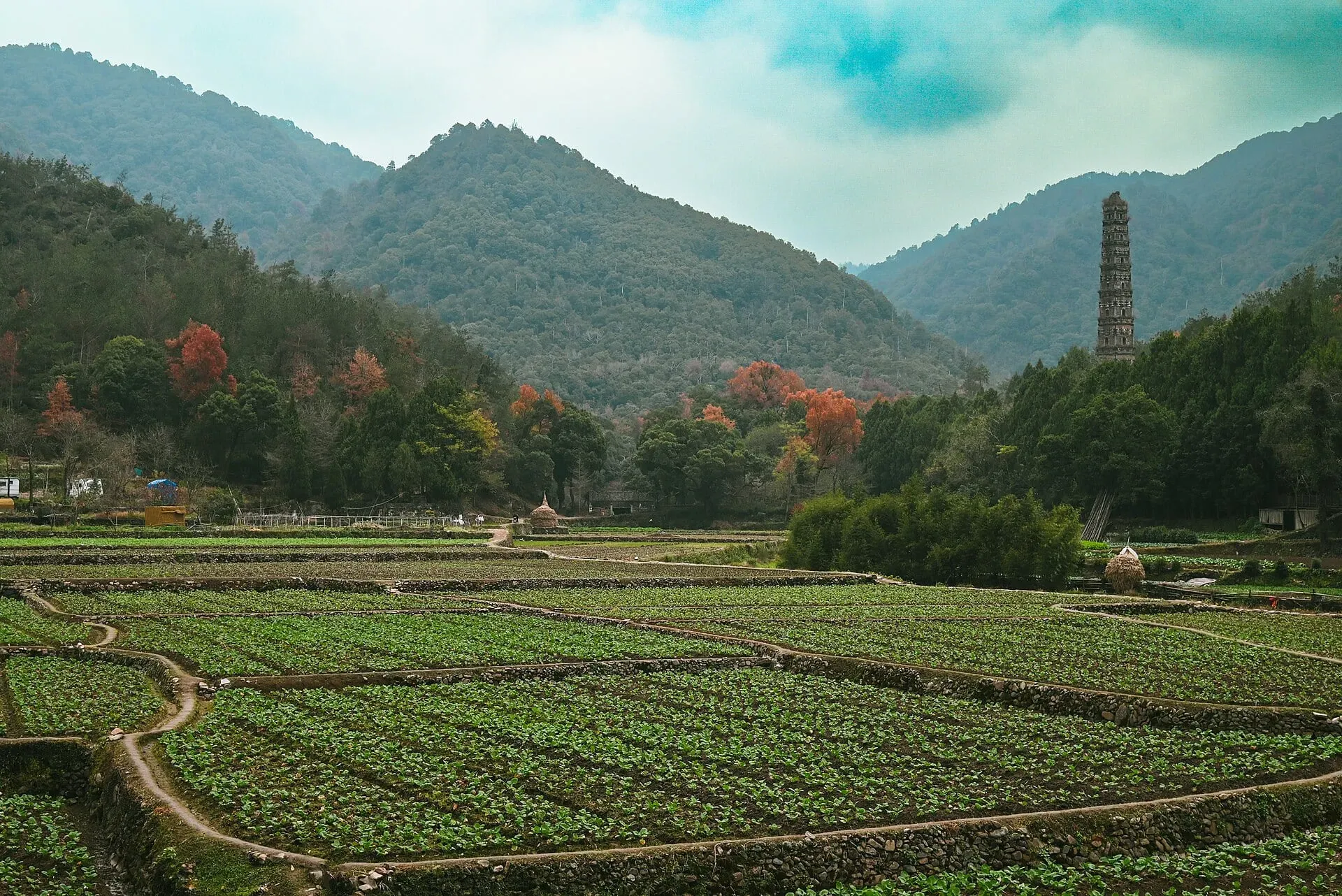
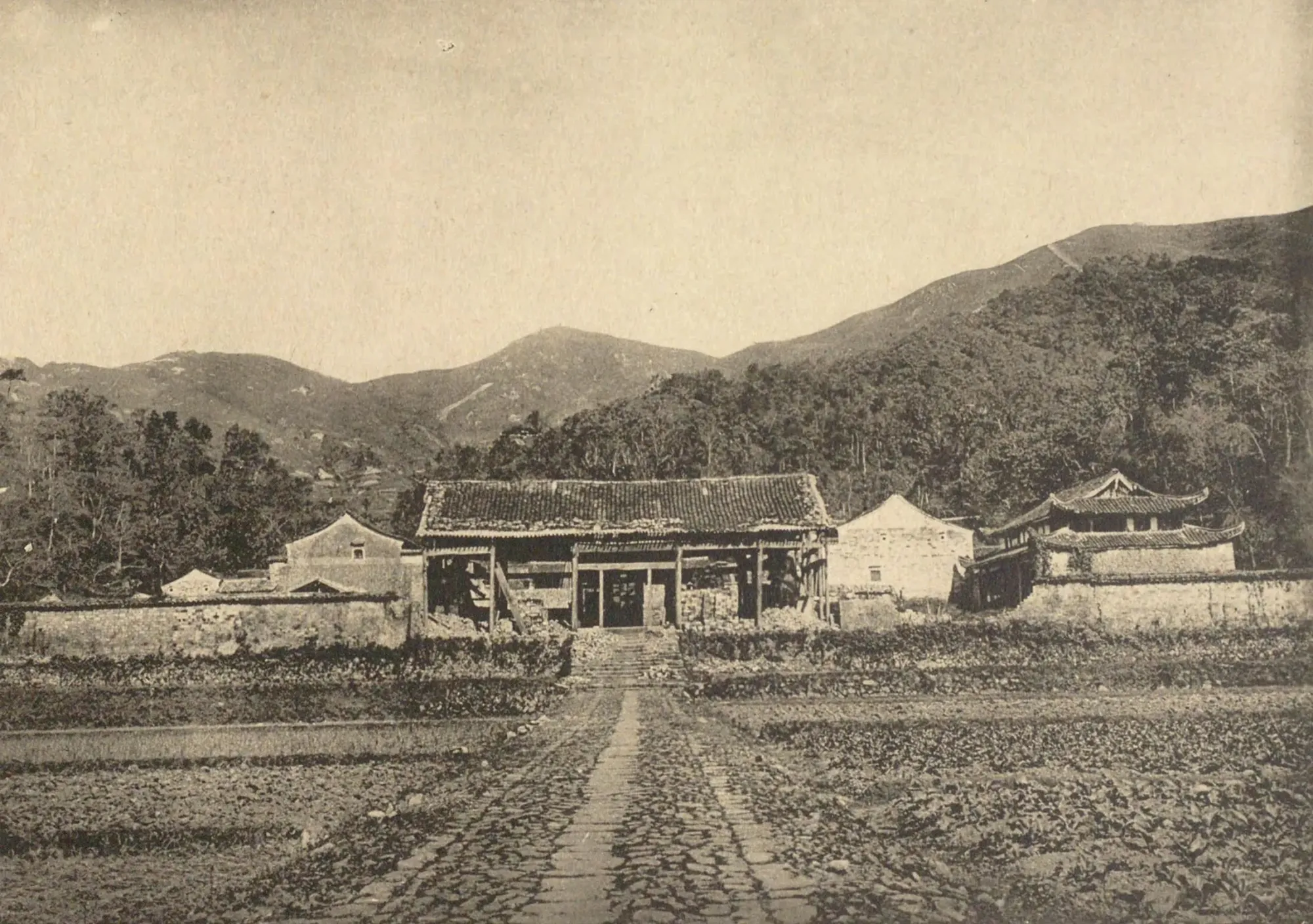
Wannian Temple. It lies on Mount Wannian in Baihe town (second county gazetteer), north of the county town (1995 county gazetteer). The Taizhou Prefecture Gazetteer of 1995 puts it about 15 km from the county town as the crow flies, or 28 km by the road round by the Stone Bridge, and says that it declined after the late Qing, leaving a main hall, a hall of the Heavenly Kings, a rear hall and three huge cedars before the gate. It became a county heritage site in 1997, the second gazetteer says, and its Hall of the Heavenly Kings, main hall and some side buildings were repaired in 2000. Xu Xiake passed it on his way down the mountain in 1613 — see Mount Tiantai.
Getting there
For the train to Tiantaishan station, see Getting to Tiantai; for getting to Guoqing Temple and what it costs, see Guoqing Temple, and for the stupa courtyard at Folong, Master Zhiyi. Linhai is the next stop after Tiantaishan on the Hangzhou–Taizhou line; check 12306 for trains, and for the way from Linhai station to the old city see Getting to Linhai. By our estimate from OpenStreetMap, Longxing Temple is about 16 km by road from Linhai station and Wannian Temple about 33 km from Tiantaishan station. For more in each town, see Places to Visit for Tiantai and Linhai.
As of November 2026 we had found no official opening hours or prices for Longxing Temple or Wannian Temple, nor any bus to Wannian. All three are Buddhist temples, so keep your voice down, and ask locally before you go.
Questions & answers
Where in China did Saichō study?
Mostly in Taizhou. He reached its prefectural city, Linhai county, in the ninth month of 804 and studied and copied texts under Daosui at Longxing Temple; in the tenth month he went up Mount Tiantai to study under Xingman at Folong; he left Taizhou in the third month of 805 and went on to Yuezhou, today’s Shaoxing, for esoteric teachings. See above, and Ziyang Street and the Old City.
Did Saichō receive the bodhisattva precepts at Guoqing Temple?
The records point to Longxing Temple in Linhai, not to Guoqing. The Naishō buppō sōjō kechimyakufu says that on the night of the second day of the third lunar month of 805, Saichō, Gishin and twenty-seven Chinese monks received the bodhisattva precepts of the Perfect Teaching together in the Hall of the Pure Land of Utmost Bliss at Longxing Temple, and articles by People’s Daily Online in 2015 and Linhai News in 2021 also place the ceremony at Longxing. The historian Tozaki Tetsuhiko notes that this part of the text is generally held to be a later addition, so the record is open to doubt.
Which temple did Eisai stay at on Mount Tiantai?
Wannian Temple. On his second journey, from 1187, he studied there under Xu’an Huaichang, followed him to Mount Tiantong, and went home in 1191; he had visited Wannian on his first journey, in 1168, as well. For his tea, see Tiantai Yunwu Tea.
Is Tendai the same as Tiantai?
Tendai is the Japanese reading of the same two characters, 天台, and English uses it for the Japanese school alone. Japanese Tendai grew from Chinese Tiantai, but Saichō joined esoteric Buddhism, meditation and the bodhisattva precepts to it, and it developed along different lines.
Can you visit these places today?
Guoqing Temple and Longxing Temple in Linhai are both close to town and easy to reach. Wannian is up in the hills, and as of November 2026 we have found no opening hours, prices or buses for it. All three are Buddhist temples, so check before you go.
Sources
- 英文为本站翻译,日文资料的中译也是本站翻译。《传教大师将来台州录》《宋高僧传》《佛祖统纪》《唐大和上东征传》的引文依 CBETA 录自《大正藏》的文本,《宋高僧传》《佛祖统纪》的成书年份依 CBETA 的著录。文中古代的月日(包括在日本的月日)都是当时的农历,没有换算成公历。
- 传教大师将来台州录(最澄,805 年)·《大正藏》第 55 册 No. 2159 · CBETA
- 宋高僧传 卷二十九(赞宁,道邃传)· CBETA
- 佛祖统纪 卷八(志磐,道邃)· CBETA
- 游方记抄 · 唐大和上东征传(真人元开)·《大正藏》第 51 册 No. 2089 · CBETA
- 户崎哲彦《最澄と陸淳(上)——『台州相送詩』と『顯戒論緣起』》·《島大言語文化》第 45 号,2018 年 10 月 31 日 · 岛根大学学术情报库
- Pei-ying Lin(林佩莹),The Tendai Use of Official Documents in the Ninth Century · Hualin International Journal of Buddhist Studies 4.1,2021 年
- Paul L. Swanson,Editor’s Introduction · Japanese Journal of Religious Studies 14/2–3(天台专号),1987 年
- 天台县志 · 第三编 天台山 · 第四章 莅山名人 · 第二节 海外名人(1995 年)· 台州史志网
- 天台县志 · 第三编 天台山 · 第二章 寺观 · 第一节 寺院(1995 年)· 台州史志网
- 天台县志(第二轮)· 第二十六编 文化 · 第一章 文化遗产 · 第三节 文物保护单位 · 台州史志网,2019 年 8 月 16 日发布
- 台州地区志 · 第四十四章 风景名胜 · 第一节 山岳名胜(1995 年)· 台州史志网
- 台州市志 · 卷 14 旅游 · 第一章 风景名胜 · 第五节 天台景区 · 台州史志网,2018 年 12 月 13 日发布
- 龙兴寺:惊艳了千年时光(杨洁珍)· 临海新闻网,2021 年 8 月 13 日
- 寻找一座古城的千年记忆 · 人民网,2015 年 5 月 26 日
- 临海4大古寺,人不多,够惊艳,11月就出发!(“临海文化和旅游”账号,潮鸣号)· 潮新闻,2023 年 11 月 1 日
- 祖師 · 歴史 · 天台宗総本山 比叡山延暦寺(2026 年 11 月 18 日查阅)
- 天台宗の歴史 · 天台宗(2026 年 11 月 18 日查阅)
- 最澄 · コトバンク(日本大百科全書、改訂新版 世界大百科事典 ほか)
- 栄西 · コトバンク(日本大百科全書、改訂新版 世界大百科事典、山川 日本史小辞典 ほか)
- 円珍 · コトバンク
- 円仁 · コトバンク(日本大百科全書 ほか)
- 成尋 · コトバンク
- 最澄 · 日文维基百科
- 明菴栄西 · 日文维基百科
- 円仁 · 日文维基百科
- Daosui · Wikipedia
- Saichō · Wikipedia
- Eisai · Wikipedia
- Dōgen · Wikipedia
- Tendai · Wikipedia